stork

The Hebrew that is translated as “stork” in English is translated in Maan as “big water bird,” as the stork is not locally know. (Source: Don Slager)

In the Contemporary Chichewa translation (2002/2016) with mulungu wachilendo it is translated as kakowa or “egret.” (Source: Mawu a Mulungu mu Chichewa Chalero Back Translation)


There is almost complete agreement that chasidah is the stork. There are two species of stork that pass over Israel, where they stay for a few days as they migrate from Europe to Africa and vice versa. These are the White Stork Ciconia ciconia and the Black Stork Ciconia nigra.

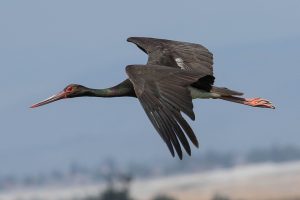
Both of these storks are large birds with long legs and long necks. They are heavier than most herons or cranes. The white stork has a white body, black wings, and a red beak and legs. The black stork is a glossy brownish black color with a white belly. It also has a red beak and legs. These storks migrate from central and eastern Europe to East and Central Africa, occasionally reaching Zimbabwe and parts of South Africa in good rainy seasons. Both types spend most of the time on the ground or in shallow water searching for food. The white stork eats mainly locusts, grasshoppers, and other insects, as well as frogs, lizards, and the chicks of ground-nesting birds. The black stork prefers fish and frogs but also eats the same things as the white stork.

When storks are about to move to another feeding ground, they usually soar around in upward currents of air called thermals, reaching great heights, and then they soar off in the direction they have chosen, conserving their energy by only occasionally beating their wings.

It is possible that the name chasidah is derived from the word chesed, meaning “kindness” or “faithfulness”, perhaps a reference to the fact that they seem to take especially good care of their young when nesting.

Storks of various species are found in most parts of the world, and many of them have migrating habits. There are species of stork that migrate from Europe to India and the Far East, some that migrate from Southeast Asia to Australia, and one, the Abdim’s Stork Ciconia abdimii, which migrates from Ethiopia to Zimbabwe and Botswana, signaling the arrival of the rainy season wherever it goes.

In the few areas where storks are not known, a borrowed word or a transliteration can be used, perhaps with a footnote to indicate that this is a big bird that migrates long distances over Israel.
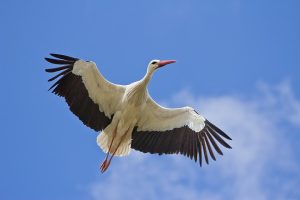
White stork, Wikimedia Commons
Black stork, Wikimedia Commons

Source: All Creatures Great and Small: Living things in the Bible (UBS Helps for Translators)

See also snow (color).
heron

There is little doubt that ’anafah refers to any type of heron found in the land of Israel, such as the Gray Heron Ardea cinerea, the Purple Heron Ardea purpurea, the Squacco Heron Ardeola ralloides, and the Night Heron Nycticorax nycticorax. However, since the name is derived from a Hebrew root meaning nose, there are many scholars who feel that the word originally was used for any waterside bird with a prominent beak. This would include not only herons but also ibises, egrets, and perhaps bitterns and spoonbills.

Herons are fairly large birds with long necks, long beaks, and usually with long legs as well. They stand or walk slowly in shallow water in rivers, dams, ponds, or lakes looking into the water for small fish, which they catch by suddenly darting their heads into the water. They fly with slow wing-beats.

They are listed as an unclean bird.

Herons and egrets are widespread around the world, and finding a local equivalent should not be a problem.

Source: All Creatures Great and Small: Living things in the Bible (UBS Helps for Translators)

hoopoe

There is unanimous agreement today about the meaning of this word.

The Hoopoe Upupa epops is so named to represent its call, which has been described as hoop-hoop, poop-poop, or similar sounds. Its name is even similar in some African languages, such as Shona mupupu and Tswana pupupu. [The German name Wiedehopf (ˈviːdəhɔpf/) is onomatopoetic as well. (Source: Zetzsche)]

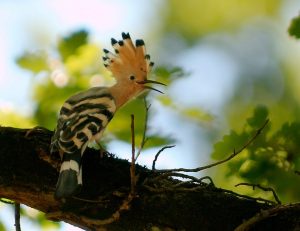
It is a bird about the size of a large dove, with a ginger colored head and body, and with wings and a tail that have black and white stripes. It has a long slender beak that curves slightly, and a long crest on its head, which it can erect into a fan shape.

The hoopoe has rather floppy wings and rises and falls as it flies. As soon as it lands, it erects its fan-shaped crest briefly. It spends a lot of time walking around on the ground looking for food. It nests in any suitable hole in a tree or in the ground and may raise two or three broods in a season. Unlike most other birds, it does not remove the nestlings’ droppings from the nest, and the nest smells badly as a result. Hoopoes eat insects and their larvae, termites, worms, small frogs, and beetles.

It is listed as an unclean bird.

The hoopoe is found all over Africa, Madagascar, the Middle East; across tropical Asia in savannah, but not rain forest areas; in Japan; and in southern Europe. In these areas a local name should not be difficult to find. Elsewhere, a name that approximates its call can usually be used, such as “hoopoo bird”, “pupu bird”, or something similar.

Hoopoe, Wikimedia Commons

Source: All Creatures Great and Small: Living things in the Bible (UBS Helps for Translators)

complete verse (Leviticus 11:19)

Following are a number of back-translations as well as a sample translation for translators of Leviticus 11:19:

  • Kupsabiny: “storks of various kinds, swifts and bats.” (Source: Kupsabiny Back Translation)
  • Newari: “Among the birds, these are the ones that will be considered repulsive. For example, various types of eagles, vultures, hawks, crows, cranes, owls, swans ospreys, and bats. It is not OK to eat the flesh of these [birds].” (Source: Newari Back Translation)
  • Hiligaynon: “You (plur.) are- not -to-eat the birds that are-like eagles, crows/ravens; birds that eat a corpse of a person or an animal, falcons, owls, vultures, birds that swoop-down-upon/pounce-upon fish, a-sort-of-white-herons, storks/cranes, and fruit-eating-bats. You (plur.) are-to-consider these birds detestable.” (Source: Hiligaynon Back Translation)
  • English: “storks, any kind of heron, hoopoes, and bats.” (Source: Translation for Translators)

Translation commentary on Leviticus 11:13 - 11:19

These verses deal with the third category of creatures which the Hebrews considered “birds.” The terminology used in that day does not correspond exactly to that which is known in the modern world and may also be at variance with other views of what constitutes a “bird.” For example, in many languages the bat mentioned in verse 19 cannot be called a “bird.” The list is made up of no less than twenty species, which leads many commentators to believe that it was intended to be exhaustive (the parallel list in Deut 14.12-18 has twenty-one names). Ten of these names appear only here and in the Deuteronomy 14 list, but nowhere else in the Old Testament. Five others are found in only one additional case outside the two lists. For this reason it is extremely difficult to identify with any degree of certainty all the species involved. Even the ancient versions such as Greek and Latin demonstrate considerable differences in their translation of these names.

In Hebrew all the names on the list are given in singular form (compare Revised Standard Version), but Good News Translation has taken into account the fact that they are collective nouns and has made them plural in translation.

Since this is the beginning of the third group discussed in this chapter, a new paragraph should be started here. It may be well in many languages to use the same kind of introductory sentence as in verses 2b and 9. The passive formulation shall not be eaten may be rendered “You must not eat….”

The repetition of the idea they are an abomination (compare verse 10) is significant because it appears for emphasis. Unless these repetitions are unacceptably awkward in the receptor language, it will be well to retain them in translation.

Many of the names on this list are followed by the expression according to its kind (compare Gen 1), which seems to indicate that the species in question is divided into two or more subgroups. In one case (verse 15) the name is preceded by the word “all” or “any” (every raven in Revised Standard Version), but this does not really change the meaning. So it has been omitted in Good News Translation.

The second word in verse 18 is usually translated pelican because of the ancient Greek and Latin renderings, but some commentators find this unconvincing in the light of the fact that this same bird is mentioned in Isaiah 34.11, Zephaniah 2.14, and Psalm 102.7 as one living in the desert or in ruins. Perhaps the renderings of New International Version or New English Bible are more likely.

In some languages it may be necessary to translate several terms by a single word in the receptor language. For example, there may be only one word for the various kinds of owls mentioned in the list. Translators may then have to say “the different kinds of owls” or something similar. In other languages there may be no word for certain of the birds in the list. If this is the case, it may be necessary to resort to a borrowing which is explained in a footnote or glossary entry. And although the final term in the list may not be considered a bird in the receptor language, it must be remembered that it was apparently included in this category in ancient Jewish thinking. So it should be a part of the bird list in this passage and not be placed in a special category. Even though the receptor-language classification of birds may be entirely different from the Old Testament system, the translator must respect what is found in the text. But an explanatory footnote will certainly be acceptable.

Quoted with permission from Péter-Contesse, René and Ellington, John. A Handbook on Leviticus. (UBS Helps for Translators). New York: UBS, 1990. For this and other handbooks for translators see here .