formal pronoun: Jesus and the Samaritan woman at the well

Like many languages (but unlike Greek or Hebrew or English), Tuvan uses a formal vs. informal 2nd person pronoun (a familiar vs. a respectful “you”). Unlike other languages that have this feature, however, the translators of the Tuvan Bible have attempted to be very consistent in using the different forms of address in every case a 2nd person pronoun has to be used in the translation of the biblical text.

As Voinov shows in Pronominal Theology in Translating the Gospels (in The Bible Translator 2002, p. 210ff. ), the choice to use either of the pronouns many times involved theological judgment. While the formal pronoun can signal personal distance or a social/power distance between the speaker and addressee, the informal pronoun can indicate familiarity or social/power equality between speaker and addressee.

Here, Jesus is addressing the woman with an informal pronoun whereas she addresses him with a formal pronoun, showing respect.

In Gbaya, where God is always addressed with the second person plural pronoun ɛ́nɛ́, the common way to address superiors, the woman addresses him with the less courteous nɛ́ in verse 4:9 but then switches to the courteous plural form ɛ́nɛ́. (Source Philip Noss)

Likewise in Burmese where in the Common Language Version (publ. 2005) the Samaritan woman changes her language level from the Common to the Royal and Religious as she discovers the real nature of Jesus. Jesus appears here as a divine revealer. (Source: Gam Seng Shae in The Bible Translator 2002, p. 202ff. )

In most Dutch translations, both Jesus and the woman use the formal pronoun, whereas in Afrikaans and Western Frisian Jesus addresses the woman informally and she addresses him with the formal pronoun.
complete verse (John 4:18)

Following are a number of back-translations of John 4:18:

  • Uma: “because you (sing.) have been married five times, and that man/husband of yours(s) there [out of sight] is not your (sing.) own man/husband. So, your (sing.) words earlier are very true.'” (Source: Uma Back Translation)
  • Yakan: “For you have had five husbands but your companion that you are one with now is not your husband. What you said is true.'” (Source: Yakan Back Translation)
  • Western Bukidnon Manobo: “Because five already have married you, and the man with you now is not your husband.'” (Source: Western Bukidnon Manobo Back Translation)
  • Kankanaey: “because you (sing.) have-gotten-married five times, and your (sing.) housemate now, he is not your (sing.) spouse.'” (Source: Kankanaey Back Translation)
  • Tagbanwa: “Because five men already have married you. Well, that one now, he’s just your man, not your husband. What you said there was true all right.'” (Source: Tagbanwa Back Translation)
  • Tenango Otomi: “Because now it is the fifth husband you have lived with. And that one you are living with now isn’t your husband. So it is apparent that you speak what is true.'” (Source: Tenango Otomi Back Translation)

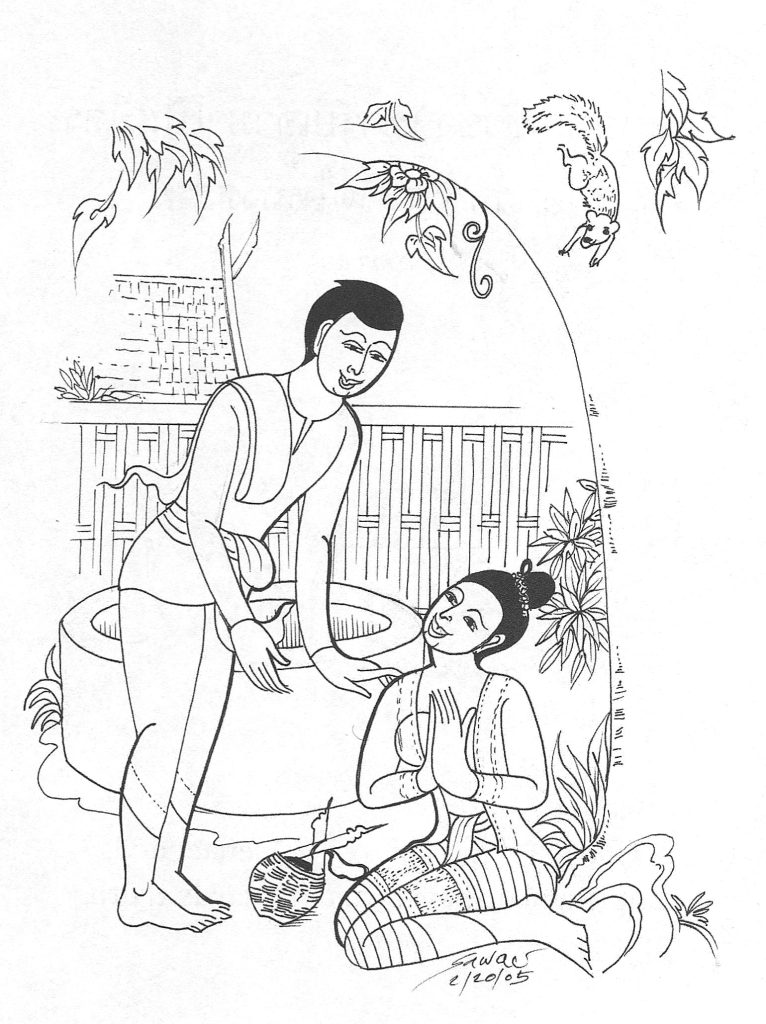
He deliberately took time to draw near to social outcasts (image)

“Jesus is dressed in a different style of clothing than the style of the woman who is shown as a Lanna Thai northerner. It is unusual for him to talk to a person from a different region, especially a woman. The clothes, the roof of the house in the background, and the dipper for water all indicate that this is in northern Thailand.”

Drawing by Sawai Chinnawong who employs northern and central Thailand’s popular distinctive artistic style originally used to depict Buddhist moral principles and other religious themes; explanation by Paul DeNeui. From That Man Who Came to Save Us by Sawai Chinnawong and Paul H. DeNeui, William Carey Library, 2010. . For more images by Sawai Chinnawong in TIPs see here.

See also The woman at the well (image).

Learn more on Bible Odyssey: Woman at the Well .

Translation commentary on John 4:18

Some scholars see a symbolic meaning in the mention of five men, but as far as translation is concerned it must be taken as a simple statement of fact. Although any number of marriages were legally possible, the Jewish rabbis did not approve of more than three.

You told me the truth is literally “This truth you have said.” New English Bible is similar: “You told me the truth there.” In some languages it is difficult to employ such a noun as truth, but some type of qualifying adjective is frequently used as an attributive, for example, “What you have just told me is true” or “The words that you have just spoken to me are true.”

Quoted with permission from Newman, Barclay M. and Nida, Eugene A. A Handbook on the Gospel of John. (UBS Handbook Series). New York: UBS, 1980. For this and other handbooks for translators see here .