9The Samaritan woman said to him, “How is it that you, a Jew, ask a drink of me, a woman of Samaria?” (Jews do not share things in common with Samaritans.)
The phrase in John 4:9 that is translated in English translations as “for Jews do not share things in common with Samaritans” or similar is translated into Mono is translated as “It is taboo for you people to drink from our buckets.” (Source: Carl Gross)
In Telugu the more unspecific “have no dealings” rendering was used since even members of the same family do not use each other’s dishes. (Source: David Clark)
In Chitonga it is translated with the existing idiom “(Jews and Samaritans) do not step on each other’s toes” and in Chichewa (interconfessional translation) as “(do not) look one another in the eyes.” (Source: Wendland 1987, p. 130)
In the EnglishGood News Bible (2nd edition of 1992), this occurrence of the Greek hoi Ioudaioi, traditionally “the Jews” in English, is translated with a term that refers to the Jewish people or is not translated at all if it implicitly refers to the Jewish people (for example “Passover” instead of “Passover of the Jews”). For an explanation of the differentiated translation in English as well as translation choices in a number of languages, see the Jews.
Like many languages (but unlike Greek or Hebrew or English), Tuvan uses a formal vs. informal 2nd person pronoun (a familiar vs. a respectful “you”). Unlike other languages that have this feature, however, the translators of the Tuvan Bible have attempted to be very consistent in using the different forms of address in every case a 2nd person pronoun has to be used in the translation of the biblical text.
As Voinov shows in Pronominal Theology in Translating the Gospels (in The Bible Translator2002, p. 210ff. ), the choice to use either of the pronouns many times involved theological judgment. While the formal pronoun can signal personal distance or a social/power distance between the speaker and addressee, the informal pronoun can indicate familiarity or social/power equality between speaker and addressee.
Here, Jesus is addressing the woman with an informal pronoun whereas she addresses him with a formal pronoun, showing respect.
In Gbaya, where God is always addressed with the second person plural pronoun ɛ́nɛ́, the common way to address superiors, the woman addresses him with the less courteous nɛ́ in verse 4:9 but then switches to the courteous plural form ɛ́nɛ́. (Source Philip Noss)
Likewise in Burmese where in the Common Language Version (publ. 2005) the Samaritan woman changes her language level from the Common to the Royal and Religious as she discovers the real nature of Jesus. Jesus appears here as a divine revealer. (Source: Gam Seng Shae in The Bible Translator 2002, p. 202ff. )
In most Dutch translations, both Jesus and the woman use the formal pronoun, whereas in Afrikaans and Western Frisian Jesus addresses the woman informally and she addresses him with the formal pronoun.
Following are a number of back-translations of John 4:9:
Uma: “That woman was surprised, because usually the Yahudi people felt-disgusted to mix with the Samaria people. That is why she said: ‘You (sing.) are a Yahudi person, I am a Samaria person. Why do you (sing.) dare to ask me for water?'” (Source: Uma Back Translation)
Yakan: “The woman answered, she said, ‘Oy, you are a Yahudi. Why do you ask for water from me and-what’s-more I am from the Samariya tribe?’ The woman spoke like that for the Yahudi don’t like hep to use the things of the Samariya people.” (Source: Yakan Back Translation)
Western Bukidnon Manobo: “And the woman said, ‘You are a Jew, and I, I am a Samaritan. Why are you asking me for water?’ (The reason she said this is because the Jews, they do not enter into conversation with a Samaritan.)” (Source: Western Bukidnon Manobo Back Translation)
Kankanaey: “‘Yes all-right, but you (sing.) are emphatically a Jew. Why perhaps do you (sing.) request water from me who am a woman from-Samaria?’ she said in reply. (Because the Jews, they don’t (empathy-particle) associate-with ones-from-Samaria.)” (Source: Kankanaey Back Translation)
Tagbanwa: “That Samaritano woman spoke, saying, ‘Why are you asking for water to drink, since you are a Judio, I a Samaritano?’ (For the Judio, they tabooed the eating and drinking utensils of the Samaritano people.)” (Source: Tagbanwa Back Translation)
Tenango Otomi: “The Jews are not allowed to speak with the natives of Samaria. Therefore when Jesus asked for water, the woman said, ‘How come? You are a Jew, and you ask me for water to drink and I am a native of Samaria.'” (Source: Tenango Otomi Back Translation)
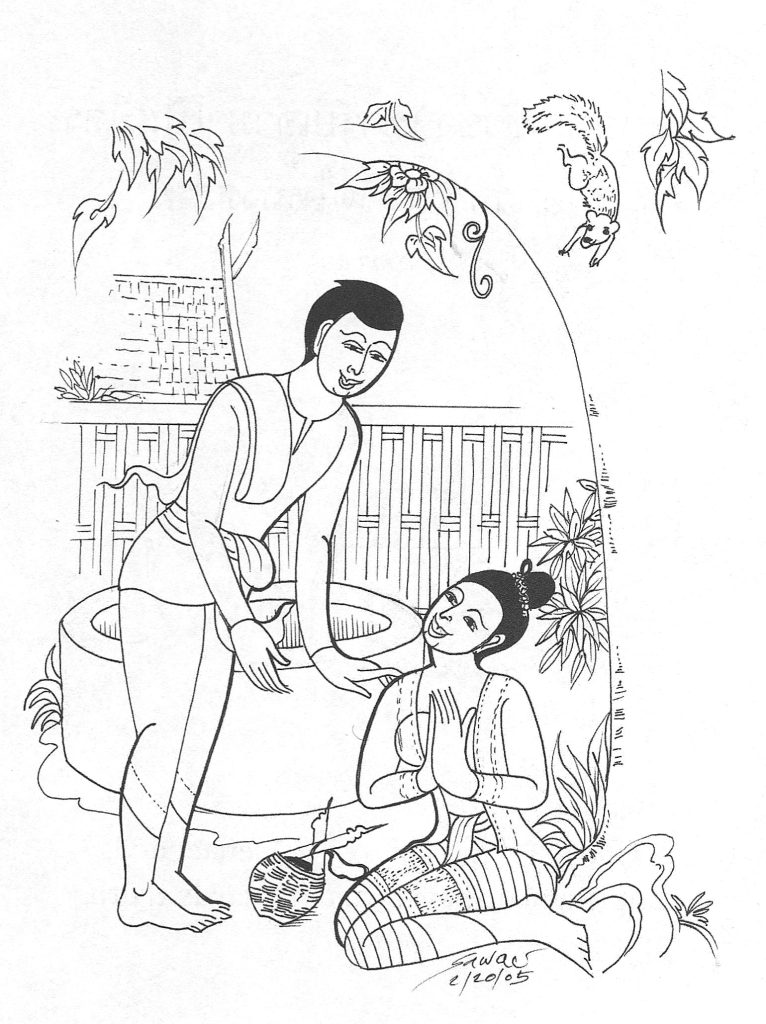
“Jesus is dressed in a different style of clothing than the style of the woman who is shown as a Lanna Thai northerner. It is unusual for him to talk to a person from a different region, especially a woman. The clothes, the roof of the house in the background, and the dipper for water all indicate that this is in northern Thailand.”
Click or tap here to see the rest of this insight.
Like a number of other East Asian languages, Japanese uses a complex system of honorifics, i.e. a system where a number of different levels of politeness are expressed in language via words, word forms or grammatical constructs. These can range from addressing someone or referring to someone with contempt (very informal) to expressing the highest level of reference (as used in addressing or referring to God) or any number of levels in-between. One way to do this is through the usage (or a lack) of an honorific prefix as shown here in the widely-used Japanese Shinkaiyaku (新改訳) Bible of 2017.
The concept of “desire” or “ask for” is translated in the Shinkaiyaku Bible as o-motome (お求め), combining “seek” (motome) with the respectful prefix o-. (Source: S. E. Doi, see also S. E. Doi in Journal of Translation, 18/2022, p. 37ff. )


Leave a Reply
You must be logged in to post a comment.