Many languages distinguish between inclusive and exclusive first-person plural pronouns (“we”). (Click or tap here to see more details)
The inclusive “we” specifically includes the addressee (“you and I and possibly others”), while the exclusive “we” specifically excludes the addressee (“he/she/they and I, but not you”). This grammatical distinction is called “clusivity.” While Semitic languages such as Hebrew or most Indo-European languages such as Greek or English do not make that distinction, translators of languages with that distinction have to make a choice every time they encounter “we” or a form thereof (in English: “we,” “our,” or “us”).
For this verse, the Adamawa Fulfulde translation uses the exclusive pronoun, excluding the king of Babylon.
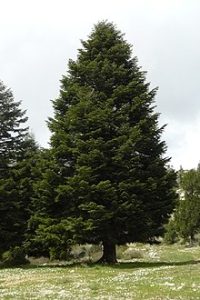
The Cilician fir Abies cilicica grew abundantly in the forests of Lebanon along with cedars, evergreen cypresses, and Grecian junipers. The Hebrew word berosh probably included fir, cypress, and juniper. According to 1 Kings 5:8 and elsewhere, berosh was used in King Solomon’s building projects. The reference in Ezekiel 27:5 to the use of berosh for the timbers/planks of ships could well be talking about fir trees since they are very straight, but the association of berosh there with Mount Senir rather favors the Grecian juniper, which was abundant there.
The Cilician fir is a tall and almost perfectly straight evergreen tree, in the same family with pines, cedars, and cypresses. It can reach a height of 25 meters (82 feet). Its flat seeds are contained in cones that fall from the tree when mature. Firs are the major source for turpentine, used by painters to dilute paint and clean brushes.
The Abies genus is represented throughout the world in temperate climates at high altitudes (for example, in Kenya, Japan, and North America). Since there are no firs or anything quite like them in tropical Africa, translators can use a transliteration, for example, firi or pir. In Ezekiel 27:5 we recommend following Zohary by rendering berosh as “fir.” The majority of English translations are divided among “fir,” “cypress,” and “pine.” In 1-2 Kings and 2 Chronicles we recommend rendering berosh as “fir” or “juniper.” Elsewhere berosh may be considered a generic word referring to cypress, fir, pine, or all of them together. In those places a general word for this type of cone-bearing tree should be used.
A tall evergreen, the Grecian Juniper Juniperus excelsa, also known as the Eastern Savin, grew in the mountains of Lebanon along with cedars, firs, and cypress (the Hebrew word berosh probably covered all three of these trees). The association of berosh with Mount Senir in Ezekiel 27:5 argues for the Grecian juniper there, since Mount Senir was known to have plenty of Grecian junipers. Lebanese people up to today refer to the juniper as brotha, a likely cognate with berosh. King Solomon undoubtedly hauled these trees to Jerusalem along with cedars and firs to use in constructing his palace and the Temple of Yahweh.
The Grecian juniper is a conical tree reaching a height of 20 meters (65 feet). Its “leaves” are round rather than flat, and the fruit is an inedible seed-bearing, fleshy cone.
There is no single Hebrew or Greek word that refers specifically to the Grecian juniper. In our discussion of cypress and fir, we have advocated translating berosh generically or as “fir” or “juniper” in 1-2 Kings and 2 Chronicles (where it is typically associated with Lebanon or cedar). If no generic word is available in the receptor language, a descriptive phrase such as “strong, beautiful tree/wood” can be used. In poetical passages, local poetic equivalents could be considered.
Following are a number of back-translations as well as a sample translation for translators of Isaiah 14:8:
Kupsabiny: “The podo trees are rejoicing because you have been crushed, and the cedars of Lebanon are happy. (They) are singing saying, ‘No one is coming to us again to cut us down, because you who always felled us is also lying down.’” (Source: Kupsabiny Back Translation)
Newari: “The pine trees and the cedars of Lebanon will also rejoice because of the king’s death and say like this, "Because you have been cut and fallen down, no tree cutter comes to cut us down."” (Source: Newari Back Translation)
Hiligaynon: “Even the pine trees and cedars of Lebanon rejoice because of what happened to the king. They are like a man who says, ‘Now that you (sing.) are gone, no one will-cut- us (excl.) -down!’” (Source: Hiligaynon Back Translation)
English: “It will be as though even the trees in the forests will joyfully sing this song, the cyprus/pine trees and the cedar trees in Lebanon will sing it: ‘You have been overthrown/are no longer a ruler, and now no one comes to get rid of us.’” (Source: Translation for Translators)
Click or tap here to see the rest of this insight.
Like a number of other East Asian languages, Japanese uses a complex system of honorifics, i.e. a system where a number of different levels of politeness are expressed in language via words, word forms or grammatical constructs. These can range from addressing someone or referring to someone with contempt (very informal) to expressing the highest level of reference (as used in addressing or referring to God) or any number of levels in-between. One way Japanese shows different degree of politeness is through the choice of a second person pronoun (“you” and its various forms) as shown here in the widely-used Japanese Shinkaiyaku (新改訳) Bible of 2017. The most commonly used anata (あなた) is typically used when the speaker is humbly addressing another person.
In these verses, however, omae (おまえ) is used, a cruder second person pronoun, that Jesus for instance chooses when chiding his disciples. (Source: S. E. Doi, see also S. E. Doi in Journal of Translation, 18/2022, p. 37ff. )
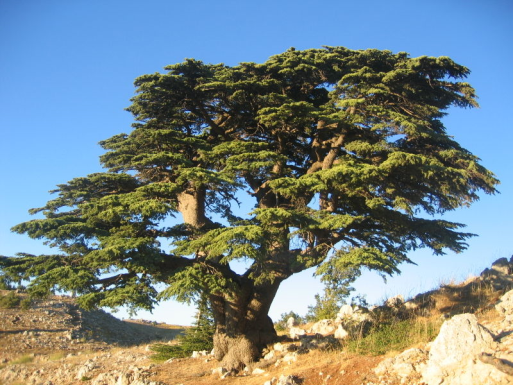
Long ago the majestic cedars of Lebanon (Cedrus libani) completely covered the upper slopes of the Lebanon Mountains on the western and northern sides. Now only a few pockets of these mighty cedars remain. At that time they were mixed, as they are today, with other trees such as Cilician fir, Grecian juniper, cypress, and Calabrian pine.
We know from 1 Kings that Solomon used cedar wood in his palace and in the Temple. Cedar was used for beams, boards, pillars, and ceilings. Historians tell us that the Assyrians also hauled cedars to their land for use in buildings. Nebuchadnezzar of Babylon also imported cedars from Lebanon. In some versions of Isaiah we read that people made idols of cedar and oak (44:14-20). Finally, when the Temple was rebuilt by the returning exiles (Ezra 3:7), they again cut down cedar trees to grace the house of God.
In 2 Samuel, 1-2 Kings, 1-2 Chronicles and Ezra, when Lebanon is specifically mentioned, there can be no doubt that ’erez is Cedrus libani, the “cedar of Lebanon,” although it is possible that sometimes the word was used loosely to include various evergreen trees.
In the description of the purification rituals (Leviticus 14:4 at al.), the word ’erez probably refers to the Phoenician juniper tree, since that was the only cedar-like tree in the Sinai Desert.
Description Cedar trees can reach 30 meters (100 feet) high with a trunk more than 2 meters (7 feet) in diameter. The leaves of true cedars are not flat like those of most trees, but consist of tufts of dark green, shiny spines. (The cedars in North America have a flatter type of spine than the biblical cedar.) The wood is fragrant and resistant to insects. Cedars bear cones and can live to be two or three thousand years old.
The cedar of Lebanon is famous for its large size (see Isaiah 2:13 et al.), and for the fragrance of its wood. Psalm 92:12 links the cedar to righteousness, that is, presumably, to its straightness and height above other trees. The cedar is the national emblem of Lebanon.
Cedrus species are found in the mountains of North Africa, in the Himalayas, in India, and in North America. Translators in these places, should, of course, use the local name in nonfigurative references. In sub Saharan Africa, translators can transliterate from Hebrew (’erez), Greek (kedar), English (sedar), or another major language, or they can take a generic solution such as “large, beautiful tree.” In poetic passages (wisdom literature and prophecy), some translators may wish to use a cultural equivalent with these traits. In Africa, according to Burkhill (The Useful Plants of West Tropical Africa, volume 4. Kew: Royal Botanic Gardens, 1985), the Pink Mahogany Guarea cedrata is also called the pink African cedar because of the cedar-like scent of its timber. Likewise, some people in India and Australia use “cedar” to refer to the toon because of its reddish wood. I do not recommend such substitutes in historical passages, since the ’erez is not related to these trees. In some figurative passages, however, the substitution could be effective, since all are large trees with reddish wood. However, each passage has to be evaluated to determine the intended effect of the image.
Here nature joins in to celebrate the overthrow of the Babylonians. Invading armies would often cut down the trees growing in the areas they occupied. They used the trees for fuel and for making siege instruments. Now these trees are left alone. The personification of trees rejoicing and speaking will be difficult to express in some languages, but it should be possible to indicate that they are fortunate that no one comes to cut them down.
In Hebrew this verse begins with an emphatic particle, which Contemporary English Version and Die Bibel im heutigen Deutsch render as “even” and Bible en français courant has “also.” Revised Standard Version and Good News Translation omit it, but translators should keep it.
This verse shifts from third person to second person to refer to the Babylonian king and his people. Grammatically speaking, the pronoun you could refer to the “scepter” of verse 5, but it is more likely to be a direct address to the king of Babylonia (see verse 9). Such pronoun shifts are common in Hebrew poetry. Good News Translation maintains third person references through verse 11. Bible en français courant uses third person references in this verse, but shifts to second person in the following verses. The third example below keeps the second person by beginning with a vocative to indicate who is being addressed.
The cypresses rejoice at you: A “cypress” tree is a kind of pine tree (so Revised English Bible, New Jewish Publication Society’s Tanakh). Rejoice at you means they are happy about what happened to the king of Babylonia. Both New Jerusalem Bible and New Jewish Publication Society’s Tanakh render at you as “at your fate.”
The cedars of Lebanon, saying: The verb phrase rejoice at you is implied here with the cedars of Lebanon as the second subject. Good News Translation combines the first two lines to make this explicit: “The cypress trees and the cedars of Lebanon rejoice over the fallen king.” For the cedars of Lebanon, see the comments on 2.13 and 9.10.
Since you were laid low, no hewer comes up against us: Here the trees express their gratitude for a quiet life. Since you were laid low refers to the overthrow of the Babylonian king. The agent of the passive verb laid low is Yahweh (see verse 5), which may be stated in those languages requiring an active form (see the third example below). This verb is part of the “rise up – go down” theme of the song (see the introduction to this section [14.3-21]). Bible en français courant translates laid low in a way to prepare for the following verses that speak of “Sheol.” For these two lines it has “From the time you [singular] are in the tomb, no one comes up here again to cut us down.” A hewer is someone who cuts things, usually wood or rock. The Hebrew word for hewer is a participle from the verb “cut.” If no noun is available, translators may use a descriptive phrase as in Bible en français courant or Good News Translation. The phrase comes up against us implies a threat or attack, so the trees celebrate the fact that nobody is going to come and cut them down. They will be left in peace.
Some translation examples for this verse are:
• Even the cypress and cedar trees of Lebanon are delighted at what happened to Babylonia’s king. They say, ‘Ever since you were overthrown, nobody has come to cut us down.’
• Lebanon’s cypress and cedar trees also rejoice because of what happened to Babylonia’s king. Ever since he was defeated, nobody has come to cut them down.
• O king of Babylonia! The cypress and cedar trees of Lebanon are so happy at your fate. They say, ‘Nobody has come to cut us down since the time Yahweh brought you down.’
Quoted with permission from Ogden, Graham S. and Sterk, Jan. A Handbook on Isaiah. (UBS Helps for Translators). New York: UBS, 2011. For this and other handbooks for translators see here .


Leave a Reply
You must be logged in to post a comment.