Jesus

The Greek Iēsous is “only” a proper name but one with great importance. The following quote by John Ellington (in The Bible Translator 1993, p. 401ff. ) illustrates this:

“In Matthew’s account of the birth of Jesus Christ, Joseph is told that when Mary gives birth to a son ‘you will name him Jesus, because he will save his people from their sins’ (1:21). This name is a Greek transliteration of the Hebrew name [Yeshua (יֵשׁוּעַ) which is a short form of a name meaning] ‘the Lord [Yahweh] saves.’ The name is very significant and is in itself especially dear to Christians around the world. (…) Unquestionably great importance is attached to the name of Jesus by Christians of all persuasions and backgrounds.”

While Iēsous (pronounced: /i.ɛː.suːs/) is transliterated as “Jesus” (pronounced /ˈdʒiːzəs/) in English (but was translated as “Hælend” [the “healing one”] in Old English — see Swain 2019) it is transliterated and pronounced in a large variety of other ways as well, following the different rules of different languages’ orthographies, writing systems and rules of pronunciation. The following is a (partial) list of forms of Jesus in Latin characters: aYeso, Azezi, Cecoc, Chesús, Chi̍i̍sū, Chisɔsi, Ciisahs, Ciise, Ciisusu, Djesu, Ɛisa, Ƹisa, Eyesu, Gesù, Gesû, Gesü, Ġesù, Ghjesù, Giêsu, ꞌGiê‑ꞌsu, Giê-xu, Gyisɛse, Hesu, Hesús, Hisus, Hisuw, Ià-sŭ, Iesen, Ié:sos, Iesu, Iesui, Iesusɨn, Iesusiva, Ié:sos, Ihu, Iisus, Iisussa, Ijeesu, iJisọsị, Iji̍sɔ̄ɔsi, Iosa, Íosa, Ìosa, İsa, I’sa, Isiso, Isõs, Ísu, Isus, Isusa, Iisussa, Isuthi, Itota, Îtu, Isuva, Izesu, Izesuq, Jasus, Jeeju, Jeesus, Jeesuse, Jeezas, Jehu, Jeisu, Jeju, Jejus, Jeso, Jesoe, Jesosa, Jesoshi, Jesosy, Jesu, Jesû, Jesua, Jesuh, Jesuhs, Jesuo, Jesús, Jésus, Jesúsu, Jethu, Jezed, Jezi, Jézi, Ježiš, Jezu, Jezus, Jézus, Jėzus, Jēzus, Jezusi, Jėzus, Jezuz, Jiijajju, Jíísas, Jiisusi, Jiizas, Jíìzọ̀s, Jisas, Jisase, Jisasi, Jisasɨ, Jisaso, Jisesi, Jisɛ̀, Jisos, Jisọs, Jisɔs, Jisu, Jiszs, Jizọs, Jizɔs, Jizọsi, Jizọsu, Jòso, Jusu, Jweesus, Ketsutsi, Njises, Sesi, Sisa, Sísa, Sisas, Sīsū, Sizi, Txesusu, uJesu, Ujísɔ̄si, ŵaYesu, Xesosi, ´Xesús, Xesús, Yasu, Ya:su, Ɣaysa, Yecu, Yeeb Sub, Yeeh Suh, Yeesey, Yeeso, Yeesso, Yēēsu, Yehsu, Yëësu, Yeisu, Yeisuw, Yeshu, Yeso, Yesò, Yëso, Yɛso, ye-su, Yésu, Yêsu, Yẹ́sụ̃, Yésʉs, Yeswa, Yet Sut, Yetut, Yexus, Yezo, Yezu, Yiesu, Yiisa, Yiisu, Yiitju, Yis, Yisɔs, Yisufa, Yitati, Yusu, ‑Yusu, :Yusu’, Zeezi, Zezi, Zezì, Zezwii, Ziizɛ, Zisas, Zîsɛ, Zjezus, Zozi, Zozii, and this (much more incomplete) list with other writings systems: ᔩᓱᓯ, ᒋᓴᔅ, Հիսուս, ᏥᏌ, ኢየሱስ, ያሱስ, ܝܫܘܥ, Ісус, Їисъ, 耶稣, იესო, ईसा, イエス, イイスス, イエスス, 예수, येशू, येशो, ਈਸਾ, ພຣະເຢຊູ, ජේසුස්, যীশু, ଯୀଶୁ, ཡེ་ཤུ་, ‘ঈছা, இயேசு, ಯೇಸು, ພຣະເຢຊູ, ယေရှု, ઇસુ, जेजू, येसु, เยซู, យេស៊ូ, ᱡᱤᱥᱩ, ယေသှု, యేసు, ᤕᤧᤛᤢ᤺ᤴ, އީސާގެފާނު, ਯਿਸੂ, ꕉꖷ ꔤꕢ ꕞ, ⵏ⵿ⵗⵢⵙⴰ, ଜୀସୁ, يَسُوعَ,ㄧㄝㄙㄨ, YE-SU, ꓬꓰ꓿ꓢꓴ, 𖽃𖽡𖾐𖼺𖽹𖾏𖼽𖽔𖾏, ꑳꌠ, ᠶᠡᠰᠦᠰ (note that some of these might not display correctly if your device does not have the correct fonts installed).

Click or tap here to read more.


In some languages the different confessions have selected different transliterations, such as in Belarusian with Isus (Ісус) by the Orthodox and Protestant churches and Yezus (Езус) by the Catholic church, Bulgarian with Iisus (Иисус) by the Orthodox and Isus (Исус) by the Protestant church, Japanese with Iesu (イエス) (Protestant and Catholic) and Iisusu (イイスス) (Orthodox), or Lingala with Yesu (Protestant) or Yezu (Catholic). These differences have come to the forefront especially during the work on interconfessional translations such as one in Lingala where “many hours were spent on a single letter difference” (source: Ellington, p. 401).

In Literary and Mandarin Chinese where transliterations of proper names between the Catholic and Protestant versions typically differ vastly, the Chinese name of Jesus (Yēsū 耶稣) remarkably was never brought into question between and by those two confessions, likely due to its ingenious choice. (Click or tap here to see more).

The proper name of God in the Old Testament, Yahweh (YHWH), is rendered in most Chinese Bible translations as Yēhéhuá 耶和華 — Jehovah. According to Chinese naming conventions, Yēhéhuá could be interpreted as Yē Héhuá, in which would be the family name and Héhuá — “harmonic and radiant” — the given name. In the same manner, 耶 would be the family name of Jesus and 稣 would be his given name. Because in China the children inherit the family name from the father, the sonship of Jesus to God the Father, Jehovah, would be illustrated through this. Though this line of argumentation sounds theologically unsound, it is indeed used effectively in the Chinese church (see Wright 1953, p. 298).

Moreover, the “given name” of 稣 carries the meaning ‘to revive, to rise again’ and seems to point to the resurrected Jesus. (Source: J. Zetzsche in Malek 2002, p. 141ff., see also tetragrammaton (YHWH))

There are different ways that Bible translators have chosen historically and today in how to translate the name of Jesus in predominantly Muslim areas: with a form of the Arabic Isa (عيسى) (which is used for “Jesus” in the Qur’an), the Greek Iēsous, or, like major 20th century Bible translations into Standard Arabic, the Aramaic Yēšūaʿ: Yasua (يَسُوعَ). (Click or tap here to see more.)

Following are languages and language groups that use a form of Isa include the following (note that this list is not complete):

  • Indo-Iranian languages: Persian, Dari, Central Pashto, Southern Pashto all use Eysa (عيسی or عيسىٰ for Southern Pashto), Sindhi uses Eysey (عيسيٰ), Southern Balochi Issa (ایسّا), Central Kurdish (Sorani) and Northern Kurdish (Kurmanji) use Îsa (عیسای and Иса respectively), Turkmen has Isa, and Tajik Isoi (Исои — compare Iso/Исо in the Tajik Qur’an)
  • Turkic languages: Turkish uses İsa, Kazakh, Kumyk, Nogai, Crimean Tatar all have Isa (Иса), Kirghiz has Iysa (Ыйса), Uzbek has Iso (Исо — compare Iiso/Ийсо in the Uzbek Qur’an), Bashkir uses Aaisa (Ғайса), North Azerbaijani İsa, Uighur uses Eysa (ئەيسا), and Kara-Kalpak İysa (Ийса)
  • Caucasian languages: Bezhta and Lezghian use Isa (Иса), Avaric has Aisa (ГІиса), and Chechen Iza (Иза)
  • Various African languages: Somali, a Cushitic language, has Ciise, Kabyle has Ɛisa and Tahaggart Tamahaq has Yeswa (both Berber languages), the Saharan languages Central Kanuri, Manga Kanuri have Isa, the Atlantic-Congo languages Dagbani, Mampruli, and Bimoba use Yisa, and the Chadian Arabic Bible has Isa (عِيسَى)
  • In Indonesian, while most Bible translations had already used Yesus Kristus rather than Isa al Masih, three public holidays used to be described using the term Isa Al Masih. From 2024 on the government is using Yesus Kristus in those holiday names instead (see this article in Christianity Today ).
  • Some languages have additional “TAZI” editions (TAZI stands for “Tawrat, Anbiya, Zabur, and Injil” the “Torah, Prophets, Psalms and Gospel”) of the New Testament that are geared towards Muslim readers where there is also a translation in the same language for non-Muslims. In those editions, Isa is typically used as well (for example, the Khmer TAZI edition uses Isa (អ៊ីសា) rather than the commonly used Yesaou (យេស៊ូ), the Thai edition uses Isa (อีซา) rather than Yesu (เยซู), the Chinese edition uses Ěrsā (尔撒) vs. Yēsū (耶稣), and the English edition also has Isa rather than Jesus.)

In German the name Jesus (pronounced: /ˈjeːzʊs/) is distinguished by its grammatical forms. Into the 20th century the grammatical rules prescribed a unique Greek-Latin declination: Jesus (nominative), Jesu (genitive, dative, vocative), Jesum (accusative), from which today only the genitive case “Jesu” is still in active use. Likewise, in Seediq (Taroko), the morphological treatment of “Jesus” also occupies a special category by not falling under the normal rule of experiencing a vowel reduction when the object-specific suffix an is added “since it was felt that the readers might resent that the name has been changed that drastically.” (Compare Msian for “Moses” (Mosi) as an object, but Yisuan for “Jesus” (Yisu).) (Source: Covell 1998. p. 249)

In Lamba the name ŵaYesu consists of a transliteration Yesu and the prefix ŵa, a plural form for “proper names when addressing and referring to persons in any position of seniority or honor.” While this was avoided in early translations to avoid possible misunderstandings of more than one Jesus, once the church was established it was felt that it was both “safe” and respectful to use the honorific (pl.) prefix. (Source C. M. Doke in The Bible Translator 1958, p. 57ff. )

In virtually all sign languages, “Jesus” is signed with the middle finger of each hand pointing to the palm (or wrist) of the other in succession (signing the nails of the cross). In the context of Bible translation this has been pointed out as theologically problematic since the “semantic connections of the original name Jesus do point towards ‘salvation,’ they do not naturally lead to crucifixion.” (Source: Phil King in Journal of Translation 1 (2020), p. 33ff.)


“Jesus” in German Sign Language (source )

Following is the oldest remaining Ethiopian Orthodox icon of Jesus from the 14th or possibly 13th century (found in the Church of the Saviour of the World in Gurji, Ethiopia). As in many Orthodox icons, Jesus’ right hand forms the Greek letters I-C-X-C for IHCOYC XPICTOC or “Jesus Christ.” Another interpretation of the right hand is that it shows three fingers pointing to the Trinity, while the two other fingers point to Jesus’ two natures.

source (c) Jacques Mercier and Alain Mathieu

Orthodox icons are not drawings or creations of imagination. They are in fact writings of things not of this world. Icons can represent our Lord Jesus Christ, the Virgin Mary, and the Saints. They can also represent the Holy Trinity, Angels, the Heavenly hosts, and even events. Orthodox icons, unlike Western pictures, change the perspective and form of the image so that it is not naturalistic. This is done so that we can look beyond appearances of the world, and instead look to the spiritual truth of the holy person or event. (Source )

The following is the so-called “Wales Window for Alabama.” It is a stained-glass window by the artist John Petts from Carmarthenshire, Wales, created in response to the 16th Street Baptist Church bombing which took place in 1963:

Stained glass is not just highly decorative, it’s a medium which has been used to express important religious messages for centuries. Literacy was not widespread in the medieval and Renaissance periods and the Church used stained glass and other artworks to teach the central beliefs of Christianity. In Gothic churches, the windows were filled with extensive narrative scenes in stained glass — like huge and colorful picture storybooks — in which worshipers could ‘read’ the stories of Christ and the saints and learn what was required for their religious salvation. (Source: Victoria and Albert Museum )

The style of the following drawing of Jesus by Annie Vallotton is described by the artist as this: “By using few lines the readers fill in the outlines with their imagination and freedom. That is when the drawings begin to communicate.” (see here )

Illustration by Annie Vallotton, copyright by Donald and Patricia Griggs of Griggs Educational Service.

Other visual representation of Jesus in TIPs include several non-Western styles of art: traditional Korean art, traditional Chinese art, modern Chinese abstract art, northern and central Thailand’s popular art, Indian Hamzanama style, traditional Vietnamese art, or Japanese prints.

See also this devotion on YouVersion .
Lord

The Hebrew adonai in the Old Testament typically refers to God. The shorter adon (and in two cases in the book of Daniel the Aramaic mare [מָרֵא]) is also used to refer to God but more often for concepts like “master,” “owner,” etc. In English Bible translations all of those are translated with “Lord” if they refer to God.

In English Old Testament translations, as in Old Testament translations in many other languages, the use of Lord (or an equivalent term in other languages) is not to be confused with Lord (or the equivalent term with a different typographical display for other languages). While the former translates adonai, adon and mare, the latter is a translation for the tetragrammaton (YHWH) or the Name of God. See tetragrammaton (YHWH) and the article by Andy Warren-Rothlin in Noss / Houser, p. 618ff. for more information.

In the New Testament, the Greek term kurios has at least four different kinds of use:

  • referring to “God,” especially in Old Testament quotations,
  • meaning “master” or “owner,” especially in parables, etc.,
  • as a form of address (see for instance John 4:11: “Sir, you have no bucket”),
  • or, most often, referring to Jesus

In the first and fourth case, it is also translated as “Lord” in English.

Most languages naturally don’t have one word that covers all these meanings. According to Bratcher / Nida, “the alternatives are usually (1) a term which is an honorific title of respect for a high-ranking person and (2) a word meaning ‘boss’, ‘master’, or ‘chief.’ (…) and on the whole it has generally seemed better to employ a word of the second category, in order to emphasize the immediate personal relationship, and then by context to build into the word the prestigeful character, since its very association with Jesus Christ will tend to accomplish this purpose.”

When looking at the following list of back-translations of the terms that translators in the different languages have used for both kurios and adonai to refer to God and Jesus respectively, it might be helpful for English readers to recall the etymology of the English “Lord.” While this term might have gained an exalted meaning in the understanding of many, it actually comes from hlaford or “loaf-ward,” referring to the lord of the castle who was the keeper of the bread (source: Rosin 1956, p. 121).

Click or tap here to see the rest of this insight

Following are some of the solutions that don’t rely on a different typographical display (see above):

  • Navajo (Dinė): “the one who has charge”
  • Mossi: “the one who has the head” (the leader)
  • Uduk: “chief”
  • Guerrero Amuzgo: “the one who commands”
  • Kpelle: “person-owner” (a term which may be applied to a chief)
  • Central Pame: “the one who owns us” (or “commands us”)
  • Piro: “the big one” (used commonly of one in authority)
  • San Blas Kuna: “the great one over all” (source for this and above: Bratcher / Nida)
  • Guhu-Samane: Soopara (“our Supervisor”) (source: Ellis Deibler in Notes on Translation July, 1967, p. 5ff.)
  • Balinese: “Venerated-one” (source: Reiling / Swellengrebel)
  • Yanesha’: “the one who carries us” (source: Nida 1952, p. 159)
  • Northern Emberá: Dadjirã Boro (“our Head”)
  • Rarotongan: Atu (“master or owner of a property”)
  • Gilbertese: Uea (“a person of high status invested with authority to rule the people”)
  • Rotuman: Gagaja (“village chief”)
  • Samoan: Ali’i (“an important word in the native culture, it derives from the Samoan understanding of lordship based on the local traditions”)
  • Tahitian: Fatu (“owner,” “master”)
  • Tuvalu: Te Aliki (“chief”)
  • Fijian: Liuliu (“leader”) (source for this and six above: Joseph Hong in The Bible Translator 1994, p. 329ff. )
  • Bacama: Həmə miye: “owner of people” (source: David Frank in this blog post )
  • Hopi: “Controller” (source: Walls 2000, p. 139)
  • Iyansi: Mwol. Mwol is traditionally used for the “chief of a group of communities and villages” with legal, temporal, and spiritual authority (versus the “mfum [the term used in other Bantu languages] which is used for the chief of one community of people in one village”). Mwol is also used for twins who are “treated as special children, highly honored, and taken care of like kings and queens.” (Source: Kividi Kikama in Greed / Kruger, p. 396ff.)
  • Ghomala’: Cyəpɔ (“he who is above everyone,” consisting of the verb cyə — to surpass or go beyond — and — referring to people. No human can claim this attribute, no matter what his or her social status or prestige.” (Source: Michel Kenmogne in Theologizing in Context: An Example from the Study of a Ghomala’ Christian Hymn )
  • Binumarien: Karaambaia: “fight-leader” (Source: Oates 1995, p. 255)
  • Warlpiri: Warlaljamarri (owner or possessor of something — for more information tap or click here)

    We have come to rely on another term which emphasizes God’s essential nature as YHWH, namely jukurrarnu (see tetragrammaton (YHWH)). This word is built on the same root jukurr– as is jukurrpa, ‘dreaming.’ Its basic meaning is ‘timelessness’ and it is used to describe physical features of the land which are viewed as always being there. Some speakers view jukurrarnu in terms of ‘history.’ In all Genesis references to YHWH we have used Kaatu Jukurrarnu. In all Mark passages where kurios refers to God and not specifically to Christ we have also used Kaatu Jukurrarnu.

    New Testament references to Christ as kurios are handled differently. At one stage we experimented with the term Watirirririrri which refers to a ceremonial boss of highest rank who has the authority to instigate ceremonies. While adequately conveying the sense of Christ’s authority, there remained potential negative connotations relating to Warlpiri ceremonial life of which we might be unaware.

    Here it is that the Holy Spirit led us to make a chance discovery. Transcribing the personal testimony of the local Warlpiri pastor, I noticed that he described how ‘my Warlaljamarri called and embraced me (to the faith)’. Warlaljamarri is based on the root warlalja which means variously ‘family, possessions, belongingness’. A warlaljamarri is the ‘owner’ or ‘possessor’ of something. While previously being aware of the ‘ownership’ aspect of warlaljamarri, this was the first time I had heard it applied spontaneously and naturally in a fashion which did justice to the entire concept of ‘Lordship’. Thus references to Christ as kurios are now being handled by Warlaljamarri.” (Source: Stephen Swartz, The Bible Translator 1985, p. 415ff. )

  • Mairasi: Onggoao Nem (“Throated One” — “Leader,” “Elder”) or Enggavot Nan (“Above-One”) (source: Enggavoter 2004)
  • Obolo: Okaan̄-ene (“Owner of person(s)”) (source: Enene Enene)
  • Angami Naga: Niepu (“master,” “owner”)
  • Lotha Naga: Opvui (“owner of house / field / cattle”) — since both “Lord” and YHWH are translated as Opvui there is an understanding that “Opvui Jesus is the same as the Opvui of the Old Testament”
  • Ao Naga: Kibuba (“human master,” “teacher,” “owner of property,” etc.) (source for this and two above: Nitoy Achumi in The Bible Translator 1992 p. 438ff. )
  • Seediq: Tholang, loan word from Min Nan Chinese (the majority language in Taiwan) thâu-lâng (頭儂): “Master” (source: Covell 1998, p. 248)
  • Thai: phra’ phu pen cao (พระผู้เป็นเจ้า) (divine person who is lord) or ong(kh) cao nay (องค์เจ้านาย) (<divine classifier>-lord-boss) (source: Stephen Pattemore)
  • Arabic often uses different terms for adonai or kurios referring to God (al-rabb الرب) and kurios referring to Jesus (al-sayyid الـسـيـد). Al-rabb is also the term traditionally used in Arabic Christian-idiom translations for YHWH, and al-sayyid is an honorary term, similar to English “lord” or “sir” (source: Andy Warren-Rothlin).
  • Tamil also uses different terms for adonai/kurios when referring to God and kurios when referring to Jesus. The former is Karttar கர்த்தர், a Sanskrit-derived term with the original meaning of “creator,” and the latter in Āṇṭavar ஆண்டவர், a Tamil term originally meaning “govern” or “reign” (source: Natarajan Subramani).
  • Burunge: Looimoo: “owner who owns everything” (in the Burunge Bible translation, this term is only used as a reference to Jesus and was originally used to refer to the traditional highest deity — source: Michael Endl in Holzhausen / Riderer 2010, p. 48)
  • Yagaria: Souve, originally “war lord” (source: Renck, p. 94)
  • Aguacateco: Ajcaw ske’j: “the one to whom we belong and who is above us” (source: Rita Peterson in Holzhausen / Riderer 2010, p. 49)
  • Konkomba: Tidindaan: “He who is the owner of the land and reigns over the people” (source: Lidorio 2007, p. 66)
  • Chichewa: Ambuye Ambuye comes from the singular form Mbuye which is used to refer to: (1) someone who is a guardian or protector of someone or group of people — a grandparent who has founded a community or village; (2) someone who is a boss or master over a group of people or servants and has absolute control over them; (3) owner of something, be it a property, animals and people who are bound under his/her rule — for people this was mostly commonly used in the context of slaves and their owner. In short, Mbuye is someone who has some authorities over those who call him/her their “Mbuye.” Now, when the form Ambuye is used it will either be for honorific when used for singular or plural when referring to more than one person. When this term is used in reference to God, it is for respect to God as he is acknowledged as a guardian, protector, and ruler of everything. (Source: Mawu a Mulungu mu Chichewa Chalero Back Translation).
  • Hdi uses rveri (“lion”) as a title of respect and as such it regularly translates adon in the Old Testament. As an address, it’s most often with a possessive pronoun as in rvera ɗa (“my lion” = “my lord” or “sir”). So, for example, Genesis 15:2 (“O Lord God”) is Rvera ɗa Yawe (“My lion Yahweh”) or Ruth to Boaz in Ruth 2:13: “May I find your grace [lit. good-stomach] my lion.” This ties in nicely with the imagery of the Lord roaring like a lion (Hosea 11:10; Amos 3:8; Joel 3:16). Better still, this makes passages like Revelation 5:5 even richer when we read about rveri ma taba məndəra la Yuda, “the Lion of the tribe of Judah”. In Revelation 19:16, Jesus is rveri ta ghəŋa rveriha “the lion above lions” (“lord of lords”). (Source: Drew Maust)

Law (2013, p. 97) writes about how the Ancient Greek Septuagint‘s translation of the Hebrew adonai was used by the New Testament writers as a bridge between the Old and New Testaments: “Another case is the use of kurios referring to Jesus. For Yahweh (in English Bibles: ‘the Lord‘), the Septuagint uses kurios. Although the term kurios usually has to do with one’s authority over others, when the New Testament authors use this word from the Septuagint to refer to Jesus, they are making an extraordinary claim: Jesus of Nazareth is to be identified with Yahweh.”

See also Father / Lord.

Honorary "are" construct denoting God (“lead out”)

Click or tap here to see the rest of this insight.

Like a number of other East Asian languages, Japanese uses a complex system of honorifics, i.e. a system where a number of different levels of politeness are expressed in language via words, word forms or grammatical constructs. These can range from addressing someone or referring to someone with contempt (very informal) to expressing the highest level of reference (as used in addressing or referring to God) or any number of levels in-between.

One way Japanese shows different degree of politeness is through the usage of an honorific construction where the morpheme are (され) is affixed on the verb as shown here in the widely-used Japanese Shinkaiyaku (新改訳) Bible of 2017. This is particularly done with verbs that have God as the agent to show a deep sense of reverence. Here, michibikidas-are-ru (導き出される) or “lead out” is used.

(Source: S. E. Doi, see also S. E. Doi in Journal of Translation, 18/2022, p. 37ff. )

sheep / lamb

Before the time of Abraham at least five breeds of sheep had already been developed in Mesopotamia. From mummified remains (that is, preserved dead bodies) and ancient art it is also known that at least two different breeds had reached Egypt by about 2000 B.C. Thus it is likely that the sheep mentioned in the Bible were of more than one breed.

The Hebrew word kar seems to be used of imported foreign sheep and may refer to a special breed but some scholars think it refers to a wether (castrated ram), since this word is never used in the context of sacrifice. This word is also used for a battering ram, that is, a heavy pole suspended on a rope, used in war for breaking down walls. ’Ayil is the word for a ram or adult male sheep, rachel is a breeding ewe or female sheep, and taleh is a very young lamb, probably still unweaned. The remaining Hebrew words refer to sheep in general.

The Greek word probaton is the general word for sheep, or flocks that may include goats. Krios is the Greek word for a ram or male sheep. Pascha is a technical name for the Passover lamb exclusively, and the remaining Greek words all mean lamb. Ovis is the Latin word for sheep.

Click or tap here for the rest of this entry in United Bible Societies’ All Creatures Great and Small: Living things in the Bible.

The early Hebrews were nomadic shepherds to whom sheep were the most important domestic animal. While goats eat almost any vegetation, sheep are much more selective about the grasses and plants they eat. This meant that suitable grazing for them was not always easy to find, and shepherds had to keep moving their flocks from place to place. This led to a nomadic lifestyle, with movable tents rather than houses being the normal household shelter. It was not until the occupation of Canaan after the Exodus that the lifestyle of the Israelites changed, and they became settled village-dwelling farmers and fruit growers.

However, even then, most households owned sheep, and some family members would function as shepherds, often living away from home for fairly long periods.

Sheep in the Bible were a source of meat, milk, wool, hides, and horns, and it seems likely that various strains were bred selectively to enhance production of these commodities. Wool is mentioned in the Bible as early as the Mosaic Law, which forbade the weaving of cloth containing both wool and plant fibers. The shearing of sheep is mentioned even earlier, in Genesis 31:19. Wool was in fact the most common and available fiber known to the people of Israel.

There was a very extensive wool trade in biblical times, stretching from Egypt to China. In the Middle East wool was cheaper than cotton or linen, which were the other common fibers. (Silk was known by the time of Solomon, but it was extremely expensive as it was produced in China and handled by numerous traders on its way west.) It would be a mistake to think of all wool at that time as being white, as Genesis 30 indicates quite clearly that there were also dark colored sheep and sheep that had dark and light patches, probably varying combinations of black, white, and brown.

We can be fairly sure that one breed of sheep known to the Israelites was the Fat-tailed Sheep Ovis laticaudata and that its fatty tail is referred to in Exodus 29:22, Leviticus 3:9 et al.

Rams’ horns had a variety of uses. Whole ram horns were used as drinking vessels, jars, and trumpets. But pieces of horn were used as handles for knives and other household implements, and for jewelry such as bracelets and beads. Needles too, and probably also arrow heads, were made from horn, as well as from bone and later from bronze and iron.

Sheep were also very important in Israelite religion. They were a very important element in the sacrificial system and in the traditional religious feasts, especially the Feast of Passover.

Sheep and goats belong to the same general family. They differ in that sheep produce wool, which is a special type of soft hair, among the ordinary hairs on their bodies. A ram’s horns too differ in shape from a goat’s horns, those of a ram curling down in a tight spiral beside its face, with those of a goat curving more gently back towards its shoulders. The sheep of biblical times produced much shorter wool than is common with wool-bearing breeds of today.

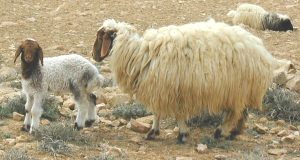
The fat-tailed or broad-tailed sheep is a smallish breed usually brown and white with a very broad tail. Like most other breeds of sheep in the Middle East it has large floppy ears.

Sheep are generally fairly timid animals, lacking the self-confidence and adaptability of goats. While goats will spread out in their search for food and then regroup without much difficulty, sheep become very insecure when they are separated from other sheep and tend to stay bunched together. They thus require a lot of shepherding. In the Middle East the method of shepherding involves training the dominant ram to follow the shepherd. The remaining sheep then follow this dominant ram, which often wears a wooden clapper or a bell. As they feed, the sheep usually keep within earshot of this sound. It is likely that this method is centuries old.

In most modern breeds only male sheep have horns, but in most ancient breeds female sheep had short horns too. This made separating sheep from goats in a single flock more difficult than it is today.

Of all animals the sheep was the most important for the Israelite nation. It had great religious, social, and economic importance.

In the Bible sheep are a common metaphor for the people of Israel and perhaps for people in general. Like sheep the people are seen as easily going astray (Psalms 119:176; Isaiah 53:6; Jeremiah 50:6; 1 Peter 2:25), as being in need of guidance and protection (1 Kings 22:17; 2 Chronicles 18:16; Matthew 9:36; Mark 6:34), as being very defenseless (Isaiah 52:7), and as being destined to an early death (Psalms 44:22; Jeremiah 12:3; Romans 8:36).

The metaphor of a lamb is used in the New Testament to refer to Christ, with an emphasis on his being a sacrifice for the sin of the world. This is especially the case in John’s gospel and Revelation. In the latter book the metaphor is introduced in a very striking way. In Revelation 5:5 as the writer is mourning the fact that no one can be found to open the scroll, he is comforted by one of the elders who tells him that “the Lion of the tribe of Judah” has triumphed and can thus open the scroll. Then the writer, expecting to see the Lion, sees instead a Lamb that looks as if it has been killed for sacrifice. The remainder of the book is then concerned with describing the triumph of this Lamb over the forces of evil.

In the gospels Jesus also refers to his disciples as “sheep” and “lambs” (Matthew 10:17; John 10:1 et al.).

The metaphor of the shepherd is extended to God himself who is the ultimate “Shepherd of Israel” (Psalms 23:1; 80:1). Then those who are responsible for the nurture, guidance, ruling, and protection of Israel, be it kings, prophets, or priests, are also likened to shepherds (Isaiah 56:11; Jeremiah 23:4; 49:19; Ezekiel 34:2; Zechariah 10:2).

The Messiah is also called a shepherd (Isaiah 40:11), and Jesus refers to himself as “the good shepherd” (John 10:11). In Hebrews 13:20 he is referred to as “the great shepherd of the sheep” and in 1 Peter 2:25 he is called “the Shepherd and Guardian of your lives”.

In languages that have a word for sheep, it is advisable to translate according to the meanings given above. If possible, the feminine forms should be translated as “female lamb” or “female sheep”. In languages in which sheep are not known, a word has usually been coined or borrowed by the time Bible translation begins, and this word should be used. It is not advisable to substitute another locally well-known animal in this case, since doing so negates the ritual and symbolic importance that sheep had for the biblical cultures.

In translating Psalms 23:1 it is extremely important to make sure that the phrase “my shepherd” preserves the relationship intended by the writer and reflects the psalmist’s theme that Yahweh is his benefactor, protector, and guide. There are really two metaphors involved in the opening verse-the caring shepherd (God) and by clear implication, the dependent sheep (the psalmist). In many languages the literal phrase “my shepherd” depicts a wrong relationship, meaning something like “the one who looks after my sheep” or “the one I employ to watch my sheep.” In many African languages unwary translators have produced a rendering that means “The Chief is (nothing more than) my herdsman.” It is often necessary to restructure the whole verse as something like “I am a sheep, and the lord is my shepherd.”

Sheep with lamb, photo by Ray Pritz

Source: All Creatures Great and Small: Living things in the Bible (UBS Helps for Translators)

See also sheep, lamb, and shepherd.

Translation commentary on Hebrews 13:20 – 13:21

Verses 20-21 are combined in Good News Translation, since the God of peace belongs to verse 20 in the Greek, but has been moved to the beginning of verse 21, the second sentence in Good News Bible. Verse 20 recalls Isaiah 63.11.

It was common for Christians to end their letters with prayer, praise, and blessing; see, for example, 1 Thessalonians 5.23 and 1 Peter 5.11. But these closing words are not merely a formality; the writer weaves into this long sentence some of the most important key words of the letter, including “blood” (sacrificial death) and covenant.

The main difficulty in this long sentence is to decide on the relation between raised, the Great Shepherd of the sheep, and his death, by which the eternal covenant is sealed. The third phrase is literally “by the blood of the eternal covenant” (Revised Standard Version). The two possibilities are (a) God raised Jesus by means of “the blood of the eternal covenant”; (b) Jesus became the Great Shepherd of the sheep by means of his sacrificial death, by which the eternal covenant is sealed. Choice (a) is the basis for Moffatt‘s translation “May the God of peace who brought up from the dead our Lord Jesus, the great shepherd of the sheep, with the blood of the eternal covenant….” New English Bible has “who brought up from the dead our Lord Jesus … by the blood of the eternal covenant,” but the idea of Christ’s “blood” (sacrificial death) being the means of his “resurrection” is difficult, especially since “God” is the subject of the sentence. Most modern translations choose (b).

Raised means literally “brought up”; this is not a common way of speaking of the resurrection, but the meaning is nonetheless clear.

God has raised from death our Lord Jesus may be expressed as “God has caused our Lord Jesus to live again.”

In this sentence the writer uses the language of Isaiah 63.11 (Shepherd of the sheep; for Great, compare 4.14); Zechariah 9.11 (“with the blood of the covenant,” Revised Standard Version); and Isaiah 55.3 (eternal covenant). Who is the Great Shepherd of the sheep may require marking as a figurative expression; for example, “who is like a Wonderful Shepherd for the sheep.” Otherwise some readers might think that Jesus has now become a chief shepherd over a flock of sheep.

As the result of his sacrificial death may be expressed as “because he died as a sacrifice.”

By which the eternal covenant is sealed may be expressed as “by his death he established the covenant which will last forever.”

The last part of this passage is a prayer directed to God. Therefore it may be necessary to introduce the prayer by a statement such as “I pray that.” The translators of Die Bibel im heutigen Deutsch first edition felt that prayers in the subjunctive, corresponding to the English May … God, are no longer part of common language. They therefore restructured the text to say:

I pray to God, who gives us peace…. I ask him to help you to do all the good he wants to be done. He himself will do in us what pleases him. He does it through Jesus Christ, to whom be praise for all times. Amen.

The text of verse 21, the second sentence in Good News Translation, is doubtful at several points:
(a) After every good thing (thing is implied) most manuscripts add “work,” but this is not included in some of the best manuscripts. Among modern translations it is included only in Jerusalem Bible as “good action” (not in Bible de Jérusalem).
(b) After Revised Standard Version‘s “working,” some good manuscripts add a word meaning “to him” (unintelligible in this context), which is omitted in translation.
(c) In place of Revised Standard Version‘s “working in you,” the UBS Greek text has “working in us.”
(d) The UBS Greek text has “forever [and ever],” indicating doubt as to whether the last two words are part of the original text. The difference is one of emphasis rather than meaning.

Revised Standard Version‘s “in his sight” is literally “before him”; Good News Translation‘s what pleases him gives the meaning.

The term peace in the expression the God of peace may be understood as a causative; for example, “the God who causes peace.” In this context, in which the reference is to the covenant, peace may be understood in terms of reconciliation; for example, “the God who causes reconciliation.”

Provide or “equip” you with every good thing you need in order to do his will recalls Philippians 2.13; see also Hebrews 11.5-6; 13.16. The writer speaks of “doing God’s will” in terms of an active task, not just passive acceptance of one’s fate. Earlier he has shown that for Jesus (10.7, 9), as for Christians (10.36), “suffering” formed part of “doing God’s will,” but now he is emphasizing the positive achievement and victory of Christ.

Provide you with every good thing you need in order to do his will may also be rendered as “give to you all that is good which you need in order to do what he wants you to do” or “… all that is good and necessary in order to do what he desires you to do.”

The first part of the prayer to the God of peace relates to what the believer himself should be doing in order to accomplish God’s will, while the second part relates to what the believer himself should become. This second part may then be rendered as “may he make of us what he would have us to be.” With this type of statement the phrase through Jesus Christ may be made a separate clause; for example, “this he will do through Jesus Christ” or “he will do this by causing Jesus Christ to accomplish it.”

The closest equivalent to the statement to Christ be the glory forever and ever may be an admonition for praise or honor; for example, “Christ is the one to be praised forever and ever” or “let us honor Christ forever and ever.”

In this context Amen fits well because this is the end of a prayer to God.

Quoted with permission from Ellingworth, Paul and Nida, Eugene A. A Handbook on The Letter of the Hebrews. (UBS Handbook Series). New York: UBS, 1983. For this and other handbooks for translators see here .

Sung version of Hebrews 13

Living Water is produced for the Bible translation movement in association with Lutheran Bible Translators. Lyrics derived from the ESV® Bible (The Holy Bible, English Standard Version®).

For more information, see here .