altar

The Greek, Latin and Hebrew that is translated as “altar” in English is translated in a number of ways:

  • Obolo: ntook or “raised structure for keeping utensils (esp. sacrifice)” (source: Enene Enene)
  • Muna: medha kaefoampe’a or “offering table” (source: René van den Berg)
  • Luchazi: muytula or “the place where one sets the burden down”/”the place where the life is laid down” (source: E. Pearson in The Bible Translator 1954, p. 160ff. )
  • Tzotzil: “where they place God’s gifts” (source: John Beekman in Notes on Translation, March 1965, p. 2ff.)
  • Tsafiki: “table for giving to God” (source: Bruce Moore in Notes on Translation 1/1992, p. 1ff.)
  • Noongar: karla-kooranyi or “sacred fire” (source: Warda-Kwabba Luke-Ang)
  • Uma: “offering-burning table” (source: Uma Back Translation)
  • Yakan: “place for sacrificing” (source: Yakan Back Translation)
  • Tagbanwa: “burning-place” (source: Tagbanwa Back Translation)
  • Tibetan: mchod khri (མཆོད་​ཁྲི།) or “offering throne” (source: gSungrab website )
  • Bura-Pabir: “sacrifice mound” (source: Andy Warrren-Rothlin)
  • Kalanga: “fireplace of sacrifice” (source: project-specific notes in Paratext)
The Ignaciano translators decided to translate the difficult term in that language according to the focus of each New Testament passage in which the word appears (click or tap here to see the rest of this insight

Willis Ott (in Notes on Translation 88/1982, p. 18ff.) explains:

  • Matt. 5:23,24: “When you take your offering to God, and arriving, you remember…, do not offer your gift yet. First go to your brother…Then it is fitting to return and offer your offering to God.” (The focus is on improving relationships with people before attempting to improve a relationship with God, so the means of offering, the altar, is not focal.)
  • Matt. 23:18 (19,20): “You also teach erroneously: ‘If someone makes a promise, swearing by the offering-place/table, he is not guilty if he should break the promise. But if he swears by the gift that he put on the offering-place/table, he will be guilty if he breaks the promise.'”
  • Luke 1:11: “…to the right side of the table where they burn incense.”
  • Luke 11.51. “…the one they killed in front of the temple (or the temple enclosure).” (The focus is on location, with overtones on: “their crime was all the more heinous for killing him there”.)
  • Rom. 11:3: “Lord, they have killed all my fellow prophets that spoke for you. They do not want anyone to give offerings to you in worship.” (The focus is on the people’s rejection of religion, with God as the object of worship.)
  • 1Cor. 9:13 (10:18): “Remember that those that attend the temple have rights to eat the foods that people bring as offerings to God. They have rights to the meat that the people offer.” (The focus is on the right of priests to the offered food.)
  • Heb. 7:13: “This one of whom we are talking is from another clan. No one from that clan was ever a priest.” (The focus in on the legitimacy of this priest’s vocation.)
  • Jas. 2:21: “Remember our ancestor Abraham, when God tested him by asking him to give him his son by death. Abraham was to the point of stabbing/killing his son, thus proving his obedience.” (The focus is on the sacrifice as a demonstration of faith/obedience.)
  • Rev. 6:9 (8:3,5; 9:13; 14:18; 16:7): “I saw the souls of them that…They were under the table that holds God’s fire/coals.” (This keeps the concepts of: furniture, receptacle for keeping fire, and location near God.)
  • Rev. 11:1: “Go to the temple, Measure the building and the inside enclosure (the outside is contrasted in v. 2). Measure the burning place for offered animals. Then count the people who are worshiping there.” (This altar is probably the brazen altar in a temple on earth, since people are worshiping there and since outside this area conquerors are allowed to subjugate for a certain time.)

See also altar (Acts 17:23).


In the Hebraic English translation of Everett Fox it is translated as slaughter-site and likewise in the German translation by Buber / Rosenzweig as Schlachtstatt.
cubit

The Hebrew, Aramaic and Greek that is translated as “cubit” or into a metric or imperial measurement in English is translated in Kutu, Kwere, and Nyamwezi as makono or “armlength.” Since a cubit is the measurement from the elbow to the tip of the middle finger, one armlength (measured from the center of the chest to the fingertips) equals two cubits or roughly 1 meter. (Source: Pioneer Bible Translators, project-specific translation notes in Paratext)

Similarly, in Akoose, the translation is “arm distance.” (Source: Joseph Nkwelle Ngome and Marlie van Rooyen & Jacobus A. Naudé in Communicatio 2009, p. 251ff.)

In Klao it is converted into “hand spans” (app. 6 inches or 12 cm) and “finger spans” (app. 1 inch or 2 cm) (source: Don Slager) and in Bariai into leoa or “fathom,” which comprises the distance from a person’s fingertip to fingertip with arms outstretched, app. 6 feet (source: Bariai Back Translation).

distance (long / wide / high)

The concepts of distance that are translated in English with “long,” “wide,” and “high/tall” are translated in Kwere with one word: utali. (Source: Pioneer Bible Translators, project-specific translation notes in Paratext)

complete verse (Exodus 27:1)

Following are a number of back-translations as well as a sample translation for translators of Exodus 27:1:

  • Kupsabiny: “You (sing.) must see to it that the place of sacrifice/alter is built with/using acacia boards. All the four sides should be the same size, each side should be seven feet and 6 inches and going up to be four feet and 6 inches.” (Source: Kupsabiny Back Translation)
  • Newari: “Make a square altar of acacia wood, five cubits long, five cubits wide and three cubits high.” (Source: Newari Back Translation)
  • Hiligaynon: “‘[You (sing.)] have-(someone)-make a square altar of acacia. Its length and width is (to be) seven and a half feet, and the height is (to be) four and one half feet.” (Source: Hiligaynon Back Translation)
  • Bariai: “God spoke again like this, ‘You (pl.) must take akas wood and then make a table of offerings with it. Its height will extend 54 inches (lit. to our[incl] opposite elbow’s bending), and its length and width will turn out the same and extend 90 inches (lit. one fathom and an extra part extending to our[incl] elbow’s bending).” (Source: Bariai Back Translation)
  • Opo: “And God also say Moses like this «you (sing., imp.) say children of Israel that they must chop white-acacia, they must build it for altar [so that] it be square which its width be joint of hand five and its height be joint of hand three.” (Source: Opo Back Translation)
  • English: “‘Tell them to make an altar from acacia wood. It is to be square, 7-1/2 feet/2.2 meters on each side, and make it 4-1/2 feet/1.3 meters high.” (Source: Translation for Translators)

acacia

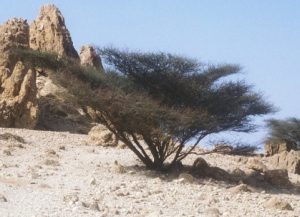
The plural form of shittah (shittim) is used sometimes as a place name (see Shittim), which is evidence of the wide distribution of this tree in Sinai and southern Palestine. The acacia referred to in the Bible was of two kinds, the Umbrella Thorn Acacia Acacia tortilis and the Common Acacia Acacia raddiana.

The Acacia tortilis is found in the hot Arabah Valley, whereas the Acacia raddiana tends to be found in cooler conditions throughout Sinai. A third variety (Acacia albida) is found in lowland Israel, the Sharon Plain, and lower Galilee. The common acacia was the only tree available to the Israelites for construction of the Tabernacle.

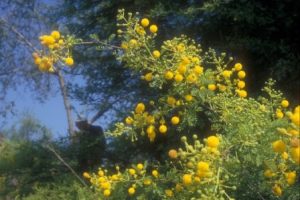
Both types of acacia are short, reaching 3-5 meters (10-17 feet) tall, but having a wide crown. As members of the Mimosa family, they have sharp spines, finely divided leaves, and tiny pale yellow flowers arranged in drooping bunches. The bean pod they produce is twisted and looped when dry.

Since the acacia is widespread in dry areas of Africa, Arabia, India and Australia, translators in those areas should be able to use a local word. In such languages a local species should be used, especially one that is used for building. Elsewhere, if none of these is available, the translator can transliterate from Hebrew (shittah) or from a major language, for example, sunt or talh (Arabic), akasiya (English/French/Spanish via Latin). West African translators need to beware of confusing “acacia” and “cassia,” a common tree with yellow flowers.

Acacia raddiana, photo by Ray Pritz
Acacia flowers, photo by Gloria Suesss

Source: Each According to its Kind: Plants and Trees in the Bible (UBS Helps for Translators)

Translation commentary on Exod 27:1

You shall make the altar uses the singular You, for Yahweh is instructing Moses. But one may also say “You must have them make,” because Moses would not be constructing the altar himself. Since this is the first verse of a new section, it may be helpful to begin with something like “The LORD said to Moses, ….” The use of the definite article, the, is surprising, since no mention of this altar has been made previously. Some translations have “an altar” (Good News Translation), since this is new information, but any shrine in the ancient world was expected to have an altar. The word for altar is derived from the verb “to slaughter,” so it refers to a place for sacrificing an animal. A number of modern cultures have similar elevated structures for sacrificing animals or for offering gifts to a deity. Sometimes this will be a stone or wood platform or table. Such terms may be used here if it is clear that this altar is dedicated to God. For acacia wood see the comment at 25.5. It is surprising that a place for burning a sacrifice would be made of wood, even though it was to be overlaid with bronze (verse 2), but at least it would be portable.

Five cubits long and five cubits broad means that it was to be “7½ feet” by “7½ feet” (Good News Translation) (or “2.2 meters” by “2.2 meters”). This of course made it square. And its height shall be three cubits means “4½ feet high” (Good News Translation) (“1.3 meters”). The cubit is discussed at 25.10.

Quoted with permission from Osborn, Noel D. and Hatton, Howard A. A Handbook on Exodus. (UBS Helps for Translators). New York: UBS, 1999. For this and other handbooks for translators see here .