The Hebrew, Latin, and Greek that is translated as “bronze” in English is translated in Newari as “bell-metal,” since bells are made of bronze in Nepal (source: Newari Back Translation).
See also bronze vessel.

וְעָשִׂ֣יתָ לַמָּסָ֗ךְ חֲמִשָּׁה֙ עַמּוּדֵ֣י שִׁטִּ֔ים וְצִפִּיתָ֤ אֹתָם֙ זָהָ֔ב וָוֵיהֶ֖ם זָהָ֑ב וְיָצַקְתָּ֣ לָהֶ֔ם חֲמִשָּׁ֖ה אַדְנֵ֥י נְחֹֽשֶׁת׃ ס
37You shall make for the screen five pillars of acacia and overlay them with gold; their hooks shall be of gold, and you shall cast five bases of bronze for them.
The Hebrew, Latin, and Greek that is translated as “bronze” in English is translated in Newari as “bell-metal,” since bells are made of bronze in Nepal (source: Newari Back Translation).
See also bronze vessel.
Following are a number of back-translations as well as a sample translation for translators of Exodus 26:37:
The plural form of shittah (shittim) is used sometimes as a place name (see Shittim), which is evidence of the wide distribution of this tree in Sinai and southern Palestine. The acacia referred to in the Bible was of two kinds, the Umbrella Thorn Acacia Acacia tortilis and the Common Acacia Acacia raddiana.
The Acacia tortilis is found in the hot Arabah Valley, whereas the Acacia raddiana tends to be found in cooler conditions throughout Sinai. A third variety (Acacia albida) is found in lowland Israel, the Sharon Plain, and lower Galilee. The common acacia was the only tree available to the Israelites for construction of the Tabernacle.
Both types of acacia are short, reaching 3-5 meters (10-17 feet) tall, but having a wide crown. As members of the Mimosa family, they have sharp spines, finely divided leaves, and tiny pale yellow flowers arranged in drooping bunches. The bean pod they produce is twisted and looped when dry.
Since the acacia is widespread in dry areas of Africa, Arabia, India and Australia, translators in those areas should be able to use a local word. In such languages a local species should be used, especially one that is used for building. Elsewhere, if none of these is available, the translator can transliterate from Hebrew (shittah) or from a major language, for example, sunt or talh (Arabic), akasiya (English/French/Spanish via Latin). West African translators need to beware of confusing “acacia” and “cassia,” a common tree with yellow flowers.
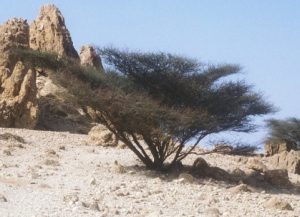
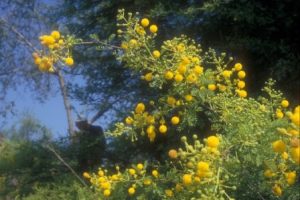
Source: Each According to its Kind: Plants and Trees in the Bible (UBS Helps for Translators)
And you shall make for the screen uses the singular you. Five pillars of acacia uses the same word for pillars as verse 32. Here again they may be referred to as “posts” (Good News Translation), “poles” (New Jerusalem Bible), or “columns” (New American Bible). And overlay them with gold uses the singular “you.” (For overlay see the comment at 25.11.)
Their hooks shall be of gold refers to the same kind of hooks as in verse 32, which here are to be attached to five pillars instead of four. The five bases for these pillars were to be different from those in verse 32. They were to be bases of bronze rather than of silver. (See the comment at 25.12.) They were also to be cast, meaning that the bronze was to be melted and poured into a mold. (See the comment at verse 11.) Since the screen was to be farther away from the ark and the Holy of Holies, a less expensive metal was to be used. (See the introductory comments to chapter 27.)
Quoted with permission from Osborn, Noel D. and Hatton, Howard A. A Handbook on Exodus. (UBS Helps for Translators). New York: UBS, 1999. For this and other handbooks for translators see here .
No comments yet.
Leave a Reply
You must be logged in to post a comment.