Some translations specifically reproduce the voice of the Hebrew text of the Old Testament / Hebrew Bible.
English:
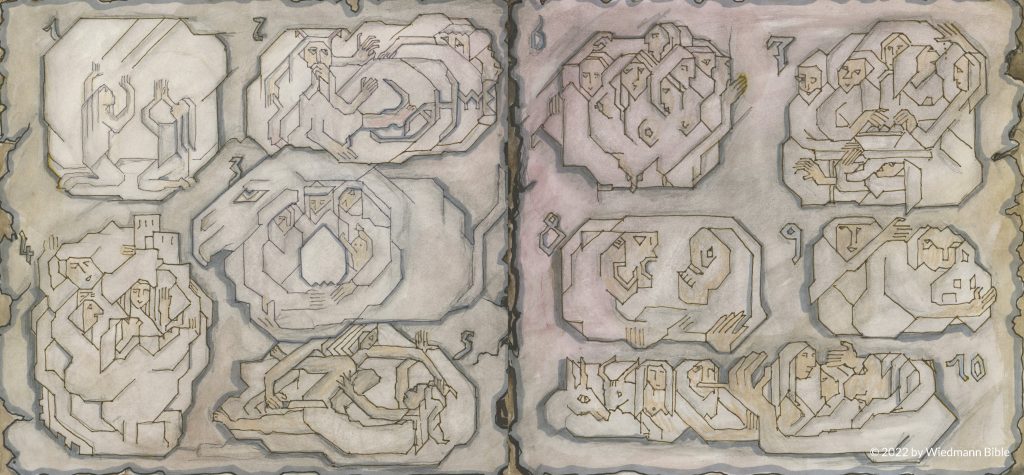
I am Yhwh your God,
who brought you out
from the land of Egypt,
from a house of serfs.
You are not to have
any other gods
before my presence.
You are not to make yourself a carved-image
or any figure
that is in the heavens above, that is on the earth beneath, that is in the waters beneath the earth;
you are not to bow down to them,
you are not to serve them,
for I, Yhwh your God,
am a zealous God,
calling-to-account the iniquity of the fathers upon the sons, to the third and the fourth (generation)
of those that hate me,
but showing loyalty to the thousandth
of those that love me,
of those that keep my commandments.
You are not to take up
the name of Yhwh your God for emptiness,
for Yhwh will not clear him
that takes up his name for emptiness.
Remember
the Sabbath day, to hallow it.
For six days, you are to serve, and are to make all your work,
but the seventh day
is Sabbath for Yhwh your God:
you are not to make any kind of work,
(not) you, nor your son, nor your daughter,
(not) your servant, nor your maid, nor your beast,
nor your sojourner that is within your gates.
For in six days Yhwh made
the heavens and the earth,
the sea and all that is in it,
and he rested on the seventh day;
therefore Yhwh gave the Sabbath day his blessing, and he hallowed it.
Honor
your father and your mother,
in order that your days may be prolonged
on the soil that Yhwh your God is giving you.
You are not to murder.
You are not to adulter.
You are not to steal.
You are not to testify
against your fellow as a false witness.
You are not to desire
the house of your neighbor,
you are not to desire the wife of your neighbor,
or his servant, or his maid, or his ox, or his donkey,
or anything that is your neighbor’s.
Source: Everett Fox 1995
German:
Ich
bin dein Gott,
der ich dich führte aus dem Land Ägypten, aus dem Haus der Dienstbarkeit.
Nicht sei dir
andere Gottheit
mir ins Angesicht.
Nicht mache dir Schnitzgebild, —
und alle Gestalt,
die im Himmel oben, die auf Erden unten, die im Wasser unter der Erde ist,
neige dich ihnen nicht,
diene ihnen nicht,
denn Ich dein Gott
bin ein eifernder Gottherr,
zuordnend Fehl von Vätern ihnen an Söhnen, am dritten und vierten Glied,
denen die mich hassen,
aber Huld tuend ins tausendste
denen die mich lieben,
denen die meine Gebote wahren.
Trage nicht
Seinen deines Gottes Namen
auf das Wahnhafte,
denn nicht straffrei läßt Er ihn,
der seinen Namen auf das Wahnhafte trägt.
Gedenke
des Tags der Feier, ihn zu heiligen.
Ein Tagsechst diene und mache all deine Arbeit,
aber der siebente Tag
ist Feier Ihm, deinem Gott:
nicht mache allerart Arbeit,
du, dein Sohn, deine Tochter,
dein Dienstknecht, deine Magd, dein Tier,
und dein Gastsasse in deinen Toren.
Denn ein Tagsechst
machte Er
den Himmel und die Erde, das Meer und alles, was in ihnen ist,
am siebenten Tag aber ruhte er,
darum segnete Er den Tag der Feier, er hat ihn geheiligt.
Ehre
deinen Vater und deine Mutter,
damit sich längern deine Tage
auf dem Ackerboden, den Er dein Gott dir gibt.
Morde nicht.
Buhle nicht.
Stiehl nicht.
Aussage nicht
gegen deinen Genossen als Lügenzeuge.
Begehre nicht das Haus deines Genossen,
begehre nicht das Weib deines Genossen,
seinen Knecht, seine Magd, seinen Ochsen, seinen Esel,
noch allirgend was deines Genossen ist.
Source: Buber / Rosenzweig 1976
French:
« Moi-même, IHVH-Adonaï, ton Elohîms qui t’ai fait sortir
de la terre de Misraîm, de la maison des serfs,
il ne sera pas pour toi d’autres Elohîms contre mes faces.
Tu ne feras pour toi ni sculpture ni toute image
de ce qui est dans les ciels en haut, sur la terre en bas,
et dans les eaux sous terre.
Tu ne te prosterneras pas devant elles et ne les serviras pas.
Oui, moi-même, IHVH-Adonaï, ton Elohîms, Él ardent
je sanctionne le tort des pères sur les fils,
jusqu’au troisième et au quatrième cycle pour mes haineux,
Mais je fais chérissement jusqu’au millième à mes amants,
aux gardiens de mes ordres.
Tu ne porteras pas le nom de IHVH-Adonaï, ton Elohîms, en vain:
car, IHVH-Adonaï n’innocente pas qui porte son nom en vain.
Souviens-toi du jour du shabat pour le consacrer.
Tu travailleras six jours: fais tout ton ouvrage.
Le septième jour, shabat pour IHVH-Adonaï, ton Elohîms,
tu ne feras aucun ouvrage, toi, ton fils, ta fille,
ton serviteur, ta servante, ta bête,
ton métèque qui est en tes portes.
Oui, six jours, IHVH-Adonaï a fait les ciels et la terre,
la mer et tout ce qui y est,
puis il s’est reposé le septième jour,
sur quoi IHVH-Adonaï a béni le jour du shabat et il le consacre.
Glorifie ton père et ta mère, pour que se prolongent
tes jours sur la glèbe que IHVH-Adonaï, ton Elohîms, te donne.
Tu n’assassineras pas.
Tu n’adultéreras pas.
Tu ne voleras pas.
Tu ne répondras pas contre ton compagnon en témoin de mensonge.
Tu ne convoiteras pas la maison de ton compagnon,
tu ne convoiteras pas la femme de ton compagnon,
son serviteur, sa servante, son boeuf, son âne,
et tout ce qui est à ton compagnon. »
Et c’est au soir, la caille monte, elle couvre le camp,
et le matin, c’était une couche de rosée autour du camp.
La couche de rosée monte, et voici: sur les faces du désert,
une croûte fine, fine comme givre sur la terre.
Les Benéi Israël voient et disent, chaque homme à son frère:
« Mân hou ? Qu’est-ce ? » Non, ils ne savaient pas ce que c’était.
Moshè leur dit:
« C’est le pain que IHVH-Adonaï vous donne en nourriture. »
Source: Chouraqui 1985
For other verses or sections translated with a Hebraic voice, see here.

Leave a Reply
You must be logged in to post a comment.