1“At that time Michael, the great prince, the protector of your people, shall arise. There shall be a time of anguish such as has never occurred since nations first came into existence. But at that time your people shall be delivered, everyone who is found written in the book.
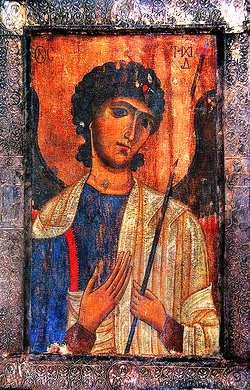
Orthodox Icons are not drawings or creations of imagination. They are in fact writings of things not of this world. Icons can represent our Lord Jesus Christ, the Virgin Mary, and the Saints. They can also represent the Holy Trinity, Angels, the Heavenly hosts, and even events. Orthodox icons, unlike Western pictures, change the perspective and form of the image so that it is not naturalistic. This is done so that we can look beyond appearances of the world, and instead look to the spiritual truth of the holy person or event. (Source )
Following are a number of back-translations as well as a sample translation for translators of Daniel 12:1:
Kupsabiny: “Then, the big angel who was called Michael, who protects your people will appear. Then there will be a lot of suffering, that had never before come since any country came into existence. But every person of yours whose name is written in the book of life will be rescued.” (Source: Kupsabiny Back Translation)
Newari: “‘Again, the angel who had put on clothes of cotton said to me, "At that time the great angel, Michael, who protects your people will arise. A time of suffering will come which has never [yet] come since the time when nations started coming into being. At that time all your people whose names have been written in God’s book will be saved.” (Source: Newari Back Translation)
Hiligaynon: “The one-like a man still said, ‘At that time, Micael will-arrive, the powerful leader/[lit. head] who is the defender of your (sing.) fellowmen. At that time the situation will-become very difficult, and that difficulties had never happened from the beginning of the nations. But your (sing.) fellow Israelinhon whose names were-written in the book where those who have eternal life were-listed will-be-saved/rescued from those hard times.” (Source: Hiligaynon Back Translation)
English: “The angel also said to me, ‘After those things happen, the great angel Michael, who protects the Israeli people, will appear. Then there will be a time when there will be great troubles/suffering. The troubles will be greater than any troubles/suffering since the nations began. At that time, all of your people whose names have been written in the book containing the names of those who have eternal life will be saved.” (Source: Translation for Translators)
At the beginning of this chapter and new section, it may be important to identify the speaker again, as has been done in Good News Translation: “The angel wearing linen clothes said.” This is not in the original text, but it is information from the wider context, and this information may need to be supplied again here for readers, in view of the extremely long monologue of the angel (10.20–11.45). It may also serve to mark the transition from the historical part of the angel’s discourse to his final words.
Michael: see 10.13, 21. The Hebrew for shall arise carries the idea of assuming a position, or taking a stand, and it is repeated here in the Hebrew for who has charge, showing that he has taken a position of responsibility for the people of Israel.
Great prince: Revised English Bible has “great captain.” However, in order to avoid giving the impression that Michael was an earthly prince or captain, it may be desirable in some cases to state clearly that he was a “great angel” (Good News Translation) or “mighty angel.” Several terms describing Michael as prince here are used also in 10.21, where he is also shown to be guardian angel of the people of Israel.
Who has charge of your people: literally “the one standing over the sons of your people.” On expressions beginning with “sons of…,” see comments on 1.6.
There shall be a time of trouble: this affirmation seems to reflect the text of Jer 30.7 (see also Joel 1.15-18 and Zeph 1.14-18). In the thought of the people of Israel, the time of the end is closely related to the theme of judgment and the resulting punishment of those who have not been faithful to God.
Since there was a nation: this may be understood to refer to the beginning of nationhood in general (New Revised Standard Version has “since nations first came into existence”). However, it is also possible that it refers to the beginning of the nation of Israel. But since the people of Israel almost certainly thought of themselves as being the first nation to come into existence, the two may be thought of as being identical. New Jerusalem Bible translates “since the nation came into being,” making it refer clearly to the existence of the nation of Israel in particular. This understanding seems also to be behind the rendering of Revised English Bible (“since they became a nation”). Probably this is the best kind of model to follow in other languages at this point. Another possible model is “ever since our nation began” or “since our people became a nation.”
At that time: the repetition of these words (found also at the beginning of this verse) may be repeated if it is natural to do so in the receptor language. But such repetition will have to be avoided in some languages, possibly by using a transition word like “Then” (Bible en français courant as well as Good News Translation). Others may wish to render it “But when that time comes.”
Your people shall be delivered: this passive formulation may be rendered actively as “God will deliver your people,” making the subject clear. But the following phrase, every one whose name shall be found written in the book, places an important limitation on the number of those who will be delivered. The book referred to may have to be more clearly identified, using an expression like “the book of God” (Die Bibel im heutigen Deutsch and Good News Translation) or “the book of life” (Bible en français courant), as in Exo 32.32-33; Psa 69.28; Rev 3.5.
Quoted with permission from Péter-Contesse, René & Ellington, John. A Handbook on Daniel. (UBS Helps for Translators). New York: UBS, 1994. For this and other handbooks for translators see here .


Leave a Reply
You must be logged in to post a comment.