The Greek, Hebrew, Aramaic and Latin that is translated as “justice” in English is translated in American Sign Language with a sign that describes the quality or principle of fairness, righteousness, and impartiality in treating other people. A literal back-translation of the signs are “FOLLOW(God is implied) ACTIONS, DECISIONS JUST-RIGHT”. A more idiomatic back-translation would be: “actions and decisions are right/fitting/just in accordance to God’s will.” The movement in the signs itself helps to indicate that this is a noun, not a verb. (Source: Ruth Anna Spooner, Ron Lawer)
“Justice” in American Sign Language, source: Deaf Harbor
The Hebrew that is translated as “turn (justice) to wormwood” in English is translated in Dan with a common metaphor for being in trouble: “the sky is falling on you.” (Source: Don Slager)
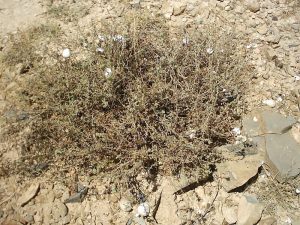
The Hebrew word la‘anah refers literally to a plant, but it is only used figuratively in the Old Testament, as something representing intense bitterness. Despite very little evidence, commentators and botanists have agreed that this word may refer to a substance derived from the white wormwood bush, which is found abundantly in the the deserts of the Holy Land.
White Wormwood Artemisia herba-alba is a bush less than half a meter (18 inches) high, with finely divided fuzzy leaves. These leaves drop at the end of the cool rainy season of Israel and are replaced with something like scales in the hot season. The flowers appear in clusters of two to four around September/October and mature into small, hairy fruits. When the plant matures, the leaves and flowers are dried to make a very bitter tea, or ground into powder, paste, or oil that is used in medicine.
Most of the references to wormwood in the Old Testament are paired with the Hebrew word for “poison/gall” (ro’sh) and are used metaphorically to represent painful experience and sorrow. In Revelation 8:11 a star named Wormwood (apsinthos in Greek) makes a third of the water on earth bitter and poisonous. The leaves of wormwood have a very bitter taste. In small quantities it was used as an anesthetic, and Europeans use it in concocting alcoholic drinks (absinthe, vermouth). It is also used to repel moths and fleas, and as an intestinal worm expeller.
The white wormwood of the Holy Land is found throughout the Middle East, North Africa (Egypt, Morocco) and Southwest Europe, but there are at least 300 species of Artemisia throughout the world, usually in dry areas. A Chinese type (huang huahaosu) is used as medicine against malaria. Artemisia cina and Artemisia maritima are found in Eurasia, where they produce santonica, an anti-worm medicine. Artemisia tilesii is used by the Inuits like codeine. The sagebrush plants of the American West also belong to this genus and were used by Native Americans for various conditions.
Most languages have words for plants that have bitter leaves and/or roots. Since all of the references to wormwood in the Old Testament are metaphorical, these plants can be used to convey the essential component of the passages. As noted above, most of the references to la‘anah are coupled with ro’sh, so the two must be dealt with together in those passages. If particular plants are not available, phrases such as “bitter fruit,” “bitter spice,” or “bitter thing” can be used.
The Greek, Hebrew, and Latin terms that are translated in English mostly as “righteous” as an adjective or personified noun or “righteousness” (also as “upright(ness)” and “just(ice)”) are most commonly expressed with concept of “straightness,” though this may be expressed in a number of ways. (Click or tap here to see the details)
Following is a list of (back-) translations of various languages:
Paasaal: “white heart” (source: Fabian N. Dapila in The Bible Translator 2024, p. 415ff.)
(San Mateo del Mar Huave: “completely good” (the translation does not imply sinless perfection)
Nuer: “way of right” (“there is a complex concept of “right” vs. ‘left’ in Nuer where ‘right’ indicates that which is masculine, strong, good, and moral, and ‘left’ denotes what is feminine, weak, and sinful (a strictly masculine viewpoint!) The ‘way of right’ is therefore righteousness, but of course women may also attain this way, for the opposition is more classificatory than descriptive.”) (This and all above from Bratcher / Nida except for Bilua: Carl Gross; Tiv: Rob Koops; Muna: René van den Berg)
Yatzachi Zapotec: “walk straight” (source for this and four previous: John Beekman in Notes on Translation November 1964, p. 1-22)
Makonde: “doing what God wants” (in a context of us doing) and “be good in God’s eyes” (in the context of being made righteous by God) (note that justify / justification is translated as “to be made good in the eyes of God.” (source: Pioneer Bible Translators, project-specific notes in Paratext)
Aari: The Pauline word for “righteous” is generally rendered by “makes one without sin” in the Aari, sometimes “before God” is added for clarity. (Source: Loren Bliese)
Ekari: maakodo bokouto or “enormous truth” (the same word that is also used for “truth“; bokouto — “enormous” — is being used as an attribute for abstract nouns to denote that they are of God [see also here]; source: Marion Doble in The Bible Translator 1963, p. 37ff. ).
Guhu-Samane: pobi or “right” (also: “right (side),” “(legal) right,” “straightness,” “correction,” “south,” “possession,” “pertinence,” “kingdom,” “fame,” “information,” or “speech” — “According to [Guhu-Samane] thinking there is a common core of meaning among all these glosses. Even from an English point of view the first five can be seen to be closely related, simply because of their similarity in English. However, from that point the nuances of meaning are not so apparent. They relate in some such a fashion as this: As one faces the morning sun, south lies to the right hand (as north lies to the left); then at one’s right hand are his possessions and whatever pertains to him; thus, a rich man’s many possessions and scope of power and influence is his kingdom; so, the rich and other important people encounter fame; and all of this spreads as information and forms most of the framework of the people’s speech.”) (Source: Ernest Richert in Notes on Translation 1964, p. 11ff.)
German New Testament translation by Berger / Nord (publ. 1999): Gerechtheit, a neologism to differentiate it from the commonly-used Gerechtigkeit which can mean “righteousness” but is more often used in modern German as “fairness” (Berger / Nord especially use Gerechtheit in Letter to the Romans) or Gerechtestun, also a neologism, meaning “righteous deeds” (especially in Letter to the Ephesians)
Following are a number of back-translations as well as a sample translation for translators of Amos 5:7:
Kupsabiny: “Oh, people of Israel! You are the ones who go astray from the truth and throw away the matters of righteousness.” (Source: Kupsabiny Back Translation)
Newari: “You pervert justice and turn it into bitterness, and throw righteousness to the dust.” (Source: Newari Back Translation)
Hiligaynon: “You (plur.) are-to-be-pitied! Justice which (is) good you (plur.) turn-into-bad and you (plur.) consider-as-nothing/give-no-value-to what-is-just.’” (Source: Hiligaynon Back Translation)
English: “You people distort what is fair/right and cause people to think that it is something that is very bitter; you treat good things as though they are evil.” (Source: Translation for Translators)
O you/You are doomed. The meaning of the Hebrew seems to be that of an exclamation, like “Woe to those who” (New American Bible). Though such an expression sounds old-fashioned in English (and so has been avoided in Good News Translation), it would be perfectly natural in many languages.
Who turn justice to wormwood/that twist justice. Wormwood is a plant which may grow to the size of a bush, and the juice of its leaves has a bitter taste. So “bitter” is the basis for the comparison: “you have changed justice into a very bitter herb” or “you who make justice a bitter thing” (Moffatt), “you who turn justice to gall” (Smith-Goodspeed). In many languages the comparison cannot be made at all; some possibilities: you that twist justice or “you that distort what is right.”
And cast down righteousness to the earth/and cheat people out of their rights. The Hebrew words for “justice” and righteousness are very similar in meaning, and commentaries usually try hard to define a difference, but in most cases it would not be possible to make a distinction in other languages. Sometimes the translator can use terms with the same general meaning, such as “you that treat as evil what is good, and despise what is right.” Other times the only solution is to combine the two expressions: “you that distort what is right and trample on it with your feet.” Though Good News Translation translation is possible for English, it can hardly be used as a translational model because of the English idiom it uses.
Quoted with permission from de Waard, Jan & Smalley, William A. A Handbook on Amos. (UBS Helps for Translators). New York: UBS, 1979. For this and other handbooks for translators see here .


Leave a Reply
You must be logged in to post a comment.