The Greek, Hebrew, Aramaic and Latin that is translated as “justice” in English is translated in American Sign Language with a sign that describes the quality or principle of fairness, righteousness, and impartiality in treating other people. A literal back-translation of the signs are “FOLLOW(God is implied) ACTIONS, DECISIONS JUST-RIGHT”. A more idiomatic back-translation would be: “actions and decisions are right/fitting/just in accordance to God’s will.” The movement in the signs itself helps to indicate that this is a noun, not a verb. (Source: Ruth Anna Spooner, Ron Lawer)
“Justice” in American Sign Language, source: Deaf Harbor
Following are a number of back-translations of Acts 8:33:
Uma: “He is disparaged and punished, yet he had no guilt. There is no-one who tell-the-account that he has descendants, because he was killed.'” (Source: Uma Back Translation)
Yakan: “He was put down/criticized and he was not judged with righteous/straight judgment. Who will be able to tell about his descendants? No one. For his life in this world has ended.'” (Source: Yakan Back Translation)
Western Bukidnon Manobo: “They shamed him and their punishing him was not righteous. He has no descendants which can be related (in a geneology) because very short is his life here on earth.'” (Source: Western Bukidnon Manobo Back Translation)
Kankanaey: “They shamed him and they didn’t try him fairly/properly. Neither will anyone relate concerning his descendants, because they cut-short (lit. did-intentionally) his life on this earth.'” (Source: Kankanaey Back Translation)
Tagbanwa: “He was caused to experience great shame and sentenced with an unfair-sentence. No-one can tell how big was the evil of his contempories for they severed his life/breath.'” (Source: Tagbanwa Back Translation)
Lalana Chinantec; “‘They mistreated him shamefully. The people who judged did not do well. They are not supposed to do as they did. How is it possible that we will say that he has people followers? They killed him. He no longer lives in this earth.’ That is what the word of Isaiah is like which the Ethiopia person was looking at.” (Source: Viola Waterhouse in Notes on Translation August 1966, p. 86ff.)
Huixtán Tzotzil: “… They mistakenly think that he does not have any children because when he was killed here in the world, once and for all he was eradicated they mistakenly think.” (Huixtán Tzotzil frequently uses the verb -cuy to express “to mistakenly think something” from the point of view of the speaker — source: Marion M. Cowan in Notes on Translation 20/1966, pp. 6ff.)
For the Old Testament quotes, see Isaiah 57:8 (from the Greek Septuagint).
God transcends gender, but most languages are limited to grammatical gender expressed in pronouns. In the case of English, this is traditionally confined to “he” (or in the forms “his,” “him,” and “himself”), “she” (and “her,” “hers,” and “herself”), and “it” (and “its” and “itself”).
Modern Mandarin Chinese, however, offers another possibility. Here, the third-person singular pronoun is always pronounced the same (tā), but it is written differently according to its gender (他 is “he,” 她 is “she,” and 它/牠 is “it” and their respective derivative forms). In each of these characters, the first (or upper) part defines the gender (man, woman, or thing/animal), while the second element gives the clue to its pronunciation.
In 1930, after a full century with dozens of Chinese translations, Bible translator Wang Yuande (王元德) coined a new “godly” pronoun: 祂. Chinese readers immediately knew how to pronounce it: tā. But they also recognized that the first part of that character, signifying something spiritual, clarified that each person of the Trinity has no gender aside from being God.
While the most important Protestant and Catholic Chinese versions respectively have opted not to use 祂, some Bible translations do and it is widely used in hymnals and other Christian materials. Among the translations that use 祂 to refer to “God” were early versions of Lü Zhenzhong’s (呂振中) version (New Testament: 1946, complete Bible: 1970). R.P. Kramers (in The Bible Translator 1956, p. 152ff. ) explains why later versions of Lü’s translation did not continue with this practice: “This new way of writing ‘He,’ however, has created a minor problem of its own: must this polite form be used whenever Jesus is referred to? Lü follows the rule that, wherever Jesus is referred to as a human being, the normal tā (他) is written; where he is referred to as divine, especially after the ascension, the reverential tā (祂) is used.”
In that system one kind of pronoun is used for humans (male and female alike) and one for natural elements, non-liquid masses, and some spiritual entities (one other is used for large animals and another one for miscellaneous items). While in these languages the pronoun for spiritual entities used to be employed when referring to God, this has changed into the use of the human pronoun.
Lynell Zogbo (in The Bible Translator 1989, p. 401ff. ) explains in the following way: “From informal discussions with young Christians especially, it would appear that, at least for some people, the experience and/or concepts of Christianity are affecting the choice of pronoun for God. Some people explain that God is no longer ‘far away,’ but is somehow tangible and personal. For these speakers God has shifted over into the human category.”
In Kouya, God (the Father) and Jesus are referred to with the human pronoun ɔ, whereas the Holy Spirit is referred to with a non-human pronoun. (Northern Grebo and Western Krahn make a similar distinction.)
Eddie Arthur, a former Kouya Bible translation consultant, says the following: “We tried to insist that this shouldn’t happen, but the Kouya team members were insistent that the human pronoun for the Spirit would not work.”
In Burmese, the pronoun ko taw (ကိုယ်တော်) is used either as 2nd person (you) or 3rd person (he, him, his) reference. “This term clearly has its root in the religious language in Burmese. No ordinary persons are addressed or known by this pronoun because it is reserved for Buddhist monks, famous religious teachers, and in the case of Christianity, the Trinity.” (Source: Gam Seng Shae in The Bible Translator 2002, p. 202ff. )
In Thai, the pronoun phra`ong (พระองค์) is used, a gender-neutral pronoun which must refer to a previously introduced royal or divine being. Similarly, in Northern Khmer, which is spoken in Thailand, “an honorific divine pronoun” is used for the pronoun referring to the persons of the Trinity (source: David Thomas in The Bible Translator 1993, p. 445 ). In Urak Lawoi’, another language spoken in Thailand, the translation often uses tuhat (ตูฮัด) — “God” — ”as a divine pronoun where Thai has phra’ong even though it’s actually a noun.” (Source for Thai and Urak Lawoi’: Stephen Pattemore)
The English “Contemporary Torah” addresses the question of God and gendered pronouns by mostly avoiding pronouns in the first five books of the Hebrew Bible/Old Testament (unless God is referred to as “lord,” “father,” “king,” or “warrior”). It does that by either using passive constructs (“He gave us” vs. “we were given”), by using the adjective “divine” or by using “God” rather than a pronoun.
Some Protestant and Orthodox English Bibles use a referential capitalized spelling when referring to the persons of the Trinity with “He,” “His,” “Him,” or “Himself.” This includes for instance the New American Standard Bible or The Orthodox New Testament, but most translations do not. Two other languages where this is also done (in most Bible translations) are the closely related Indonesian and Malay. In both languages this follows the language usage according to the Qur’an, which in turn predicts that usage (see Soesilo in The Bible Translator 1991, p. 442ff. and The Bible Translator 1997, p. 433ff. ).
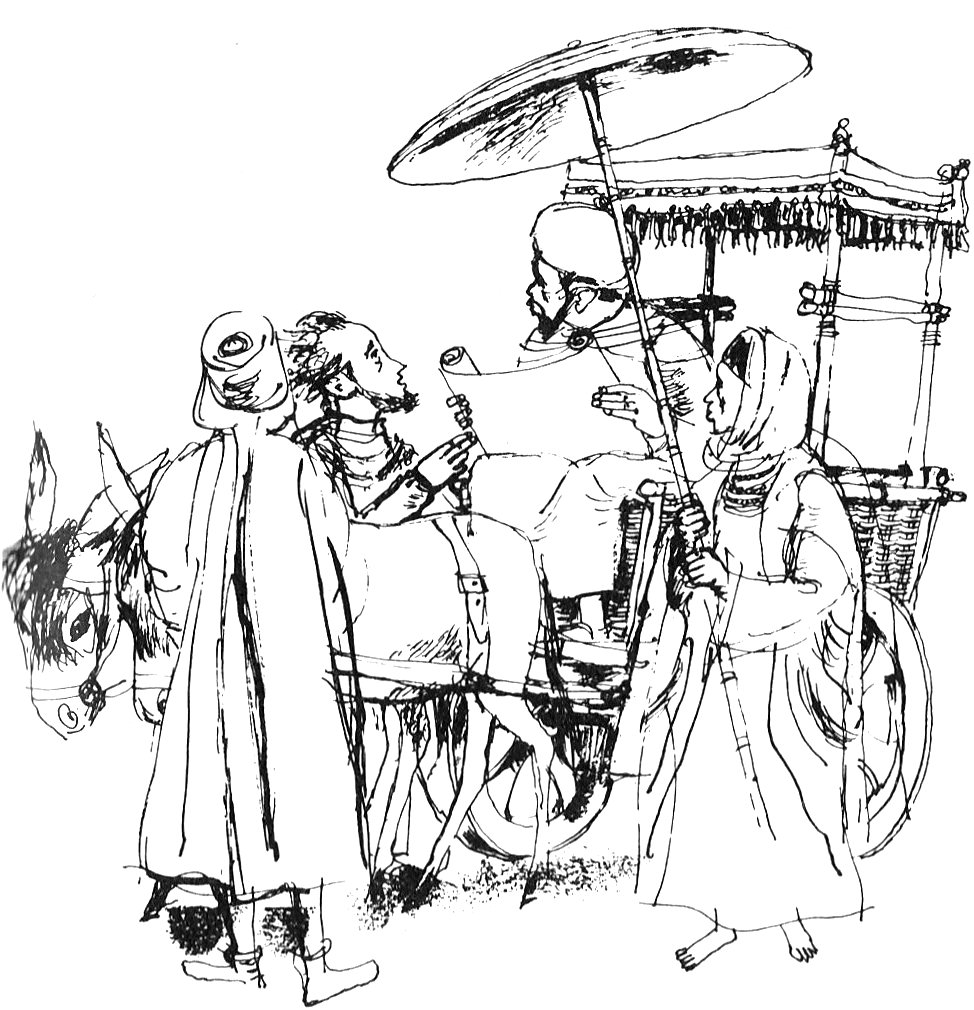
Illustration by Horst Lemke (1922-1985) for the GermanGute Nachricht für Sie – NT68, one of the first editions of the Good News Bible in German of 1968. Lemke was a well-known illustrator who illustrated books by Erich Kästner , Astrid Lindgren and many others.
He was humiliated, and justice was denied him is literally “in his humiliation his judgment was taken away.” The first part of this expression is easily taken to mean he was humiliated, but the second half causes difficulty. Most translations tend either in the direction of the Good News Translation or the direction of Jerusalem Bible, “he has been humiliated and has no one to defend him” (see also New English Bible “he has been humiliated and has no redress”). The second line of verse 33 (in Greek a rhetorical question) is rendered by the Good News Translationno one will be able to tell about his descendants, since he was put to death without leaving any posterity. This view is followed by New English Bible, Jerusalem Bible, and An American Translation*, among others. There is also the possibility that the word translated descendants may mean “contemporary generation.” If this is the case, the question can mean “who can relate the evil of his contemporaries?” Phillips has “His generation who shall declare?” Like the King James Version rendering, “who shall declare his generation?” this makes little sense. Because his life on earth has come to an end (literally “his life was lifted from the earth”) is best understood as referring, in this context, to Christ’s death, though some commentators understand this verse to refer to his exaltation from the earth to heaven.
Quoted with permission from Newman, Barclay M. and Nida, Eugene A. A Handbook on The Acts of the Apostles. (UBS Handbook Series). New York: UBS, 1972. For this and other handbooks for translators see here .
Living Water is produced for the Bible translation movement in association with Lutheran Bible Translators. Lyrics derived from the ESV® Bible (The Holy Bible, English Standard Version®).

Leave a Reply
You must be logged in to post a comment.