
Click here to see the image in higher resolution.
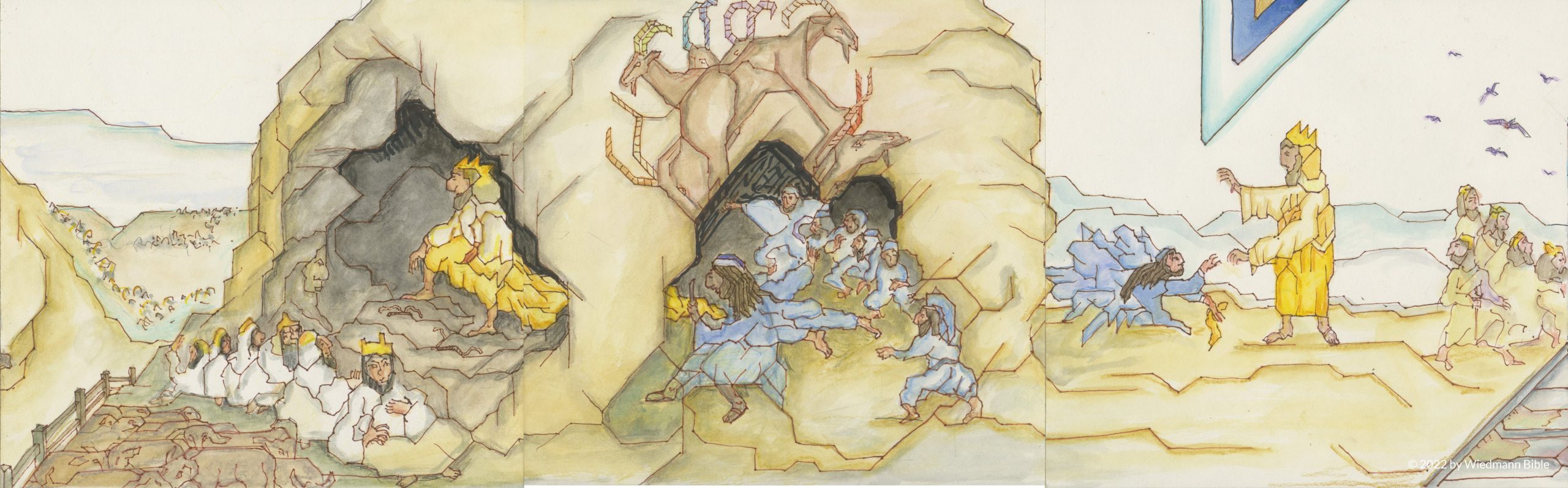
Image taken from the Wiedmann Bible. For more information about the images and ways to adopt them, see here .
For other images of Willy Wiedmann paintings in TIPs, see here.

יִשְׁפֹּ֤ט יְהוָה֙ בֵּינִ֣י וּבֵינֶ֔ךָ וּנְקָמַ֥נִי יְהוָ֖ה מִמֶּ֑ךָּ וְיָדִ֖י לֹ֥א תִֽהְיֶה־בָּֽךְ׃
12May the Lord judge between me and you! May the Lord avenge me on you, but my hand shall not be against you.
The Hebrew and Greek that is typically translated as “sin” in English has a wide variety of translations.
The Greek ἁμαρτάνω (hamartanō) carries the original verbatim meaning of “miss the mark” and likewise, many translations contain the “connotation of moral responsibility.”
In Shipibo-Conibo the term is hocha. Nida (1952, p. 149) tells the story of its choosing: “In some instances a native expression for sin includes many connotations, and its full meaning must be completely understood before one ever attempts to use it. This was true, for example, of the term hocha first proposed by Shipibo-Conibo natives as an equivalent for ‘sin.’ The term seemed quite all right until one day the translator heard a girl say after having broken a little pottery jar that she was guilty of ‘hocha.’ Breaking such a little jar scarcely seemed to be sin. However, the Shipibos insisted that hocha was really sin, and they explained more fully the meaning of the word. It could be used of breaking a jar, but only if the jar belonged to someone else. Hocha was nothing more nor less than destroying the possessions of another, but the meaning did not stop with purely material possessions. In their belief God owns the world and all that is in it. Anyone who destroys the work and plan of God is guilty of hocha. Hence the murderer is of all men most guilty of hocha, for he has destroyed God’s most important possession in the world, namely, man. Any destructive and malevolent spirit is hocha, for it is antagonistic and harmful to God’s creation. Rather than being a feeble word for some accidental event, this word for sin turned out to be exceedingly rich in meaning and laid a foundation for the full presentation of the redemptive act of God.”
In Warao it is translated as “bad obojona.” Obojona is a term that “includes the concepts of consciousness, will, attitude, attention and a few other miscellaneous notions.” (Source: Henry Osborn in The Bible Translator 1969, p. 74ff. ). See other occurrences of Obojona in the Warao New Testament.
Martin Ehrensvärd, one of the translators for the Danish Bibelen 2020, comments on the translation of this term: “We would explain terms, such that e.g. sin often became ‘doing what God does not want’ or ‘breaking God’s law’, ‘letting God down’, ‘disrespecting God’, ‘doing evil’, ‘acting stupidly’, ‘becoming guilty’. Now why couldn’t we just use the word sin? Well, sin in contemporary Danish, outside of the church, is mostly used about things such as delicious but unhealthy foods. Exquisite cakes and chocolates are what a sin is today.” (Source: Ehrensvärd in HIPHIL Novum 8/2023, p. 81ff. )
See also sinner.
Following are a number of back-translations as well as a sample translation for translators of 1 Samuel 24:12:
Like a number of other East Asian languages, Japanese uses a complex system of honorifics, i.e. a system where a number of different levels of politeness are expressed in language via words, word forms or grammatical constructs. These can range from addressing someone or referring to someone with contempt (very informal) to expressing the highest level of reference (as used in addressing or referring to God) or any number of levels in-between.
One way Japanese shows different degree of politeness is through the usage of an honorific construction where the morpheme rare (られ) is affixed on the verb as shown here in the widely-used Japanese Shinkaiyaku (新改訳) Bible of 2017. This is particularly done with verbs that have God as the agent to show a deep sense of reverence. Here, mukui-rare-ru (報いられる) or “repay” is used.
(Source: S. E. Doi, see also S. E. Doi in Journal of Translation, 18/2022, p. 37ff. )
May the LORD judge between me and you: in some languages it will be necessary to say something like “May the LORD settle the question of whether you are right or I am right” or “I’ll let the LORD decide which one of us has done right” (Contemporary English Version).
May the LORD avenge me upon you: a literal translation may be difficult to understand. Good News Translation expresses the meaning clearly. David has already determined in his own mind what the LORD would decide about who is right and who is wrong. So his second wish is that the one who is in the wrong (Saul) should be punished. A possible model translation is “and may he [the LORD] make you pay for the wrong that you have done to me” (La Bible du Semeur). Others may say something like “The LORD will be the one who makes you pay for the wrong you did; I will not be the one.”
But: this translation of the common Hebrew conjunction takes it as marking contrast between what Yahweh would do and what David would not do. Most modern versions understand it in this way, so the Good News Translation model is not recommended at this point.
My hand shall not be against you: that is, “but I won’t do anything to you” (Contemporary English Version). See the same expression in 18.17. And compare also the following verse.
Quoted with permission from Omanson, Roger L. and Ellington, John E. A Handbook on the First and Second Books of Samuel, Volume 1. (UBS Helps for Translators). New York: UBS, 2001. For this and other handbooks for translators see here .
No comments yet.
Leave a Reply
You must be logged in to post a comment.