Following are a number of back-translations as well as a sample translation for translators of 1 Kings 6:36:
Kupsabiny: “A wall was also constructed to surround the inner courtyard of the House of God. Stones were piled upon each other three times then the top was fastened with cedar planks.” (Source: Kupsabiny Back Translation)
Newari: “Then he, having arranged the inner courtyard, and having laid three layers of cut stone, he added one layer of cedar beams.” (Source: Newari Back Translation)
Hiligaynon: “He also had-made the inside courtyard of the temple. This was-surrounded with a stone-wall that for every three layers of these trimmed stones were-overlapped with cedar wood.” (Source: Hiligaynon Back Translation)
English: “They built a courtyard in front of the temple. The walls around the courtyard were made of cedar and stone; to make the walls, between each layer of cedar beams they put down two layers of stone.” (Source: Translation for Translators)
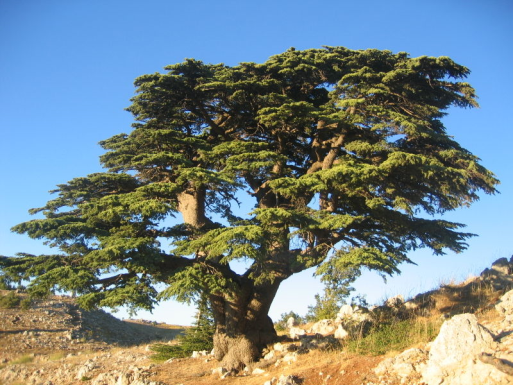
Long ago the majestic cedars of Lebanon (Cedrus libani) completely covered the upper slopes of the Lebanon Mountains on the western and northern sides. Now only a few pockets of these mighty cedars remain. At that time they were mixed, as they are today, with other trees such as Cilician fir, Grecian juniper, cypress, and Calabrian pine.
We know from 1 Kings that Solomon used cedar wood in his palace and in the Temple. Cedar was used for beams, boards, pillars, and ceilings. Historians tell us that the Assyrians also hauled cedars to their land for use in buildings. Nebuchadnezzar of Babylon also imported cedars from Lebanon. In some versions of Isaiah we read that people made idols of cedar and oak (44:14-20). Finally, when the Temple was rebuilt by the returning exiles (Ezra 3:7), they again cut down cedar trees to grace the house of God.
In 2 Samuel, 1-2 Kings, 1-2 Chronicles and Ezra, when Lebanon is specifically mentioned, there can be no doubt that ’erez is Cedrus libani, the “cedar of Lebanon,” although it is possible that sometimes the word was used loosely to include various evergreen trees.
In the description of the purification rituals (Leviticus 14:4 at al.), the word ’erez probably refers to the Phoenician juniper tree, since that was the only cedar-like tree in the Sinai Desert.
Description Cedar trees can reach 30 meters (100 feet) high with a trunk more than 2 meters (7 feet) in diameter. The leaves of true cedars are not flat like those of most trees, but consist of tufts of dark green, shiny spines. (The cedars in North America have a flatter type of spine than the biblical cedar.) The wood is fragrant and resistant to insects. Cedars bear cones and can live to be two or three thousand years old.
The cedar of Lebanon is famous for its large size (see Isaiah 2:13 et al.), and for the fragrance of its wood. Psalm 92:12 links the cedar to righteousness, that is, presumably, to its straightness and height above other trees. The cedar is the national emblem of Lebanon.
Cedrus species are found in the mountains of North Africa, in the Himalayas, in India, and in North America. Translators in these places, should, of course, use the local name in nonfigurative references. In sub Saharan Africa, translators can transliterate from Hebrew (’erez), Greek (kedar), English (sedar), or another major language, or they can take a generic solution such as “large, beautiful tree.” In poetic passages (wisdom literature and prophecy), some translators may wish to use a cultural equivalent with these traits. In Africa, according to Burkhill (The Useful Plants of West Tropical Africa, volume 4. Kew: Royal Botanic Gardens, 1985), the Pink Mahogany Guarea cedrata is also called the pink African cedar because of the cedar-like scent of its timber. Likewise, some people in India and Australia use “cedar” to refer to the toon because of its reddish wood. I do not recommend such substitutes in historical passages, since the ’erez is not related to these trees. In some figurative passages, however, the substitution could be effective, since all are large trees with reddish wood. However, each passage has to be evaluated to determine the intended effect of the image.
He built means “he caused the workers to build,” as in the earlier cases of this type of expression.
The inner court: Court may be rendered “courtyard” (New Century Version) or “enclosed space.” There seem to have been three separate courts built by Solomon: (1) the inner court, mentioned also in 1 Kgs 7.12, may have completely surrounded the Temple, although according to Good News Translation, it was built “in front of the Temple” (since this courtyard was located higher up on the hill where the Temple was built, it was also called “the upper court” in Jer 36.10); (2) a second court, called “the other court” in 1 Kgs 7.8 and “the middle court” in 2 Kgs 20.4, was located south of the Temple; and (3) a “great court,” mentioned in 1 Kgs 7.12, surrounded both the Temple and the other royal buildings.
Three courses of hewn stone and one course of cedar beams: The wall surrounding the inner court consisted of alternating between three rows of stone and one row of wooden beams made of cedar. The row of wooden beams was probably included to help make the wall stable. A literal translation of this phrase may give the false impression that the wall had only three layers of stone and one layer of cedar beams on top. The meaning, however, seems to be that there were “three courses of dressed stone to one course of cedar beams” (New Revised Standard Version) and that this pattern was repeated at least a few times. If this interpretation is correct, then Good News Translation may be a useful model for other languages.
A literal translation of the Hebrew may also be confusing since it was not the courtyard itself but rather the surrounding wall that was built with layers of stone and cedar beams. In addition to Good News Translation, Bible en français courant provides another helpful model for this verse by beginning it as follows: “Then they enclosed the inner court with a wall made up of….”
For hewn stone, refer to the comments on 1 Kgs 5.17.
Quoted with permission from Omanson, Roger L. and Ellington, John E. A Handbook on 1-2 Kings, Volume 1. (UBS Helps for Translators). New York: UBS, 2008. For this and other handbooks for translators see here .

Leave a Reply
You must be logged in to post a comment.