
The Greek that is translated in English as “breastplate” or similar is translated in Copainalá Zoque as “metal over your chest.” (Source: William Wonderly in The Bible Translator 1953, p. 14ff. )
chariot
The Hebrew, Latin and Greek that is translated into English as “chariot” is translated into Anuak as “canoe pulled by horse.” “Canoe” is the general term for “vehicle” (source: Loren Bliese). Similarly it is translated in Lokạạ as ukwaa wạ nyanyang ntuuli or “canoe that is driven by horses.” (Source: J.A. Naudé, C.L. Miller Naudé, J.O. Obono in Acta Theologica 43/2, 2023, p. 129ff. )
Other translations include:
- Eastern Highland Otomi: “cart pulled by horses” (source: Larson 1998, p. 98)
- Chichicapan Zapotec: “ox cart” (in Acts 8) (ox carts are common vehicles for travel) (source: Loren Bliese)
- Chichimeca-Jonaz, it is translated as “little house with two feet pulled by two horses” (source: Viola Waterhouse in Notes on Translation August 1966, p. 86ff.)
- Hausa Common Language Bible as keken-doki or “cart of donkey” (source: Andy Warren-Rothlin)
- Mairasi: “going-thing [vehicle]” (source: Enggavoter 2004)
It is illustrated for use in Bible translations in East Africa by Pioneer Bible Translators like this:

Image owned by PBT and Jonathan McDaniel and licensed with the Creative Commons Attribution 3.0 Unported License.
See also cart.
The fifth angel blew his trumpet (image)
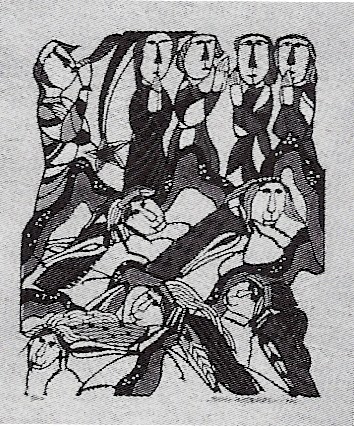
Hand colored stencil print on washi by Sadao Watanabe (1983).
Image taken with permission from the SadaoHanga Catalogue where you can find many more images and information about Sadao Watanabe.
For other images of Sadao Watanabe art works in TIPs, see here.
complete verse (Revelation 9:9)
Following are a number of back-translations of Revelation 9:9:
- Uma: “Their chests were covered with scales like an iron shirt. The sound of their wings was like the sound of a throng of carts [Indonesian: kereta] pulled by horses gong to a battle.” (Source: Uma Back Translation)
- Yakan: “Their chests are covered all over with scales like iron to cover/shield their chests. When they move their wings a sound is heard like the sound of very many horses running, bringing/pulling their wagons to the fighting place.” (Source: Yakan Back Translation)
- Western Bukidnon Manobo: “They had scales like iron armor, and the sound of their wings when they fly was like the sound of many calesas pulled by horses running when they go to fight.” (Source: Western Bukidnon Manobo Back Translation)
- Kankanaey: “Their chests were protected with something like an iron protector. The sound (lit. voice) of their wings, it was like the rumble of many carriages pulled by horses who are running to go join-in-battle.” (Source: Kankanaey Back Translation)
- Tagbanwa: “Their chests were wrapped around with what was like a wrapping of iron. The sound of their wings when arching/beating was like the crackling-sound of wheels of many pulled vehicles for going fighting and the stamping by the horses doing-the-pulling, when coming-together/locking with the enemy.” (Source: Tagbanwa Back Translation)
- Tenango Otomi: “Their coverings on their chests appear to be all metal. The sound of their wings is like the sound of wagons which are pulled by running horses going to war.” (Source: Tenango Otomi Back Translation)
Translation commentary on Revelation 9:9
Scales like iron breastplates: the Greek text says “breastplates like iron breastplates” (using the same word twice). Besides this passage and 9.17, the word occurs also at Eph 6.14 and 1 Thes 5.8. War horses sometimes wore breast shields to protect them from the enemy’s spears and swords. Instead of scales, something like “body-armour” (New Jerusalem Bible) is preferable. Biblia Dios Habla Hoy translates “their bodies were covered with a kind of iron armor,” or the translation can be “their bodies were covered with what looked like pieces of metal used to protect the chests of people.”
The noise of their wings: for a similar description of the noise of locusts’ wings, see Joel 2.5. In some languages this phrase will be rendered as “the flapping (or, whirring) noise of their wings” or “the noise that their wings made as they flew.”
The noise of many chariots with horses rushing into battle: a chariot was a two-wheeled vehicle pulled by one or more horses. The loud and rustling noise made by the wings of these locusts sounded like many horse-drawn chariots rushing into battle. The noise in some languages will be described with an adjective or an ideophone. An alternative rendering is “the rattling noise” (see Nahum 3.2). Chariots in many languages is translated as “horse-drawn war carts” or “war carts (or, wagons) pulled by horses.” So this clause may also be rendered as “the whirring (or, rattling) noise of many horse-drawn war carts racing (or, dashing) into the battlefield.”
Quoted with permission from Bratcher, Robert G. and Hatton, Howard A. A Handbook on The Revelation to John. (UBS Handbook Series). New York: UBS, 1993. For this and other handbooks for translators see here .
Leave a Reply
You must be logged in to post a comment.