
For the phrase “you have put all things under their feet,” see 1 Corinthians 15:27.
what are human beings that you are mindful of them . . .
For the phrase “what are human beings that you are mindful of them, mortals[a] that you care for them? Yet you have made them a little lower than God, and crowned them with glory and honor. You have given them dominion over the works of your hands; you have put all things under their feet.” see Hebrews 2:6, Hebrews 2:7, and Hebrews 2:8.
Note that this quote in the New Testament is not taken from the Hebrew Bible but from the Greek Septuagint (LXX) which translates into English as “What is man that you are mindful of him or son of man that you attend to him? You diminished him a little in comparison with angels; with glory and honor you crowned him. And you set him over the works of your hands; you subjected all under his feet.” (Translation by NETS — for the Greek version see the title’s tooltip)
You have made him master over your handiwork - laying the world at his feet (image)
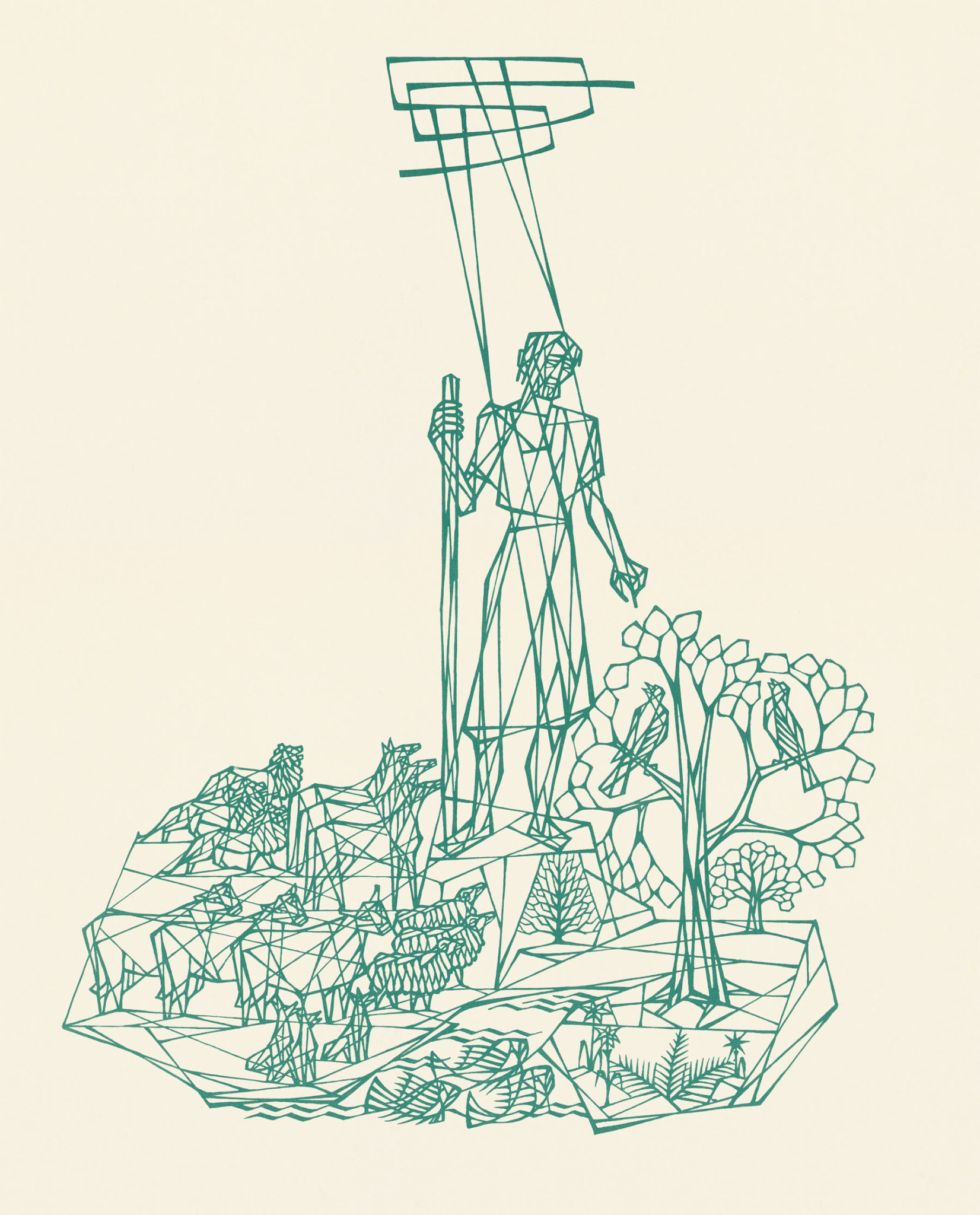
Drawing by Ismar David from The Psalms: A new English translation, linked with permission from Ismar David Archive .
For other images of Ismar David drawings, see here.
complete verse (Psalm 8:6)
Following are a number of back-translations as well as a sample translation for translators of Psalm 8:6:
- Chichewa Contempary Chichewa translation, 2002/2016:
“You placed him ruler of the work of your hands;
you placed all things under his feet;” (Source: Mawu a Mulungu mu Chichewa Chalero Back Translation) - Newari:
“You also gave him authority over all that You made,” (Source: Newari Back Translation) - Hiligaynon:
“You (sing.) made him ruler of what you (sing.) have-created;
you (sing.) put-under-the-jurisdiction of him all these things,” (Source: Hiligaynon Back Translation) - Eastern Bru:
“God created all things so that humans rule over everything. And God allowed all things to be under the soles of their feet, such as these:” (Source: Bru Back Translation) - Laarim:
“You gave him to rule all things which you made,
you put all things in his hand,” (Source: Laarim Back Translation) - Nyakyusa-Ngonde (back-translation into Swahili):
“Umempa mamlaka katika kazi zako zote,
umeviweka vitu vyote chini katika miguu yake,” (Source: Nyakyusa Back Translation) - English:
“You put us in charge of everything that you made;
you gave us authority over all things—” (Source: Translation for Translators)
addressing God
Translators of different languages have found different ways with what kind of formality God is addressed. The first example is from a language where God is always addressed distinctly formal whereas the second is one where the opposite choice was made.
Click or tap here to see the rest of this insight
Like many languages (but unlike Greek or Hebrew or English), Tuvan uses a formal vs. informal 2nd person pronoun (a familiar vs. a respectful “you”). Unlike other languages that have this feature, however, the translators of the Tuvan Bible have attempted to be very consistent in using the different forms of address in every case a 2nd person pronoun has to be used in the translation of the biblical text.
As Voinov shows in Pronominal Theology in Translating the Gospels (in: The Bible Translator 2002, p. 210ff. ), the choice to use either of the pronouns many times involved theological judgment. While the formal pronoun can signal personal distance or a social/power distance between the speaker and addressee, the informal pronoun can indicate familiarity or social/power equality between speaker and addressee.
In these verses, in which humans address God, the informal, familiar pronoun is used that communicates closeness.
Voinov notes that “in the Tuvan Bible, God is only addressed with the informal pronoun. No exceptions. An interesting thing about this is that I’ve heard new Tuvan believers praying with the formal form to God until they are corrected by other Christians who tell them that God is close to us so we should address him with the informal pronoun. As a result, the informal pronoun is the only one that is used in praying to God among the Tuvan church.”
In Gbaya, “a superior, whether father, uncle, or older brother, mother, aunt, or older sister, president, governor, or chief, is never addressed in the singular unless the speaker intends a deliberate insult. When addressing the superior face to face, the second person plural pronoun ɛ́nɛ́ or ‘you (pl.)’ is used, similar to the French usage of vous.
Accordingly, the translators of the current version of the Gbaya Bible chose to use the plural ɛ́nɛ́ to address God. There are a few exceptions. In Psalms 86:8, 97:9, and 138:1, God is addressed alongside other “gods,” and here the third person pronoun o is used to avoid confusion about who is being addressed. In several New Testament passages (Matthew 21:23, 26:68, 27:40, Mark 11:28, Luke 20:2, 23:37, as well as in Jesus’ interaction with Pilate and Jesus’ interaction with the Samaritan woman at the well) the less courteous form for Jesus is used to indicate ignorance of his position or mocking (source Philip Noss).
In Dutch and Western Frisian translations, however, God is always addressed with the formal pronoun.
hand (of God) (Japanese honorifics)
Like a number of other East Asian languages, Japanese uses a complex system of honorifics, i.e. a system where a number of different levels of politeness are expressed in language via words, word forms or grammatical constructs. These can range from addressing someone or referring to someone with contempt (very informal) to expressing the highest level of reference (as used in addressing or referring to God) or any number of levels in-between.
One way to do this is through the usage (or a lack) of an honorific prefix as shown here in the widely-used Japanese Shinkaiyaku (新改訳) Bible of 2017. When the referent is God, the “divine” honorific prefix mi- (御 or み) is used here in mi-te (御手) or “hand (of God).”
(Source: S. E. Doi, see also S. E. Doi in Journal of Translation, 18/2022, p. 37ff. )
See also hand of the LORD.
Honorary "are" construct denoting God (“place”)
Click or tap here to see the rest of this insight.
Like a number of other East Asian languages, Japanese uses a complex system of honorifics, i.e. a system where a number of different levels of politeness are expressed in language via words, word forms or grammatical constructs. These can range from addressing someone or referring to someone with contempt (very informal) to expressing the highest level of reference (as used in addressing or referring to God) or any number of levels in-between.
One way Japanese shows different degree of politeness is through the usage of an honorific construction where the morpheme are (され) is affixed on the verb as shown here in the widely-used Japanese Shinkaiyaku (新改訳) Bible of 2017. This is particularly done with verbs that have God as the agent to show a deep sense of reverence. Here, ok-are-ru (置かれる) or “place” is used.
(Source: S. E. Doi, see also S. E. Doi in Journal of Translation, 18/2022, p. 37ff. )
Translation commentary on Psalm 8:6 - 8:8
In these three verses the psalmist lists “all creation” (Good News Translation) over which God has placed humankind as ruler. The works of thy hands is a way of saying “the things that you made” (see “the work of thy fingers” in verse 3). “To put under the feet of” means “to make (someone) a ruler, to place under his dominion.” Thou hast given him dominion over the works of thy hands must often be recast as two verb phrases; for example, “You have put him in charge and made him to rule over all you created.”
Verse 6b is cited in 1 Corinthians 15.27.
The psalmist is thinking primarily of the animals, and so by the usual classification he lists them all: (1) domestic animals, sheep and oxen (or “cattle,” Good News Translation); (2) wild animals, literally the beasts of the field; (3) wild birds; (4) marine life, the fish of the sea, including (5) the sea monsters (verse 8b; see Gen 1.21), which were classified separately from ordinary fish (see Die Bibel im heutigen Deutsch “the fish and monsters in the sea”). Many translations, however, take whatever passes along the paths of the sea to be only a more inclusive statement about all marine creatures.
Some languages do not have general terms for certain classes of animals. As there is no symbolic value attached to sheep or cattle here, an expression for any or all domestic animals may be used. Beasts of the field are sometimes referred to as “forest animals” or “bush animals” in contrast to “village animals.” Of the sea as attributive to the fish may have to be recast in many languages where the seas are unknown. Hence one must often say “the big fish from the big rivers” or “big animals that live in the big waters.”
Quoted with permission from Bratcher, Robert G. and Reyburn, William D. A Handbook on the Book of Psalms. (UBS Helps for Translators). New York: UBS, 1991. For this and other handbooks for translators see here .
Leave a Reply
You must be logged in to post a comment.