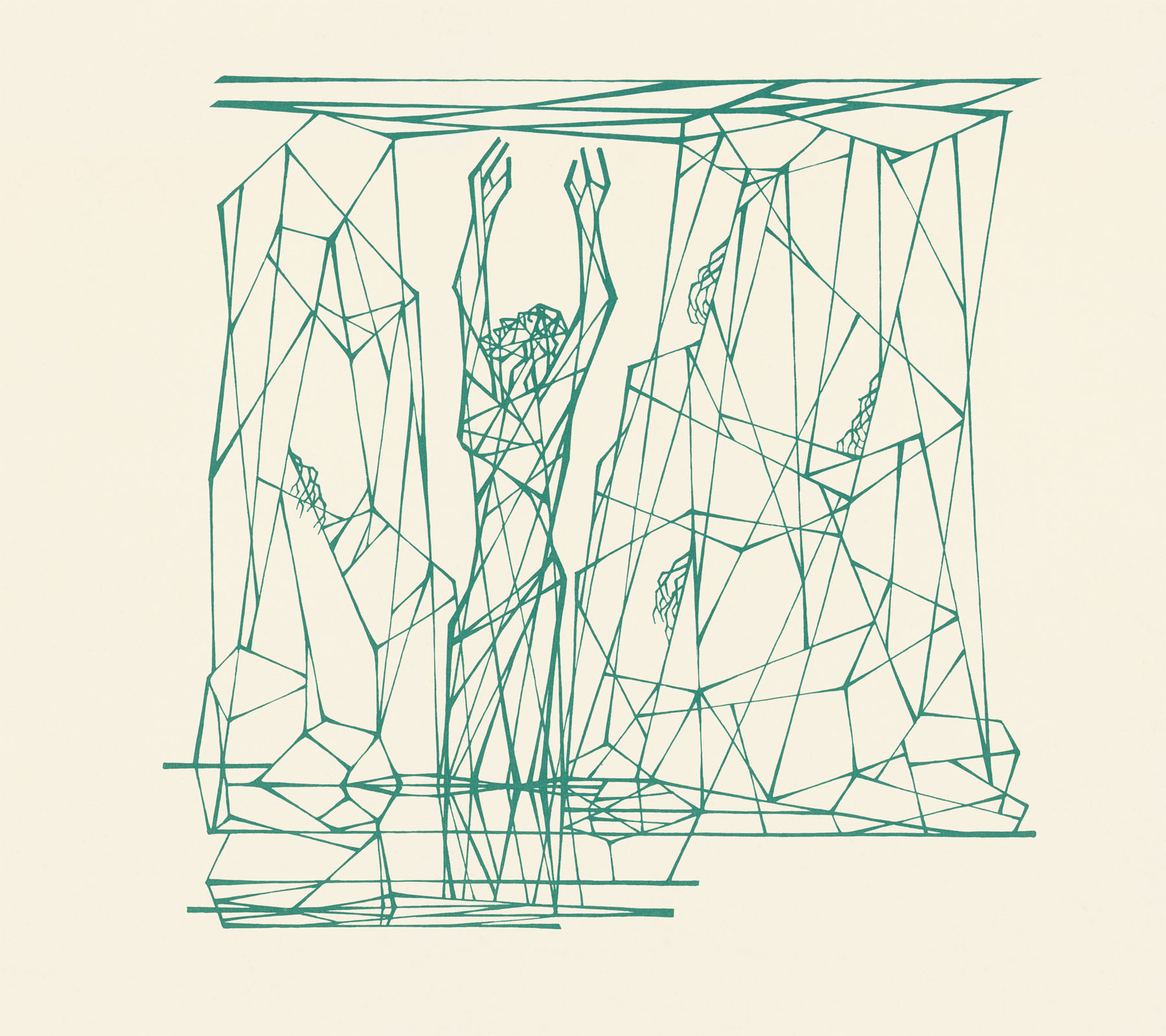
Drawing by Ismar David from The Psalms: A new English translation, linked with permission from Ismar David Archive .
For other images of Ismar David drawings, see here.

טָבַ֤עְתִּי ׀ בִּיוֵ֣ן מְ֭צוּלָה וְאֵ֣ין מָעֳמָ֑ד בָּ֥אתִי בְמַעֲמַקֵּי־מַ֝֗יִם וְשִׁבֹּ֥לֶת שְׁטָפָֽתְנִי׃
2I sink in deep mire,
where there is no foothold;
I have come into deep waters,
and the flood sweeps over me.
Drawing by Ismar David from The Psalms: A new English translation, linked with permission from Ismar David Archive .
For other images of Ismar David drawings, see here.
Following are a number of back-translations as well as a sample translation for translators of Psalm 69:2:
The psalmist compares his difficult and dangerous situation to that of someone who is about to drown. All the figures used, waters … up to my neck, deep mire, deep waters, and flood, indicate extreme danger and peril of death; see 18.16; 40.2, for similar descriptions. Either the psalmist is dangerously ill, or his enemies are threatening his life.
The psalmist is using an exaggerated form of imagery here for the purpose of making his plight vivid and picturable. In some languages the imagery used may be so unnatural that it may be necessary to substitute others. To translate the figures of verses 1-2 in nonfigurative language and at the same time keep a semblance of poetic form would be extremely difficult and is not generally recommended.
In verse 1b neck translates the word nefesh. See Peacock (1976), page 217.
In verse 2b the word translated foothold (Good News Translation “solid ground”) occurs nowhere else in the Old Testament. It is related to the verb meaning “to stand” or “to take a stand.”
The flood sweeps over me: literally “flowing waters wash over me.” The picture may be from either an ocean or a flooded and swiftly-moving river.
The translator may find the logical sequence unclear; for example, in verse 1 the water is said to be up to the psalmist’s neck, and it is only later in verse 2c that the writer is said to be in danger of drowning. This is because verse 1 depicts a general condition, and verse 2, specific aspects of that condition. In order to clarify this picture in some languages, the translator may find it clearer to place lines c and d at the beginning and to follow verse 2 with verse 1; for example, “I am out in deep water, and the waves are about to drown me. I am sinking in deep mud and there is no solid ground; the water is up to my neck; save me, O God!”
Quoted with permission from Bratcher, Robert G. and Reyburn, William D. A Handbook on the Book of Psalms. (UBS Helps for Translators). New York: UBS, 1991. For this and other handbooks for translators see here .
No comments yet.
Leave a Reply
You must be logged in to post a comment.