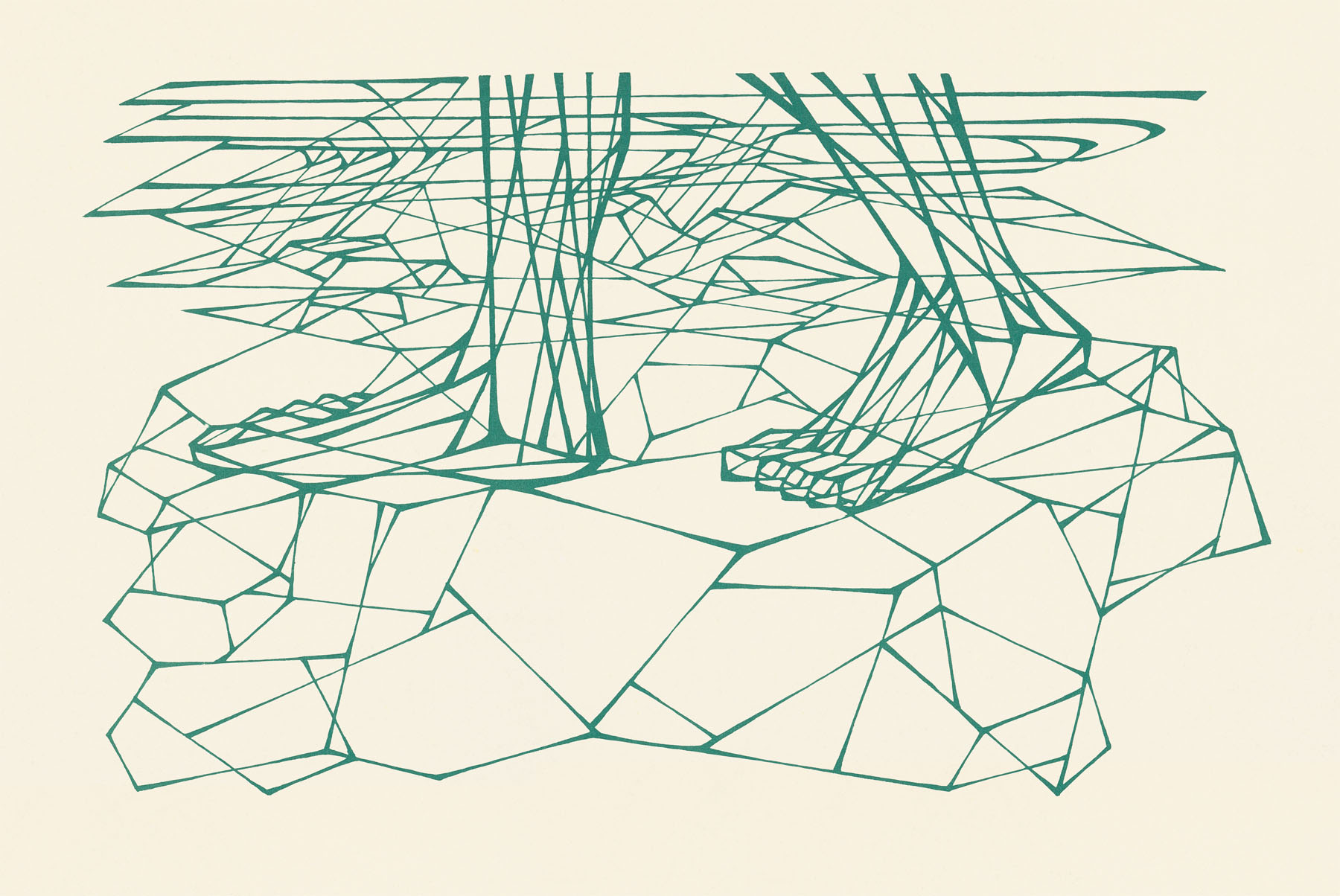
Drawing by Ismar David from The Psalms: A new English translation, linked with permission from Ismar David Archive .
For other images of Ismar David drawings, see here.

תָּמֹ֣ךְ אֲ֭שֻׁרַי בְּמַעְגְּלוֹתֶ֑יךָ בַּל־נָמ֥וֹטּוּ פְעָמָֽי׃
5My steps have held fast to your paths;
my feet have not slipped.
Drawing by Ismar David from The Psalms: A new English translation, linked with permission from Ismar David Archive .
For other images of Ismar David drawings, see here.
Following are a number of back-translations as well as a sample translation for translators of Psalm 17:5:
Translators of different languages have found different ways with what kind of formality God is addressed. The first example is from a language where God is always addressed distinctly formal whereas the second is one where the opposite choice was made.
Like many languages (but unlike Greek or Hebrew or English), Tuvan uses a formal vs. informal 2nd person pronoun (a familiar vs. a respectful “you”). Unlike other languages that have this feature, however, the translators of the Tuvan Bible have attempted to be very consistent in using the different forms of address in every case a 2nd person pronoun has to be used in the translation of the biblical text.
As Voinov shows in Pronominal Theology in Translating the Gospels (in: The Bible Translator 2002, p. 210ff. ), the choice to use either of the pronouns many times involved theological judgment. While the formal pronoun can signal personal distance or a social/power distance between the speaker and addressee, the informal pronoun can indicate familiarity or social/power equality between speaker and addressee.
In these verses, in which humans address God, the informal, familiar pronoun is used that communicates closeness.
Voinov notes that “in the Tuvan Bible, God is only addressed with the informal pronoun. No exceptions. An interesting thing about this is that I’ve heard new Tuvan believers praying with the formal form to God until they are corrected by other Christians who tell them that God is close to us so we should address him with the informal pronoun. As a result, the informal pronoun is the only one that is used in praying to God among the Tuvan church.”
In Gbaya, “a superior, whether father, uncle, or older brother, mother, aunt, or older sister, president, governor, or chief, is never addressed in the singular unless the speaker intends a deliberate insult. When addressing the superior face to face, the second person plural pronoun ɛ́nɛ́ or ‘you (pl.)’ is used, similar to the French usage of vous.
Accordingly, the translators of the current version of the Gbaya Bible chose to use the plural ɛ́nɛ́ to address God. There are a few exceptions. In Psalms 86:8, 97:9, and 138:1, God is addressed alongside other “gods,” and here the third person pronoun o is used to avoid confusion about who is being addressed. In several New Testament passages (Matthew 21:23, 26:68, 27:40, Mark 11:28, Luke 20:2, 23:37, as well as in Jesus’ interaction with Pilate and Jesus’ interaction with the Samaritan woman at the well) the less courteous form for Jesus is used to indicate ignorance of his position or mocking (source Philip Noss).
In Dutch and Western Frisian translations, however, God is always addressed with the formal pronoun.
The psalmist uses the familiar figure of walking down a road to refer to his complete submission to Yahweh’s commands. The word translated paths is literally “track (of a wagon), course”; see its use in 65.11, “the tracks of your chariot.” “In your way” or thy paths must indicate the way the LORD has directed people to go, and not merely indicate a path which belongs to the LORD. One may recast this as “I have always followed the way you have gone” or “I have always walked where you have shown me.”
For the verb translated slipped (literally “totter, stagger”) see its use in 10.6, “be moved.” The parallelism in this verse expresses the movement from the general steps in line a to the specific feet in line b. The meaning is to be understood as “Not only have my steps stayed on your paths, but my feet have never even slipped.” Good News Translation, which replaces steps and feet with “walked” and “strayed,” does not bring out the intensification.
Quoted with permission from Bratcher, Robert G. and Reyburn, William D. A Handbook on the Book of Psalms. (UBS Helps for Translators). New York: UBS, 1991. For this and other handbooks for translators see here .
John Wu Ching-hsiung (1899-1986) was a native of Ningbo, Zhejiang, a renowned jurist who studied in Europe and the United States, and served as a professor of law at Soochow University, as a judge and the Acting President of the Shanghai Provisional Court, and as the Vice President of the Commission for the Drafting of the Constitution of the Republic of China, before becoming the Minister of the Republic of China to the Holy See. Wu has written extensively, not only on law but also on Chinese philosophy, and has also written his autobiography, Beyond East and West, in English. Wu was a devout Catholic and had a personal relationship with Chiang Kai-shek (1887-1975). Wu began translating the the Psalms in 1938, and was encouraged by Chiang to translate the entire New Testament, which he corrected in his own handwriting. (…) John Wu Ching-hsiung’s translation of the Psalms (first draft in 1946, revised in 1975) was translated into Literary Chinese in the form of poetic rhyme, with attention paid to the style of writing. According to the content and mood of the different chapters of the original psalm, Wu chose Chinese poetic forms such as tetrameter, pentameter, heptameter [4, 5 or 7 syllables/Chinese characters per stanza], and the [less formal] Sao style, and sometimes more than two poetic forms were used in a single poem. (Source: Simon Wong)
“Nothing could have been farther from my mind than to translate the Bible or any parts of it with a view to publishing it as an authorized version. I had rendered some of the Psalms into Chinese verse, but that was done as a part of my private devotion and as a literary hobby. When I was in Hongkong in 1938, I had come to know Madame H. H. Kung [Soong Ai-ling], and as she was deeply interested in the Bible, I gave her about a dozen pieces of my amateurish work just for her own enjoyment. What was my surprise when, the next time I saw her, she told me, “My sister [Soong Mei-ling] has written to say that the Generalissimo [Chiang Kai-shek] likes your translation of the Psalms very much, especially the first, the fifteenth, and the twenty-third, the Psalm of the Good Shepherd!”
“In the Autumn of 1940, when I was in Chungking, the Generalissimo invited me several times to lunch with him and expressed his appreciation of the few pieces that he had read. So I sent him some more. A few days later I received a letter from Madame Chiang [Soong Mei-ling], dated September 21, 1940, in which she said that they both liked my translation of the few Psalms I had sent them. ‘For many years,’ she wrote, ‘the Generalissimo has been wanting to have a really adequate and readable Wen-li (literary) translation of the Bible. He has never been able to find anyone who could undertake the matter.’ The letter ends up by saying that I should take up the job and that ‘the Generalissimo would gladly finance the undertaking of this work.’
“After some preliminary study of the commentaries, I started my work with the Psalms on January 6, 1943, the Feast of the Epiphany.
“I had three thousand years of Chinese literature to draw upon. The Chinese vocabulary for describing the beauties of nature is so rich that I seldom failed to find a word, a phrase, and sometimes even a whole line to fit the scene. But what makes such Psalms so unique is that they bring an intimate knowledge of the Creator to bear upon a loving observation of things of nature. I think one of the reasons why my translation is so well received by the Chinese scholars is that I have made the Psalms read like native poems written by a Chinese, who happens to be a Christian. Thus to my countrymen they are at once familiar and new — not so familiar as to be jejune, and not so new as to be bizarre. I did not publish it as a literal translation, but only as a paraphrase.
“To my greatest surprise, [my translation of the Psalms] sold like hot dogs. The popularity of that work was beyond my fondest dreams. Numberless papers and periodicals, irrespective of religion, published reviews too good to be true. I was very much tickled when I saw the opening verse of the first Psalm used as a headline on the front page of one of the non-religious dailies.”
A contemporary researcher (Lindblom 2021) mentions this about Wu’s translation: “Wu created a unique and personal work of sacred art that bears the imprint of his own admitted love and devotion, a landmark achievement comparable to Antoni Gaudi’s Basilica of the Sagrada Família in Barcelona, Spain. Although its use is still somewhat limited today, it continues to attract readers for the aforementioned qualities, and continues to be used in prayers and music by those who desire beauty and an authentic Chinese-sounding text that draws from China’s ancient traditions.”
The translation of Psalm 17 from the 1946 edition is in pentameter (the 1946 edition did not have verse numbers either):
無妄
求主矜愚直。聽我聲聲訴。我言無矯飾。但將赤誠吐。 願主鑒中情。願主持公平。 主曾賜鍛鍊。清夜測吾心。考驗亦云詳。未發纖屑妄。凡我口所言。莫非心所想。我既抱精一。心口豈有兩。 耿耿懷主訓。習俗非所尚。驕人行殘暴。何曾敢傚倣。 兢兢履主道。未嘗循邪枉。
何為此絮絮。知主必聽之。還祈傾爾耳。俾得畢其詞。 急難求主佑。吾主未嘗辭。我今復求主。援手昭仁慈。 願主保小子。如保目中瞳。孵我於翼下。雍雍爾懷中。 既無群小慍。又免敵圍攻。
兇敵與群小。麻木無惻隱。 驕矜而自慢。相逼何太甚。 眈眈如餓虎。其勢不可遏。又如彼伏獅。穴中覷過客。
懇切求恩主。興起戮妖孽。用爾干與戈。救我脫橫逆。 更望賜提撕。俾與鄉願隔。鄉願生斯世。但為斯世活。以主無盡藏。暢恣其口腹。金玉既滿堂。有子萬事足。積蓄遺兒孫。繩繩相承續。 吾志異乎是。所求非世祿。清白歸我主。常享承顏樂。當吾甦醒日。見主便是福。
Transcription into Roman alphabet:
wú wàng
qiú zhǔ jīn yú zhí 。 tīng wǒ shēng shēng sù 。 wǒ yán wú jiǎo shì 。 dàn jiāng chì chéng tǔ 。 yuàn zhǔ jiàn zhōng qíng 。 yuàn zhǔ chí gōng píng 。 zhǔ zēng cì duàn liàn 。 qīng yè cè wú xīn 。 kǎo yàn yì yún xiáng 。 wèi fā xiān xiè wàng 。 fán wǒ kǒu suǒ yán 。 mò fēi xīn suǒ xiǎng 。 wǒ jì bào jīng yī 。 xīn kǒu qǐ yǒu liǎng 。 gěng gěng huái zhǔ xùn 。 xí sú fēi suǒ shàng 。 jiāo rén xíng cán bào 。 hé zēng gǎn xiào fǎng 。jīng jīng lǚ zhǔ dào 。 wèi cháng xún xié wǎng 。
hé wéi cǐ xù xù 。 zhī zhǔ bì tīng zhī 。 huán qí qīng ěr ěr 。 bǐ dé bì qí cí 。 jí nán qiú zhǔ yòu 。 wú zhǔ wèi cháng cí 。 wǒ jīn fù qiú zhǔ 。 yuán shǒu zhāo rén cí 。 yuàn zhǔ bǎo xiǎo zǐ 。 rú bǎo mù zhōng tóng 。 fū wǒ yú yì xià 。 yōng yōng ěr huái zhōng 。 jì wú qún xiǎo yùn 。 yòu miǎn dí wéi gōng 。
xiōng dí yǔ qún xiǎo 。 má mù wú cè yǐn 。 jiāo jīn ér zì màn 。 xiāng bī hé tài shèn 。 dān dān rú è hǔ 。 qí shì bù kě è 。 yòu rú bǐ fú shī 。 xué zhōng qù guò kè 。
kěn qiē qiú ēn zhǔ 。 xīng qǐ lù yāo niè 。 yòng ěr gān yǔ gē 。 jiù wǒ tuō héng nì 。 gēng wàng cì tí sī 。 bǐ yǔ xiāng yuàn gé 。 xiāng yuàn shēng sī shì 。 dàn wéi sī shì huó 。 yǐ zhǔ wú jìn cáng 。 chàng zī qí kǒu fù 。 jīn yù jì mǎn táng 。 yǒu zǐ wàn shì zú 。 jī xù yí ér sūn 。 shéng shéng xiāng chéng xù 。 wú zhì yì hū shì 。 suǒ qiú fēi shì lù 。 qīng bái guī wǒ zhǔ 。 cháng xiǎng chéng yán lè 。 dāng wú sū xǐng rì 。 jiàn zhǔ biàn shì fú 。
With thanks to Simon Wong.
No comments yet.
Leave a Reply
You must be logged in to post a comment.