The musical instrument that is most often translated as “lyre” or “lute” in English is translated in the following ways:
Chichewa Contempary Chichewa translation, 2002/2016: pangwe (a musical instrument that is made from a hollow tube filled with pellets or small stones to create a rain-like sound) or “five stringed instrument” (source: Mawu a Mulungu mu Chichewa Chalero Back Translation)
Kankanaey: “guitar” (Source: Kankanaey Back Translation)
Newari: “sitar ” (source: Newari Back Translation)
Description: The lyre consisted of a sound box out of the ends or sides of which projected two arms. The arms supported a crosspiece. Strings descended from the crosspiece over the sound box. As with the nevel, the number of strings could vary. Their varying thickness and tension gave the instrument a range of notes. The lyre was normally made of wood. The strings were made of animal intestines (perhaps from sheep).
Usage: The strings were normally plucked with the fingers. The kinor in particular is frequently depicted as an instrument that accompanied singing.
Job 21:12: For the stringed instrument (kinor in Hebrew) accompanying the tambourine, French Common Language Version has “guitar” and the French La Bible de Jérusalem has “zither,” which seems to be an instrument used in 1 Samuel 10:5. The first line of this verse may also be rendered “The children sing as people play the tambourine and the lyre.” In some languages these instruments will be a local drum and a stringed instrument; the latter may be a guitar. If no instruments can be found to render any of the instruments in this verse, the translator may have to express the whole verse differently; for example, “The children dance and sing and make joyful sounds/music.”
The identity of the instrument called sabka’ in Aramaic in Daniel (Hebrew) is uncertain. NRSVue renders it “trigon,” which is a small triangular lyre-type instrument with four strings. Probably trigon is technically correct, but it is unknown to the average English reader. Good News Translation has attempted to find a better-known equivalent with “zither,” but the zither has far too many strings (over thirty). Some translations use “lyre” for sabka’ and render the Aramaic word qathros before it as “zither”. Revised English Bible has “triangle,” but most readers will wrongly identify that as a percussion instrument. Common English Version avoids the problem by rendering only the first three instruments in the list and grouping the last three together, including sabka’ as follows: “Trumpets, flutes, harps, and all other kinds of musical instruments.”
Lyre (source: Knowles, revised by Bass (c) British and Foreign Bible Society 1994)
German Luther translation: Posaune, today: “trombone,” originally with the meaning of a wind instrument made from cow horn (from Latin bucina [bovi- / “cow” + the root of cano / “sing”]. Incidentally, bucina is also used in the Latin Vulgate translation). By the time of Luther’s translation it referred to the natural trumpet or a fanfare trumpet (see also trumpet). Once the meaning morphed to “trombone” in the 19th century, trombone ensembles started to play a central role in Protestant German churches and do so to the present day. In 2016, “Posaunenchöre” became added to the UNESCO Intangible Cultural Heritage list . (Note that Exodus 19:13 is the only exception in the Luther Bible. From the 1956 revision on, Widderhorn or “ram’s horn” is used here) (source: Zetzsche)
Description: The horn was a wind instrument made from the horn of an animal, usually a male sheep.
Usage: The animal horn was softened so that it could be shaped. The point of the horn was cut off to leave a small opening through which the user blew. The vibration of the lips produced the sound.
The ram’s horn served two general purposes:
1. It was blown in certain religious contexts, not as musical accompaniment to worship but as a signal for important events. Some of these events were the giving of the Law on Mount Sinai, the Day of Atonement, the bringing of the Ark of the Covenant into Jerusalem, and the coronation of kings.
2. It also served as a signal or alarm when war was approaching. Such references are particularly common in the prophetic books, when the prophets are calling the people to repent (Hosea 5:8; 8:1; Joel 2:1; 2:15; Amos 3:6).
Translation: In many passages the purpose of the ram’s horn called shofar in Hebrew was to sound an alarm. This will be easy to express in those cultures where the horns of animals are used as musical instruments to give signals to large groups of people. In other cultures it may be possible to find another instrument that is used for an equivalent purpose. In some languages, for example, instruments such as bells or drums are the warnings for war. Some translations have transliterated the word shofar. Unless the instrument is well known, such a borrowing should normally be accompanied by a footnote or a glossary entry.
In some passages it will be necessary to expand the translation in order to indicate that the blowing of the ram’s horn was not just for music; for example, in Ezekiel 7:14Contemporary English Version has “A signal has been blown on the trumpet,” and the GermanContemporary English Version says “An alarm is sounded” [elsewhere, the same German version refers to the horns as Kriegshörner or “war horns.”]
Man blowing ram’s horn (source: Knowles, revised by Bass (c) British and Foreign Bible Society 1994)
Image taken from the Wiedmann Bible. For more information about the images and ways to adopt them, see here . For other images of Willy Wiedmann paintings in TIPs, see here.
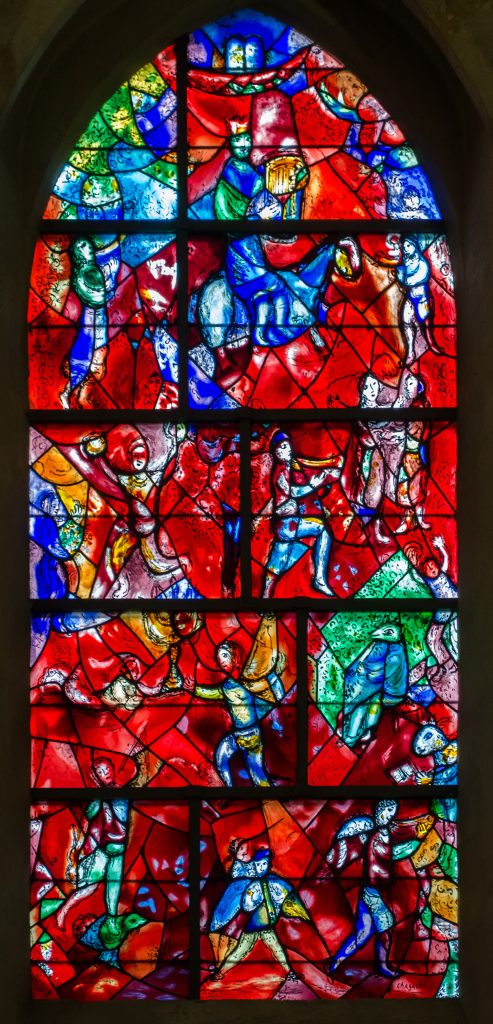
The following is a stained glass window in the Chichester Cathedral in England by Marc Chagall from 1967:
Photo by Jules & Jenny, hosted by Wikimedia Common under the cc-by-2.0 license
Stained glass is not just highly decorative, it’s a medium which has been used to express important religious messages for centuries. Literacy was not widespread in the medieval and Renaissance periods and the Church used stained glass and other artworks to teach the central beliefs of Christianity. In Gothic churches, the windows were filled with extensive narrative scenes in stained glass — like huge and colorful picture storybooks — in which worshipers could ‘read’ the stories of Christ and the saints and learn what was required for their religious salvation. (Source: Victoria and Albert Museum )
Following are a number of back-translations as well as a sample translation for translators of Psalm 150:3:
Chichewa Contempary Chichewa translation, 2002/2016:
“Praise him by singing trumpets,
praise him with harp and lyre.” (Source: Mawu a Mulungu mu Chichewa Chalero Back Translation)
Newari:
“Praise Him by blowing the horn.
Praise Him by playing the lute and violin.” (Source: Newari Back Translation)
Hiligaynon:
“[You (plur.)] praise him by-means-of sounding trumpets/[trumpeta].
[You (plur.)] praise him by-means-of harps/[arpa] and lyres/[lira].” (Source: Hiligaynon Back Translation)
Laarim:
“You (plur.) praise him by blowing horn,
praise him with harp,” (Source: Laarim Back Translation)
Nyakyusa-Ngonde (back-translation into Swahili):
“Msifuni na mvumo wa tarumbeta,
msifuni na kinubi na limba.” (Source: Nyakyusa Back Translation)
English:
“Praise him by blowing trumpets loudly;
praise him by playing harps and small lyres/ other instruments that have many strings!” (Source: Translation for Translators)
The Natügu translation of Psalm 150 features “indigenous instruments and body movements associated with [a traditional] dance to reflect the high praise of the composition.” The English back-translation follows (the Natügu original can be read right here ):
1 Let’s exalt Yahweh in his being in the House-for-worshipping.
And in his being in the High Heaven.
2 Let’s make-songs-about him for his exceeding greatness
In doing powerful things.
3-5 Let’s dance to him with leg-rattles
and strongly beat the drum to him.
Let’s dance to him by our banging things,
our smacking things, and by our shaking things in our hands.
Let’s blow the conch shell and bamboo flutes (to him).
And let’s strum the guitar and ukulele in our exalting him.
6 We who are alive should rejoice in Yahweh.
Our praising Yahweh is forever and ever.
Following is a translation of Psalm 150 into dance and song in Kabiyè by Groupe Ɛsɔwazaa. The video is followed by an English back-translation as well as the original Kabiyè text and a French back-translations. The leader (call) part is in standard type, the ensemble (response) is italicized.
Uuuuyi, uuuyi, hiiiii [shouts of joy]
Praise the Eternal, eee.
In heaven in his house, eee.
Praise him in heaven, eee.
For his power, eee.
For his works, eee.
For his greatness, eee.
Which has no end, eee.
Eee which has no end, eee.
Eeeyiyaaa, eewooo. (5 times)
Take the horn, eee.
Every stringed instrument, eee.
Drums and flutes, eee.
Bring them and let us praise him with them, eee.
With the cymbals, eee.
Big and small, eee.
On his throne, eee. (4 times)
Eeeyiyaaa, eewooo. (5 times)
Are you alive? yes.
Come and let us praise God, eee. (3 times)
Everything that breathes, eee.
Eee Praises God, eee.
Eee Let us praise God, eee. (2 times)
Trees and birds, eee.
(They) praise God, eee.
Eeeyiyaaa, eewooo. (5 times)
Praise the Eternal, eee. (2 times)
Eee Praise the Eternal, eee.
Praise the Eternal, eee.
He is so good, eee.
He is so big, eee.
He is so vast, eee.
Shout to praise him with shouts, eee.
Shout to praise him, eee.
Stoop down to praise him, eee. (4 times)
Rise up to praise him, eee. (2 fois)
Eeeyiyaaa, eewooo. (5 times)
Dance to praise him, eee. (2 fois)
Eeeyiyaaa, eewooo. (6 times)
Praise the Eternal, eee. (4 times)
He is so good, eee.
He is so just, eee.
He is so vast, eee.
Eeeyiyaaa, eewooo.
Click or tap here to see the the text in French back-translation
Uuuuyi, uuuyi, hiiiii [cris d’allégresse]
Louez l’Eternel, eee.
Au ciel dans sa maison, eee.
Louez-le au ciel, eee.
Pour sa puissance, eee.
Pour ses oeuvres, eee.
Pour sa grandeur, eee.
Qui n’a pas de fin, eee.
Eeeyiyaaa, eewooo. (5 fois)
Prenez la corne, eee.
Tout instrument à cordes, eee.
Tambours et flutes, eee.
Amenez et louons-le avec, eee.
Avec les cymbales, eee.
Grandes et petites, eee.
Sur son trône, eee. (4 fois)
Eeeyiyaaa, eewooo. (6 fois)
Es-tu vivant ? oui.
Viens et louons Dieu, eee. (3 fois)
Tout ce qui respire, eee.
Eee Loue Dieu, eee.
Eee Louons Dieu, eee. (2 fois)
Arbres et oiseaux, eee.
Louent Dieu, eee.
Eeeyiyaaa, eewooo. (4 fois)
Louez l’Eternel, eee. (2 fois)
Eee Louez l’Eternel, eee.
Louez l’Eternel, eee.
Il est tellement bon, eee.
Il est tellement grand, eee.
Il est tellement vaste, eee.
Acclamez pour louez-le avec, eee.
Acclamez pour le louer, eee.
Eeeyiyaaa, eewooo. (4 fois)
Abaissez-vous pour le louer, eee. (4 fois)
Levez-vous pour le louer, eee. (2 fois)
Eeeyiyaaa, eewooo. (4 fois)
Dansez pour le louer, eee. (4 fois)
Louez l’Eternel, eee. (4 fois)
Il est tellement bon, eee.
Il est tellement juste, eee.
Il est tellement vaste, eee.
Eeeyiyaaa, eewooo.
Kabiye transcription and translation to French was completed by Mawèdong Amana, checking of Kabiye orthography and French translation was done by Kpatcha Hemou and Essokilina Tchamie, English translation by Sarah Jane Capper. Groupe Ɛsɔwazaa members: Pouwèdéou Noëline Mizou, Tchilalou Atakora, Poyodi Pounegue, Ezolina Françoise Tayele.
The artists in these videos composed these songs by studying Psalms 6, 150 and 118 as well as Kabiye music and dance styles. They participated in a two-week workshop organized by SIL Togo-Benin in Kara, Togo in partnership with the master’s thesis research of Sarah Jane Capper for Dallas International University; the Association pour la Promotion des Saintes-Écritures en Kabiye (APSEK); and Scriptura.
Following is a translation of Psalm 150 into dance and song in Kabiyè by Groupe Mɛwɛ Tam Sɔɔlɩm. The video is followed by an English back-translation as well as the original Kabiyè text and a French back-translations. The leader (call) part is in standard type, the ensemble (response) is italicized.
Yuuuuiii, uuuii, uuuii [shouts of joy]
Let us praise God, the Eternal, God, Eternal.
Eee let us praise God, the Eternal yee, God, Eternal. (2 times)
Eee let us praise God, the Eternal yoo, God, Eternal.
Let us praise God, the Eternal, God, the Eternal!
Yee let us praise God, the Eternal yee, God, the Eternal!
Eee let us praise him in his house yee, God, Eternal. (2 times)
Eee where he shows his power, God, Eternal. (2 times)
In his royal house yeee, the Eternal, God, Eternal!
In his royal house, the Eternal yooo, God, Eternal!
In his royal house, the Eternal yeee, God, Eternal!
God, the Eternal yee, God, the Eternal.
Eee let us praise God, the Eternal yeee, God, Eternal.
His works are many, God, Eternal.
His works are numerous yeee, God, Eternal.
Hmmmm, My God is great, God, Eternal.
He is so big yee, God, Eternal. (2 times)
With what should we praise him? God, Eternal.
Let us say, “With what should we praise him yeee?” God, Eternal.
Hummm Eternal God yee, Eternal God.
Eternal God, Eternal God. (3 times)
Let us praise him with horns yeee, let us praise the Eternal. (3 times)
Ooo let us praise him with horns yeee, let us praise the Eternal.
Let us praise him with flutes yeee, let us praise the Eternal. (2 times)
Let us praise him with drums yeee, let us praise the Eternal. (2 times)
Aaa let us praise him with drums yeee, let’s praise the Eternal.
Let us praise him with drums and dances yeee, let us praise the Eternal. (2 times)
Let us praise him with flutes yeee, let us praise the Eternal.
Aaa let us praise him with flutes yeee, Let us praise the Eternal.
Let us praise God, he is eternal yee, let us praise the Eternal. (2 times)
Who must praise God? Everything that God has made and created and that lives must come and praise God.
Let everything that breathes, praise God.
Eee let everything that breathes, praise the Eternal. (2 times)
Let all humans praise him yee, let us praise the Eternal.
Let boys and girls praise him yee, let us praise the Eternal.
Let women and men praise him yee, let us praise the Eternal. (2 times)
Ooo let us praise the Eternal yee, Let us praise the Eternal.
Let the animals praise him, let us praise the Eternal.
Let the trees and the wind praise him, let us praise the Eternal.
Let the trees and the flowers praise him, let us praise the Eternal.
Hummm, praise the Eternal yee, praise the Eternal.
Let the trees and the flowers praise him yee, let us praise the Eternal.
May all humans praise him yee, let us praise the Eternal.
Let us praise the Eternal yee, let us praise the Eternal. (2 times)
Let the idolaters praise him yee, let us praise the Eternal. (2 times)
Let the Christians praise him yee, let us praise the Eternal. (2 times)
Dance with glory to praise him yee, let us praise the Eternal.
Dance with glory to praise him yee, let us praise the Eternal.
Dance with glory to praise him, let us praise the Eternal.
Hɩmmm praise the Eternal, let us praise the Eternal yeee, let us praise the Eternal. (2 times)
Everything that breathes, praise the Eternal, let us praise the Eternal. (2 times)
Praise the Eternal, praise the Eternal, praise the Eternal. (2 times)
Click or tap here to see the the text in French back-translation
Yuuuuiii, uuuii, uuuii [cris d’allégresse]
Louons Dieu, l’Eternel, Dieu, Eternel.
Eee louons Dieu, l’Eternel yee, Dieu, Eternal. (2 fois)
Eee louons Dieu, l’Eternel yoo, Dieu, Eternel.
Louons Dieu, l’Eternel, Dieu, Eternel!
Eee louons Dieu, l’Eternel yee, Dieu, Eternel!
Eee louons-le dans sa maison yee, Dieu, Eternal! (2 fois)
Eee là où il montre sa puissance, Dieu, Eternel. (2 fois)
Dans sa maison royale yeee, l’Eternel, Dieu, Eternel!
Dans sa maison royale, l’Eternel yooo, Dieu, Eternel!
Dans sa maison royale, l’Eternel yeee, Dieu, Eternel.
Dieu, l’Eternel yee, Dieu, Eternel.
Eee louons Dieu, l’Eternel yeee, Dieu, Eternel.
Ses œuvres sont nombreuses, Dieu, Eternel.
Ses œuvres sont nombreuses yeee, Dieu, Eternel.
Hmmmm, Mon Dieu est grand, Dieu, Eternel.
Il est tellement grand yee, Dieu, Eternel.(2 fois)
Avec quoi devons-nous le louer? Dieu, Eternel.
Disons avec quoi devons-nous le louer yeee? Dieu, Eternel.
Hummm Dieu Eternel yee, Dieu Eternel.
Dieu Eternel, Dieu Eternel. (3 fois)
Louons-le avec des cornes yeee, louons l’Eternel. (3 fois)
Ooo louons-le avec des cornes yeee, louons l’Eternel.
Louons-le avec des flutes yeee, louons l’Eternel. (2 fois)
Louons-le avec les tambours yeee, louons l’Eternel. (2 fois)
Aaa louons-le avec les tambours yeee, louons l’Eternel.
Louons-le avec des tambours et des danses yeee, louons l’Eternel. (2 fois)
Louons-le avec de flutes yeee, louons l’Eternel.
Aaa louons-le avec de flutes yeee, louons l’Eternel.
Louons Dieu, il est éternel yee, louons l’Eternel. (2 fois)
Qu’est-ce qui doit louer Dieu ? Tout ce que Dieu a fait et créé et qui vit doit venir et louer Dieu.
Que tout ce qui respire, loue Dieu.
Eee que tout ce qui respire, loue l’Eternel. (2 fois)
Que tous les humains le louent yee, louons l’Eternel.
Que les garçons et les filles le louent yee, louons l’Eternel.
Que les femmes et les hommes le louent yee, louons l’Eternel. (2 fois)
Ooo louons l’Eternel yee, louons l’Eternel.
Que les animaux le louent, louons l’Eternel.
Que les arbres et le vent le louent, louons l’Eternel.
Que les arbres et les fleurs le louent, louons l’Eternel.
Hummm, louent l’Eternel yee, louons l’Eternel.
Que les arbres et les fleurs le louent yee, louons l’Eternel.
Que tous les humains le louent yee, louons l’Eternel.
Louons l’Eternel yee, louons l’Eternel. (2 fois)
Que les idolâtres le louent yee, louons l’Eternel. (2 fois)
Que les chrétiens le louent yee, louons l’Eternel. (2 fois)
Dansez avec gloire pour le louer yee, louons l’Eternel. (2 fois)
Dansez avec gloire pour le louer yee, louons l’Eternel.
Dansez avec gloire pour le louer, louons l’Eternel.
Hɩmmm louez l’Eternel, louons l’Eternel yeee, louons l’Eternel. (2 fois)
Tout ce qui respire, loue l’Eternel, louons l’Eternel. (2 fois)
Louez l’Eternel, louez l’Eternel, louez l’Eternel. (2 fois)
Kabiye transcription and translation to French was completed by Mawèdong Amana, checking of Kabiye orthography and French translation was done by Kpatcha Hemou and Essokilina Tchamie, English translation by Sarah Jane Capper. Groupe Mɛwɛ Tam Sɔɔlɩm members: Piwèlong Tamassi, Kézié Daniel Bataba, Toï Mèhèza Meba, Essokamhaou Pagana, Mamalinèwè Pekpissi.
The artists in these videos composed these songs by studying Psalms 6, 150 and 118 as well as Kabiye music and dance styles. They participated in a two-week workshop organized by SIL Togo-Benin in Kara, Togo in partnership with the master’s thesis research of Sarah Jane Capper for Dallas International University; the Association pour la Promotion des Saintes-Écritures en Kabiye (APSEK); and Scriptura.
God transcends gender, but most languages are limited to grammatical gender expressed in pronouns. In the case of English, this is traditionally confined to “he” (or in the forms “his,” “him,” and “himself”), “she” (and “her,” “hers,” and “herself”), and “it” (and “its” and “itself”).
Modern Mandarin Chinese, however, offers another possibility. Here, the third-person singular pronoun is always pronounced the same (tā), but it is written differently according to its gender (他 is “he,” 她 is “she,” and 它/牠 is “it” and their respective derivative forms). In each of these characters, the first (or upper) part defines the gender (man, woman, or thing/animal), while the second element gives the clue to its pronunciation.
In 1930, after a full century with dozens of Chinese translations, Bible translator Wang Yuande (王元德) coined a new “godly” pronoun: 祂. Chinese readers immediately knew how to pronounce it: tā. But they also recognized that the first part of that character, signifying something spiritual, clarified that each person of the Trinity has no gender aside from being God.
While the most important Protestant and Catholic Chinese versions respectively have opted not to use 祂, some Bible translations do and it is widely used in hymnals and other Christian materials. Among the translations that use 祂 to refer to “God” were early versions of Lü Zhenzhong’s (呂振中) version (New Testament: 1946, complete Bible: 1970). R.P. Kramers (in The Bible Translator 1956, p. 152ff. ) explains why later versions of Lü’s translation did not continue with this practice: “This new way of writing ‘He,’ however, has created a minor problem of its own: must this polite form be used whenever Jesus is referred to? Lü follows the rule that, wherever Jesus is referred to as a human being, the normal tā (他) is written; where he is referred to as divine, especially after the ascension, the reverential tā (祂) is used.”
In that system one kind of pronoun is used for humans (male and female alike) and one for natural elements, non-liquid masses, and some spiritual entities (one other is used for large animals and another one for miscellaneous items). While in these languages the pronoun for spiritual entities used to be employed when referring to God, this has changed into the use of the human pronoun.
Lynell Zogbo (in The Bible Translator 1989, p. 401ff. ) explains in the following way: “From informal discussions with young Christians especially, it would appear that, at least for some people, the experience and/or concepts of Christianity are affecting the choice of pronoun for God. Some people explain that God is no longer ‘far away,’ but is somehow tangible and personal. For these speakers God has shifted over into the human category.”
In Kouya, God (the Father) and Jesus are referred to with the human pronoun ɔ, whereas the Holy Spirit is referred to with a non-human pronoun. (Northern Grebo and Western Krahn make a similar distinction.)
Eddie Arthur, a former Kouya Bible translation consultant, says the following: “We tried to insist that this shouldn’t happen, but the Kouya team members were insistent that the human pronoun for the Spirit would not work.”
In Burmese, the pronoun ko taw (ကိုယ်တော်) is used either as 2nd person (you) or 3rd person (he, him, his) reference. “This term clearly has its root in the religious language in Burmese. No ordinary persons are addressed or known by this pronoun because it is reserved for Buddhist monks, famous religious teachers, and in the case of Christianity, the Trinity.” (Source: Gam Seng Shae in The Bible Translator 2002, p. 202ff. )
In Thai, the pronoun phra`ong (พระองค์) is used, a gender-neutral pronoun which must refer to a previously introduced royal or divine being. Similarly, in Northern Khmer, which is spoken in Thailand, “an honorific divine pronoun” is used for the pronoun referring to the persons of the Trinity (source: David Thomas in The Bible Translator 1993, p. 445 ). In Urak Lawoi’, another language spoken in Thailand, the translation often uses tuhat (ตูฮัด) — “God” — ”as a divine pronoun where Thai has phra’ong even though it’s actually a noun.” (Source for Thai and Urak Lawoi’: Stephen Pattemore)
The English “Contemporary Torah” addresses the question of God and gendered pronouns by mostly avoiding pronouns in the first five books of the Hebrew Bible/Old Testament (unless God is referred to as “lord,” “father,” “king,” or “warrior”). It does that by either using passive constructs (“He gave us” vs. “we were given”), by using the adjective “divine” or by using “God” rather than a pronoun.
Some Protestant and Orthodox English Bibles use a referential capitalized spelling when referring to the persons of the Trinity with “He,” “His,” “Him,” or “Himself.” This includes for instance the New American Standard Bible or The Orthodox New Testament, but most translations do not. Two other languages where this is also done (in most Bible translations) are the closely related Indonesian and Malay. In both languages this follows the language usage according to the Qur’an, which in turn predicts that usage (see Soesilo in The Bible Translator 1991, p. 442ff. and The Bible Translator 1997, p. 433ff. ).



.jpg)
Leave a Reply
You must be logged in to post a comment.