The parable of The Parable of the Sower is illustrated for use in Bible translations in West Africa by Wycliffe Cameroon like this:
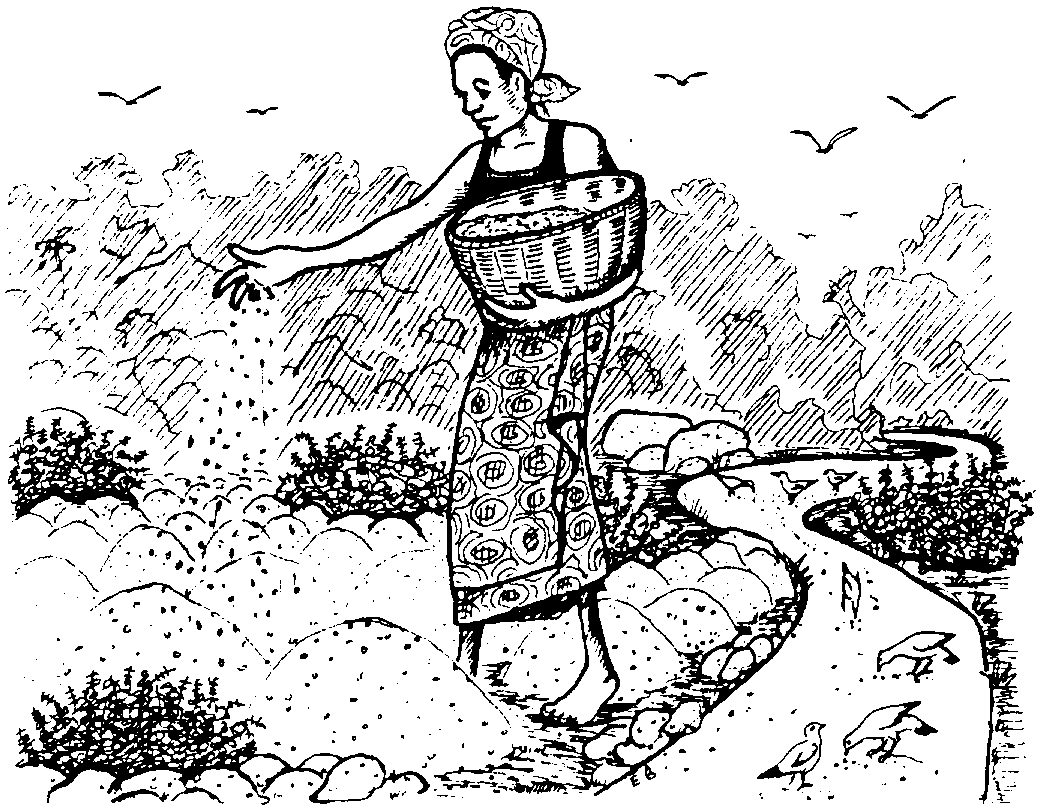
Illustration 1999 Mbaji Bawe Ernest, © Wycliffe Bible Translators, Inc. Used with permission.

ἡλίου δὲ ἀνατείλαντος ἐκαυματίσθη καὶ διὰ τὸ μὴ ἔχειν ῥίζαν ἐξηράνθη.
6But when the sun rose, they were scorched, and since they had no root, they withered away.
The parable of The Parable of the Sower is illustrated for use in Bible translations in West Africa by Wycliffe Cameroon like this:
Illustration 1999 Mbaji Bawe Ernest, © Wycliffe Bible Translators, Inc. Used with permission.
The Hebrew and Greek terms that is translated as “sunrise” and “sunset” or similar in English are translated in Chichewa as “sun coming out” and “sun entering.” The understanding is that the sun moves and that when it is evening it goes back where it belongs. (Source: Mawu a Mulungu mu Chichewa Chalero Back Translation)
See also periods of the night.
Following are a number of back-translations of Matthew 13:6:
They were scorched indicates a brief time lapse between verses 5 and 6, for in this verse they no longer refers to the seeds of verse 5, but rather to “the young plants” (Good News Translation). Evidently the seeds sprout after the heat of the day, but the next day, when the sun comes out in full force again, the newly sprouted plants are scorched by the same heat that initially made the seeds sprout so quickly. In many languages it will be necessary to transform the Greek passive were scorched to an active with the agent expressed, as in Good News Translation; for example, “the sun scorched the young plants.”
As Revised Standard Version indicates, root is singular in Greek; however, a number of translations prefer the plural “roots” (Good News Translation, New American Bible, New Jerusalem Bible, Phillips). In many languages it will be necessary to render “because they did not have enough roots,” or “… long enough roots,” or “… the roots did not go deep enough,” since plants require some degree of root before they will sprout. Die Bibel im heutigen Deutsch restructures considerably but with the same impact: “because they did not have enough soil.”
They withered away is translated “the plants soon dried up” by Good News Translation.
Quoted with permission from Newman, Barclay M. and Stine, Philip C. A Handbook on the Gospel of Matthew. (UBS Handbook Series). New York: UBS, 1988. For this and other handbooks for translators see here .
No comments yet.
Leave a Reply
You must be logged in to post a comment.