
The Greek that is translated as “beget” (or “begat” in the past tense) in older English versions and “was the father of” in more recent ones is translated into Latvian with dzemdināt: “make to give birth” (from dzemdēt “give birth”).
genealogy in Matthew 1
Genealogies play an important role among many of Indonesian language groups and it’s important to follow the right format to make them recognizable as such. Daniel Arichea explains (in The Bible Translator 1986. p. 232ff. ):
“In translating the genealogies, we need to pay attention to the standard form of genealogical lists in the language of translation. Among the Bataks, it was discovered after some research that the genealogies are recorded in the form of a list of ancestors. Furthermore, this list almost always starts from the ancestor and goes down to the descendants. This seems to be true also for many other Indonesian groups, although there are some variations. For the genealogies to have meaning among the Bataks and other groups of similar cultures, these genealogies must be in a form which is appropriate.
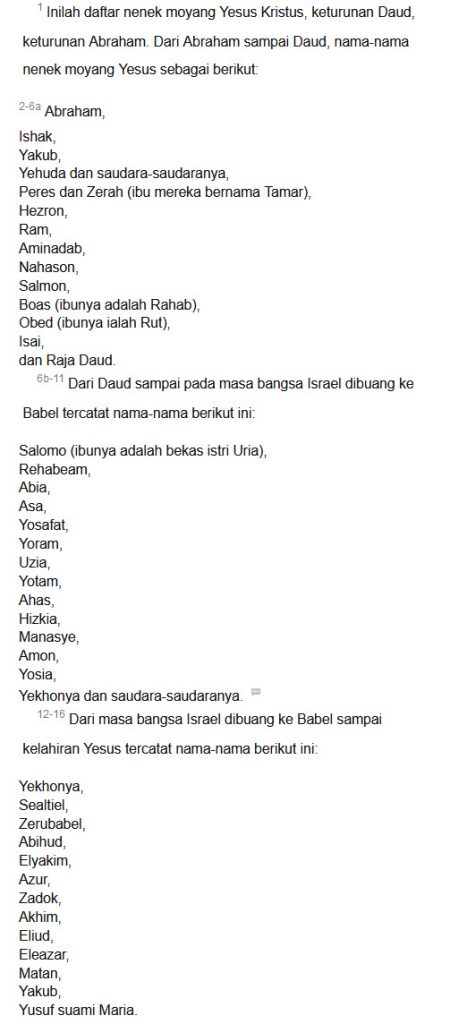
“In Matthew 1:2-16, the biblical form is strange to many Indonesians. (…) The second edition of the Common Language Indonesian New Testament (Alkitab dalam Bahasa Indonesia Masa Kini) discarded the biblical form and came out with a series of ancestral lists. (…) When this was tested, however, many Indonesians did not recognize these lists as genealogical lists, but saw them simply as a list of names. In the light of such reactions, the new edition which is included in the recently published common language Bible has printed these lists as genealogical lists moving downward from the ancestors to the descendants. Thus, verse 2 reads: “From Abraham until David, the names of the ancestors of Jesus are as follows” [which is then followed by a list].”
You can see this in the following screen capture (available right here ):
Similarly to that, Joanne Shetler (1992) describes the impact of the genealogy in the Balangao language of the Philippines:
“Then one day Ama [the co-translator and Christian leader] casually picked up an English New Testament from my shipping-crate desk. He opened it to the first page, Matthew 1, which is a list of names. He stood frozen, staring at it. Incredulous, he asked me, ‘You mean this has a genealogy in it?’
“I said, ‘Yeah, but just skip over that so you can get to the good part.’
“‘You mean this is true?’ he asked. Eyes riveted to the page, he struggled through the list of names.
“Something’s going on here! I got some shelf paper and made a genealogy from Adam to Jesus, from the ceiling clear down to the floor. Ama took it all over the village. He carefully explained, ‘We always thought it was the rock and the banana plant that gave birth to people. But we don’t have their names written down. Look, here are ALL the names—written down!’
“Balangaos had their own creation story, passed down from generation to generation through oral tradition. Ama told me their story:
“Long ago, when there were no people yet on the earth, the rock and the banana plant argued as to which of them would give birth to people and populate the earth. In the course of events, it was the frail banana plant from whom all the people of the earth descended. After producing fruit, the banana plant dies and new shoots spring up for succeeding generations. People have inherited all the frailty of the banana plant and are susceptible to all kinds of dangers and inevitably, death.
“Although their story accounted for man’s frailty, it didn’t have their ancestors’ names written down. A genealogy written was powerful. Balangaos loved that genealogy from the Gospel of Matthew. It proved the Bible was true: for the first time they had the actual names from the beginning of the world — written down.
In the Kölsch translation (publ. 2017), the genealogy is summarized: “From Abraham to David there were fourteen generations. There were another fourteen generations from David until the Jews were deported to Babylon and from Babylon to Jesus there were yet another fourteen generations. This shows that Joseph (Jupp), Mary’s husband, was a descendant of Abraham and David.” (Translation: Jost Zetzsche)
Isaac
The name that is transliterated as “Isaac” in English is signed in Spanish Sign Language and French Sign Language with a sign that is linked to his mother’s laughter when she hears that she will be pregnant with him (referring to Genesis 18:12 – 18:15) and also is the meaning of the Hebrew “Isaac” (Yitschaq — “he laughs”):
“Isaac” in French Sign Language (source: La Bible en langue des signes française )
Learn more on Bible Odyssey: Isaac .
For more information on translations of proper names with sign language see Sign Language Bible Translations Have Something to Say to Hearing Christians .
complete verse (Matthew 1:2)
Following are a number of back-translations of Matthew 1:2:
- Uma: “From Abraham to Daud, the names of the grandparents of Yesus are these: Abraham was the progenitor of Ishak, Ishak was the progenitor of Yakub, Yakub was the progenitor of Yehuda and his siblings,” (Source: Uma Back Translation)
- Western Bukidnon Manobo: “Abraham was the father of Isaac; Isaac, he was the father of Jacob. Now Jacob, his offspring were Juda and his brothers.” (Source: Western Bukidnon Manobo Back Translation)
- Kankanaey: “Abraham was the father of Isaac who was the father of Jacob who was in-turn the father of Juda and his siblings.” (Source: Kankanaey Back Translation)
- Tagbanwa: “Abraham was the father of Isaac. Isaac was the father of Jacob, he being the father of Juda and his brothers.” (Source: Tagbanwa Back Translation)
- Tenango Otomi: “Abraham was the father of Isaac. Isaac was the father of Jacob. Jacob was the father of Judah and others who were his brothers.” (Source: Tenango Otomi Back Translation)
Judah, Judea
The name that is transliterated as “Judah” or “Judea” in English (referring to the son of Jacob, the tribe, and the territory) is translated in Spanish Sign Language as “lion” (referring to Genesis 49:9 and Revelation 5:5). This sign for lion is reserved for regions and kingdoms. (Source: John Elwode in The Bible Translator 2008, p. 78ff. and Steve Parkhurst)
“Judah” and “Judea” in Spanish Sign Language, source: Sociedad Bíblica de España
For more information on translations of proper names with sign language see Sign Language Bible Translations Have Something to Say to Hearing Christians .
See also Judah, Judah (son of Jacob) , and Tribe of Judah .
Abraham
The name that is transliterated as “Abraham” in English is translated in the vast majority of sign languages, including American Sign Language with the sign signifying “hold back arm” (referring to Genesis 22:12).
“Abraham” in American Sign Language (source )
In Vietnamese (Hanoi) Sign Language it is translated with a sign for that demonstrates his new destiny. Previously, he had been called to wander from his home, and the name “Abram” reflected this movement (see here). The new sign name is in one location and stays there, showing Abraham will be given a land to call his own. At this time, Abraham was in the southern part of Canaan, which is shown on the base arm by the location near the elbow. (Source: The Vietnamese Sign Language translation team, VSLBT)
“Abraham” in Vietnamese Sign Language, source: SooSL
For more information on translations of proper names with sign language see Sign Language Bible Translations Have Something to Say to Hearing Christians .
In Tira it is transliterated as Abaram. The choice of this, rather than the widely-known “Ibrahim,” as used in the Tira translation of the Qu’ran, was to offset it against the Muslim transliteration which originates from Arabic. (Source: J.A. Naudé, C.L. Miller Naudé, J.O. Obono in Acta Theologica 43/2, 2023, p. 129ff. )
Click or tap here to see two short video clips about Abraham (source: Bible Lands 2012)
See also our ancestor Abraham and Abram.
Learn more on Bible Odyssey: Abraham .
Jacob
The Hebrew, Latin, and Greek that is transliterated as “Jacob” in English is translated in Spanish Sign Language with a sign that signifies “lentil,” referring to the soup he gave his brother in exchange for his birthright (see Genesis 25:34). Note that another Spanish Sign Language sign for Jacob also users the sign for Jewish. (Source: Steve Parkhurst)
“Jacob” in Spanish Sign Language, source: Sociedad Bíblica de España
In German Sign Language it is a sign that shows the touching of the hip, described in Genesis 32:25:
“Jacob” in German Sign Language (source: Taub und katholisch )
In Finnish Sign Language it is translated with the signs signifying “smooth arm” (referring to the story starting at Genesis 27:11). (Source: Tarja Sandholm)
“Jacob” in Finnish Sign Language (source )
For more information on translations of proper names with sign language see Sign Language Bible Translations Have Something to Say to Hearing Christians .
See also Esau.
Learn more on Bible Odyssey: Jacob .
Leave a Reply
You must be logged in to post a comment.