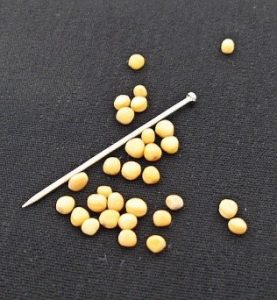
mustard seed

The Greek that is translated in English as “mustard seed” is translated in Muna as “wonolita seed.” René van den Berg explains: “The mustard plant rarely exceeds 50 cm in height. A wonolita is a big forest tree growing from a tiny seed.”

In the Bislama and Uripiv translations it is translated as “banyan.” “The banyan tree is one of the biggest in the islands, and it grows from a tiny seed. We (Uripiv) added a footnote to explain to more advanced readers what we had done: ‘Here Matthew compares the kingdom of God to a mustard seed, but since mustard doesn’t grow here, we put banyan, so that Matthew’s meaning will be clear.’” (source: Ross McKerras)

In Elhomwe it is translated as “tree seed.” (Source: project-specific translation notes in Paratext)

In Gbaya is is translated with the ideophone (a word that expresses what is perceived by the five senses) kɛ̧́ɛ̧́ which “denotes a very tiny and barely visible object. (…) The Gbaya team applied it to faith instead of referring to a mustard seed which is unknown to Gbaya readers.” (Source: Philip Noss in The Bible Translator 1985, p. 423ff. )

See also mustard.
Mark 4:30-32 in Russian Sign Language

Following is the translation of Mark 4:30-32 into Russian Sign Language with a back-translation underneath:


Source: Russian Bible Society / Российское Библейское Общество

Jesus also gave an explanation of what the Kingdom of God is like. For example, there are different kinds of seeds. There are bigger seeds and there are smaller seeds. There is the smallest seed, and if you plant it in the ground, it will grow into a big plant. Birds will make nests on it. And so is the Kingdom of God.

Original Russian back-translation (click or tap here):

Иисус еще дал такое объяснение, чему подобно Царство Божье. Например, есть разные семена. Бывают семена побольше, а бывают совсем маленькие. Есть одно самое маленькое семя, а если посадить его в землю, из него вырастет большое растение. Птицы будут вить гнезда на нем. Вот так же и Царство Божье.

Back-translation by Luka Manevich

<< Mark 4:26-29 in Russian Sign Language
Mark 4:33-34 in Russian Sign Language >>

Mark 4:26-33a in Mexican Sign Language

Following is the translation of Mark 4:26-33a into Mexican Sign Language with back-translations into Spanish and English underneath:


© La Biblia en LSM / La Palabra de Dios

Retrotraducciones en español (haga clic o pulse aquí)

Jesús dijo: “Otro ejemplo, en la tierra de un campo un hombre sembró semillas, y cuando estaba listo el hombre se fue. ¿El hombre sabe hacer las plantas? No, él no sabe.

Las semillas sólas hacen la planta crecer, el hombre duerme y al día siguiente se despierta, y duerme y al día siguiente etc. La planta crece y después el hombre viene y ve que está listo y cosecha.

Eso parece a uds, la gente que cree que v a estar junto con Dios en su reino.

Oigan, otro ejemplo, dejame ver, mira, hay muchas diferentes semillas, pero la más pequeña es la mostaza, pero cuando cae en la tierra la planta crece fuerte y vence las otras plantas, y en la planta los pájaros pueden sentarse en sus nidos.

Eso es parecido a uds que creen en Dios, que ya están junto con Él en su reino.”

Jesús siguió a contar otras historias y muchos diferentes ejemplos.


Jesus said: “Another example, in de ground of a field a man sowed seeds and when he was ready the man went away. Does the man know how to make the plants? No, he does not know.

“The seeds on their own make the plant grow, the man sleeps and wakes up the next day, and sleeps and the next day… and so on. The plant grows and afterwards the man comes and sees that it is ready and harvests.

“This is like you people who believe that you will be together with God in his kingdom.

“Listen, another example, let me see, look here, there are many different kinds of seeds but the smallest is the mustard. But when it falls in the soil a strong plant grows, stronger than other plants, and in it birds can sit on their nests.

“This is like you people who believe in God who are already together with him in his kingdom.”

Jesus went on to tell other stories and many different examples.

Source: La Biblia en LSM / La Palabra de Dios

<< Mark 4:26-33a in Mexican Sign Language
Mark 4:33b-34 in Mexican Sign Language >>

mustard

There is by no means full agreement about the precise identity of the plant in Jesus’ famous references to the mustard seed. Two types of mustard grow in the Holy Land and probably grew there in Bible times: Black Mustard Brassica nigra and White Mustard Sinapis alba. Both species were either cultivated or gathered in Bible times, probably more for the oil, which was used in medicine and cooking, than as a spice. Both types are cultivated today.

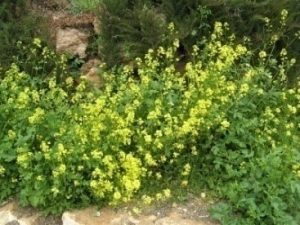
Mustard plants are related to some other well-known food plants, such as collards, broccoli, cauliflower, Brussels sprouts, rutabaga, and Chinese cabbage. They are planted and harvested each year. They grow to 2 meters (7 feet) in height and have branches like a tree. At the ends of the branches there are bright yellow flowers with four petals, like nearly all the members of the Brassicaceae family. The seeds are small among the seeds of garden plants, being about 2 millimeters (1/12 inch) in diameter, but they are not by any means the smallest of all seeds.

The point of the mustard seed parable of Jesus is that something small can produce something very large and complex, like the kingdom of God, or like the amazing deeds of a person with faith.

At least thirty kinds of mustard are known in the world, twenty-one of them in Europe. Others are found in Northeast Africa, India, Japan, and China. The quality in focus in all of the Gospel references is the smallness of the mustard seed compared to the large size of the resulting plant. The translator must keep that in mind, even if a relative of the mustard is found. If no effective equivalent is available, it will be necessary to transliterate “mustard” from a major language.

White mustard plants, photo by Nigel Hepper
Mustard seeds with pin, photo by Ray Pritz

Source: Each According to its Kind: Plants and Trees in the Bible (UBS Helps for Translators)

See also mustard seed.

complete verse (Mark 4:31)

Following are a number of back-translations of Mark 4:31:

  • Uma: “There is a person who planted hawi seed [mustard greens] in the ground.” (Source: Uma Back Translation)
  • Yakan: “The ruling of God over his people,’ said Isa, ‘is figuratively like one kind of a very small seed. When it is planted this seed is very tiny.” (Source: Yakan Back Translation)
  • Western Bukidnon Manobo: “The growing bigger of the rule of God is like a plant with a very small seed which is planted on the earth.” (Source: Western Bukidnon Manobo Back Translation)
  • Kankanaey: “It can be compared to a mustard seed which is the smallest of all seeds on the surface of the earth.” (Source: Kankanaey Back Translation)
  • Tagbanwa: “It’s like a seed of mustasa’, which is the smallest of all which are cultivated.” (Source: Tagbanwa Back Translation)

Translation commentary on Mark 4:31

Exegesis:

kokkō sinapeōs (only here in Mark) ‘grain (seed) of mustard’: the plant is identified as the sinapsis nigra (cf. Lagrange). The mustard grows wild in Palestine: it is an annual plant, growing from seed, and, especially when cultivated, may reach a height of 10 to 12 feet. A garden herb (cf. lachanon ‘herb’ next verse), it is, not quite accurately, called a ‘tree’ (Lk. 13.19), due to its large size.

mikroteron on ‘being smaller (than)’: as is common, the comparative ‘smaller than’ is used for the superlative ‘smallest of.’ The neuter tense of the adjective and participle is probably due to the neuter spermatōn ‘seeds’ which follows.

on ‘being’: the participle is concessive ‘though it is.’

spermatōn (12.19, 20, 21, 22) ‘seeds’ (notice sporos ‘seed’ in v. 27, and kokkos ‘grain,’ ‘seed’ in this verse).

Translation:

It must be translated so as to refer to ‘the kingdom of God.’

Grain of mustard seed may be rendered as ‘a seed of a plant called mustard,’ employing a word borrowed from the dominant prestige language of the area (Central Tarahumara, Eastern Highland Otomi). Frequently, one can find a type of local mustard plant, which, though somewhat different, can still be used as a basis for the translation, e.g. ‘a seed of a kind of … plant’ (in which the appropriate close equivalent can be used; cf. Taungthu). Toraja-Sa’dan, Indonesian and Javanese use sawi, a sort of mustard plant (Brassica rubosa), the leaves of which are eaten as vegetables.

The constructions introduced by which, when are such that they frequently require some radical readjustments, e.g. ‘it is like the grains of a plant called mustard; when these seeds are sown in the earth, they are the smallest….’ In this rendering we have suggested the plural for singular since in a number of languages such generic statements must be regularly in the plural form. However, for the sake of the following verse, it is preferable, if at all possible, to employ the singular throughout. Note also the change of sown upon to ‘sown in,’ as in a number of languages.

Despite the fact that the statement smallest of all the seeds on earth cannot be taken in any absolute sense, one should nevertheless translate the text as it is.

Quoted with permission from Bratcher, Robert G. and Nida, Eugene A. A Handbook on the Gospel of Mark. (UBS Handbook Series). New York: UBS, 1961. For this and other handbooks for translators see here .

SIL Translator's Notes on Mark 4:31

4:31

The Berean Standard Bible has reordered the clauses in the Greek text. For that reason, the Notes and Display for this verse use the Contemporary English Version as the base text.

4:31a

(Contemporary English Version) It is like what happens when a mustard seed: This clause It is like what happens when a mustard seed is a type of comparison called a simile. It compares the kingdom of God to what happens when a mustard seed is planted in the ground. The Jewish people considered the mustard seed to be a symbol of smallness. However, the mustard plant grew to be a tree as large as three meters (ten feet) high.

The point of similarity in this comparison is the contrast in size. The mustard seed is small but the mature plant is large. Like the mustard plant, the kingdom of God is very small at its beginning, but it becomes very large.

Here is another way to translate It is like what happens when a mustard seed:

It is like a tiny grain of mustard-seed which… (Phillips’ New Testament in Modern English)

mustard seed: If people in your language group do not know about mustard seeds or plants, here are some ways to translate mustard seed:

• Use a loan word along with a general term if necessary. For example:

a seed of the plant/tree called mustard

• Use a descriptive phrase. For example:

a very tiny seed

If you use this option, you may want to combine the information with 4:31a–b to avoid saying the same thing twice. For example:

The kingdom of heaven is like the smallest of all the seeds on the earth.

• Use the name of a local seed that is known to be very small, but grows into a tree. If you use this option, you may want to indicate the literal name in a footnote. For example, you could say in the footnote:

The Greek text is literally “a mustard seed.”

Regardless of the way you translate mustard seed, it is suggested that you add a footnote that explains the significance of mustard seed in the Jewish culture. For example:

For the Jews, the mustard seed was a symbol of something that was very small. But the mustard seed that was planted in the country of the Jews grew into a tree that was three meters high.

4:31b

(Contemporary English Version) is planted in the ground: The Greek verb that the Contemporary English Version translates as is planted is passive. In some languages you may need to use an active verb and supply a general subject. For example:

you plant in the ground (New Century Version)
-or-
A man…plants it in the ground. (Good News Bible)

(Contemporary English Version) It is the smallest seed in all the world: The Greek phrase that the Contemporary English Version translates as It is the smallest seed in the world is literally: “being smaller than all of the seeds of the earth.” This expression is a hyperbole. It exaggerates the smallness of the seed. This helps teach the point that the kingdom of God started with only a few people.

Here are some other ways to translate this phrase:

the smallest of all the seeds on earth (Revised Standard Version)
-or-
one of the smallest seeds on earth (God’s Word)
-or-
the smallest of all seeds (New Living Translation)

© 2008 by SIL International®

Made available under the terms of a Creative Commons Attribution-ShareAlike 4.0 License (CC BY-SA) creativecommons.org/licenses/by-sa/4.0

All Scripture quotations in this publication, unless otherwise indicated, are from The Holy Bible, Berean Standard Bible.
BSB is produced in cooperation with Bible Hub, Discovery Bible, OpenBible.com, and the Berean Bible Translation Committee.