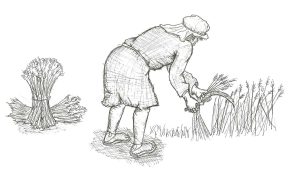
The Hebrew and Greek that is translated as “sickle” in English is illustrated for use in Bible translations in East Africa by Pioneer Bible Translators like this:
Image owned by PBT and Jonathan McDaniel and licensed with the Creative Commons Attribution 3.0 Unported License.
Jesus also told a parable. What is the Kingdom of God like? What is it like? Jesus told an example. A man came into a field and sowed seed. Then he left and went about his business. He sleeps at night and goes about his business during the day, not caring how his seeds grow in the field. Meanwhile the seeds grow, the ears appear, the whole field changes, becomes yellow, it is time to harvest. This man comes and sees that it is time to harvest, then he takes a sickle and cuts off all the ears in the field, he harvests. That’s what the Kingdom of God is like.
Original Russian back-translation (click or tap here):
Иисус еще рассказал притчу. Какое оно, Царство Бога? На что оно похоже? Иисус рассказал пример. В поле пришел человек и посеял семена. Потом он ушел и занимался своими делами. Ночью он спит, днем занимается своими делами и не заботится о том, как растут его семена в поле. Между тем семена вырастают, появляются колосья, все поле меняется, становится желтым, уже пора собирать урожай. Этот человек приходит, и видит, что пора собирать урожай, тогда он берет серп и срезает все колосья на поле, собирает урожай. Вот на это и похоже Царство Божье.
Retrotraducciones en español (haga clic o pulse aquí)
Jesús dijo: “Otro ejemplo, en la tierra de un campo un hombre sembró semillas, y cuando estaba listo el hombre se fue. ¿El hombre sabe hacer las plantas? No, él no sabe.
Las semillas sólas hacen la planta crecer, el hombre duerme y al día siguiente se despierta, y duerme y al día siguiente etc. La planta crece y después el hombre viene y ve que está listo y cosecha.
Eso parece a uds, la gente que cree que v a estar junto con Dios en su reino.
Oigan, otro ejemplo, dejame ver, mira, hay muchas diferentes semillas, pero la más pequeña es la mostaza, pero cuando cae en la tierra la planta crece fuerte y vence las otras plantas, y en la planta los pájaros pueden sentarse en sus nidos.
Eso es parecido a uds que creen en Dios, que ya están junto con Él en su reino.”
Jesús siguió a contar otras historias y muchos diferentes ejemplos.
Jesus said: “Another example, in de ground of a field a man sowed seeds and when he was ready the man went away. Does the man know how to make the plants? No, he does not know.
“The seeds on their own make the plant grow, the man sleeps and wakes up the next day, and sleeps and the next day… and so on. The plant grows and afterwards the man comes and sees that it is ready and harvests.
“This is like you people who believe that you will be together with God in his kingdom.
“Listen, another example, let me see, look here, there are many different kinds of seeds but the smallest is the mustard. But when it falls in the soil a strong plant grows, stronger than other plants, and in it birds can sit on their nests.
“This is like you people who believe in God who are already together with him in his kingdom.”
Jesus went on to tell other stories and many different examples.
Following are a number of back-translations of Mark 4:29:
Uma: “When the rice is ripe, the owner goes carrying a sickle to cut it with, since harvest time has come.'” (Source: Uma Back Translation)
Yakan: “When it’s fruit is ripe the owner of the field commands it immediately to be harvested for the harvest has come.'” (Source: Yakan Back Translation)
Western Bukidnon Manobo: “And when it ripens, the owner of the land harvests it because it is harvest time.'” (Source: Western Bukidnon Manobo Back Translation)
Kankanaey: “When it is ripe, then he goes to harvest-it.'” (Source: Kankanaey Back Translation)
Tagbanwa: “Well, when it’s ripe, of course it will be harvested for then it’s harvest time.'” (Source: Tagbanwa Back Translation)
Living Water is produced for the Bible translation movement in association with Lutheran Bible Translators. Lyrics derived from the ESV® Bible (The Holy Bible, English Standard Version®).
hotan de paradoi ho karpos ‘when the fruit allows,’ i.e. ‘when the crop permits’: so, in a general sense, “when the grain is ripe” (Revised Standard Version).
paradidōmi here has the sense of ‘permit,’ ‘allow’ (this is the sense of the Greek text, but thinks that the underlying spoken Aramaic probably meant ‘when the fruit has been produced’). For the use of paradidōmi ‘hand over’ see 1.14, 3.19.
apostellei to drepanon, hoti parestēken ho therismos ‘he sends forth the sickle, because the harvest has come’: the words reflect an O.T. passage, Joel 3.13 (LXX, 4.13).
apostellō ‘send’: Field argues for the meaning ‘put forth’ on the basis of the Hebrew verb shalach ‘send forth,’ ‘stretch out’ which in Joel 3.13 the Septuagint translates exapostellō ‘send forth.’
to drepanon (only here in Mark) ‘sickle’: by a change of figure ‘sends forth the sickle’ stands for ‘sends out the reapers’ (Gould; cf. The Modern Speech New Testament).
ho therismos (only here in Mark) ‘harvest,’ ‘time of harvest,’ ‘harvesting.’
Translation:
Ripe is rendered variously as ‘hard,’ ‘complete,’ ‘ready,’ and ‘fully grown.’
Puts in the sickle may refer to either (1) the immediate process of cutting the grain (by the grammatical subject of the expression), e.g. ‘he cuts it down’ (Copainalá Zoque, Southern Subanen) or ‘cuts with a rounded machete’ in which ‘rounded machete’ is the name of the harvesting sickle (Tabasco Chontal), or (2) the sending of workmen into the harvest fields to do the work (seemingly the preferable rendering), e.g. ‘sends those who bear the knives,’ in which ‘knives’ is the cultural equivalent of sickle (Shipibo-Conibo); ‘gives the order to those who cut with the sickle’ (Batak Toba).
Harvest is ‘the time of cutting’ (Barrow Eskimo) or ‘harvesting-time’ (Shipibo-Conibo).
Quoted with permission from Bratcher, Robert G. and Nida, Eugene A. A Handbook on the Gospel of Mark. (UBS Handbook Series). New York: UBS, 1961. For this and other handbooks for translators see here .
And as soon as the grain is ripe: The Greek verb that the Berean Standard Bible translates as ripe indicates that the grain is ready for harvesting. The New Jerusalem Bible says:
when the crop is ready
grain: The Greek word that the Berean Standard Bible translates as grain is singular in form but refers to many individual grain seeds. In some languages it may be more natural to use a plural form like “grain seeds” or a different noun like “crop” here.
4:29b
he swings the sickle: The verb swings is an indirect way of referring to cutting the grain with the sickle. Some other ways of translating this expression are:
the man starts cutting it with his sickle (Good News Bible) -or-
he puts the sickle to it (New International Version)
sickle: The word sickle refers to a curved cutting tool. It is used to cut many stalks (with the grain still on them) at one time.
If people in your area do not use a tool like a sickle to cut grain, you may want to:
• Use a term for a cutting tool that could be used in this way. For example:
knife -or-
machete
• Translate this verse part without referring to the kind of tool used. Here are some examples:
he cuts it -or-
he reaps/harvests it
4:29c
because the harvest has come: The word that the Berean Standard Bible translates as because introduces the reason why the man begins to use his sickle. He uses it because the crops are ready to harvest.
Here are some other ways to translate this phrase:
because harvest time has come (Good News Bible) -or-
because this is the harvest time (New Century Version) -or-
because the crops are ripe
General Comment on 4:29a–c
In some languages, it may be redundant to translate 4:29c as a separate clause. This is because the meaning of 4:29c may already be clear from 4:29a–b. If that is true in your language, you may combine the three parts of the verse. For example:
When it is ripe, he takes his sickle and begins to harvest it. -or-
Then when harvest season comes and the grain is ripe, the farmer cuts it with a sickle. (Contemporary English Version) -or-
As soon as it is ripe, he goes and harvests it.
General Comment on 4:29b–c
In this verse, 4:29c expresses the reason for the result in 4:29b. In some languages, it may be more natural to change the order of these clauses. For example:
29cthe harvest has come, 29bso he puts the sickle to it -or- 29cthe harvest has come, 29bthat is why he puts the sickle to it
Made available under the terms of a Creative Commons Attribution-ShareAlike 4.0 License (CC BY-SA) creativecommons.org/licenses/by-sa/4.0
All Scripture quotations in this publication, unless otherwise indicated, are from The Holy Bible, Berean Standard Bible.
BSB is produced in cooperation with Bible Hub, Discovery Bible, OpenBible.com, and the Berean Bible Translation Committee.

Leave a Reply
You must be logged in to post a comment.