In American Sign Language it is translated with the sign for “government/governor” plus the sign for “P” with a circular movement. The reference to government indicates Pilate’s position of authority in the Roman Empire. (Source: Ruth Anna Spooner, Ron Lawer)
“Pilate” in American Sign Language, source: Deaf Harbor
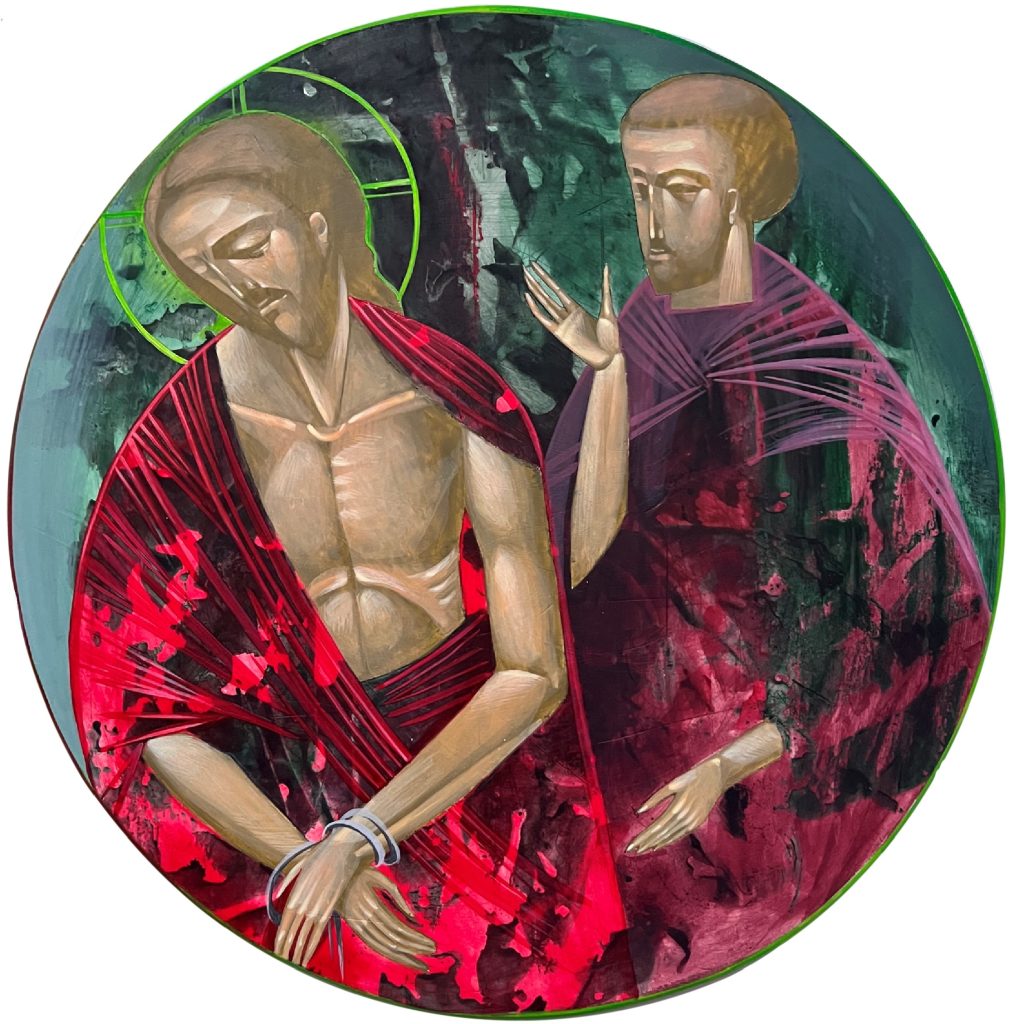
Orthodox Icons are not drawings or creations of imagination. They are in fact writings of things not of this world. Icons can represent our Lord Jesus Christ, the Virgin Mary, and the Saints. They can also represent the Holy Trinity, Angels, the Heavenly hosts, and even events. Orthodox icons, unlike Western pictures, change the perspective and form of the image so that it is not naturalistic. This is done so that we can look beyond appearances of the world, and instead look to the spiritual truth of the holy person or event. (Source )
For purchasing artworks by Kateryna Shadrina go to IconArt Gallery .
Retrotraducciones en español (haga clic o pulse aquí)
Muy de mañana los líderes de los sacerdotes y los ancianos y los maestros de la ley dialogaron y tomaron una decisión. Ataron las manos de Jesús con una cuerda tras su espalda y lo llevaron ante el gobernador.
Él, Pilato, le preguntó a Jesús: “¿Eres tú el rey de los judíos?” Jesús (respondió): “Tú mismo lo has dicho.”
Los líderes de los sacerdotes hicieron acusaciones contra Jesús y lo criticaron y Pilato otra vez preguntó: “Jesús, ellos (hablan) en contra de ti, ¿no vas a decir nada?”
Jesús guardó silencio, estaba callado, Pilato lo vio preguntandose….
Early in the morning the leaders of the priests and the elders and teachers of the law had a discussion and came to a decision. They tied Jesus’ hands behind his back with a rope and took him before the governor.
He, Pilate, asked Jesus: “Are you the king of the Jews?” Jesus (answered): “You have said it yourself.”
The leaders of the priests made accusations against Jesus and criticized him and Pilate asked again: “Jesus, they (talk) against you, are you not going to say anything?”
Jesus kept silent, he was quiet and Pilate looked at him and wondered…
The chief priests, elders, and scribes were judges, and they deliberated. Early in the morning, when it was light, they made a decision. What was it? They had to bring Jesus to Pilate. That was what they decided among themselves. Pilate was the Roman governor of Judea. They took Jesus, tied his hands, and led him to where Pilate was. The chief priests were gathered there. Jesus stood before them. Pilate asked Jesus:
— Are you the king of the Jews?
Jesus answered:
— You yourself say that I am the king of the Jews.
The chief priests began to get angry. They began to accuse Jesus of crimes. Pilate, after listening, asked Jesus again:
— Why are you silent, why don’t you say anything? Look how many accusations there are against you.
But Jesus said nothing, he simply remained silent. Pilate was very surprised.
This was the beginning of the Passover holiday. According to tradition, every year at this time the people could ask Pilate to release one prisoner. At this time, there was a man named Bar-Abba in prison, as well as accomplices in his crimes. Earlier, Bar-Abba had rebelled against the Romans and committed murder. Therefore, he was put in prison. The people, according to tradition, came and began to ask Pilate to release Bar-Abba. Pilate realized that this was what the high priests had ordered. They had handed Jesus over to trial out of envy. Pilate realized this and said to the people:
— Here is Jesus, who is the king of the Jews, perhaps you want me to release him?
But the high priests began to incite the people to ask specifically for the release of Bar-Abba. Pilate said:
— And Jesus, whom you call the king of the Jews, what do you want me to do with him? And the people began to shout that Jesus should be crucified.
Pilate said:
— What did Jesus do wrong?
But the people began to shout even louder that Jesus must be crucified. And then Pilate ordered that Bar-Abba be released, and that Jesus be beaten with whips and crucified on the cross.
Original Russian back-translation (click or tap here):
Первосвященники, старейшины, а также книжники были судьями, они совещались. Ранним утром, когда рассвело, они приняли решение. Какое это было решение? Нужно привести Иисуса к Пилату. Так они между собой решили. Пилат был римский правитель Иудеи. Они взяли Иисуса, связали ему руки и повел его туда, где был Пилат. Там же собрались первосвященники. Перед ними стоял Иисус. Пилат спросил Иисуса:
— Ты царь иудеев?
Иисус ответил:
— Это ты сам так говоришь, что я царь иудеев.
Первосвященники начали злиться. Начали обвинять Иисуса в преступлениях. Пилат, выслушав, повторно спросил Иисуса:
— Почему ты молчишь, ничего не говоришь? Посмотри, сколько обвинений против тебя.
Но Иисус ничего не говорил, просто молчал. Пилат был очень сильно удивлён.
Это время было началом праздника Пасхи. По традиции, каждый год в это время народ мог попросить у Пилата, чтобы он отпустил одного заключенного. В это время в тюрьме был человек по имени Бар-Абба, а также соучастники в его преступлениях. Ранее Бар-Абба поднял бунт против римлян и совершил убийство. Поэтому его посадили в тюрьму. Народ по традиции пришел и стал просить Пилата, чтобы он отпустил Бар-Аббу. Пилат понял, что так велели первосвященники. Они из зависти отдали Иисуса на суд. Это понял Пилат и сказал народу:
— Вот Иисус, который царь иудейский, может быть, вы хотите, чтобы я его отпустил?
Но первосвященники начали подговаривать народ, чтобы они просили именно отпустить Бар-Аббу. Пилат сказал:
— А Иисус, которого вы называете царем иудеев, что вы хотите, чтобы я с ним сделал? И люди начали кричать, что Иисуса нужно распять. Пилат сказал:
— Что Иисус сделал плохого?
Но народ ещё сильнее начал кричать, что Иисус должен быть распят. И тогда Пилат приказал, чтобы Бар-Аббу отпустили, а Иисуса избили бичами и распяли на кресте.
Like many languages (but unlike Greek or Hebrew or English), Tuvan uses a formal vs. informal 2nd person pronoun (a familiar vs. a respectful “you”). Unlike other languages that have this feature, however, the translators of the Tuvan Bible have attempted to be very consistent in using the different forms of address in every case a 2nd person pronoun has to be used in the translation of the biblical text.
As Voinov shows in Pronominal Theology in Translating the Gospels (in: The Bible Translator2002, p. 210ff. ), the choice to use either of the pronouns many times involved theological judgment. While the formal pronoun can signal personal distance or a social/power distance between the speaker and addressee, the informal pronoun can indicate familiarity or social/power equality between speaker and addressee.
Here, Pilate is addressing Jesus with an informal pronoun and Jesus Pilate with the formal, respectful form.
Voinov explains: “Pilate, as governor of Judea, would consider himself superior to Jesus, a carpenter and itinerant teacher, on the power hierarchy. This is especially visible when Pilate reminds Jesus that he is the one who decides whether Jesus lives or dies. An informal pronoun is appropriate in Tuvan to render this attitude. The more difficult question concerns the form Jesus should use in responding to Pilate. On the one hand, it can be argued from passages such as John 18:33-37 and 19:11 that Jesus did not accept Pilate’s authority. There Jesus affirms himself as king and lets Pilate know that Pilate’s authority is subordinate to God. On the other hand, it seems likely that Jesus would show due respect to the authorities, not out of fear for his life, but rather because this constituted a part of the Jewish concept of righteousness. (…) One potential problem with this solution is that readers may think that Jesus is trying to curry the favor of these powerful people in order to save himself. Before making a final decision the Tuvan translators did comprehension testing concerning this point. None of the readers interpreted Jesus’ use of the informal pronoun in this way, but rather said that Jesus was showing respect appropriate to the position of his addressee.”
In Gbaya, where God is always addressed with the second person plural pronoun ɛ́nɛ́, the common way to address superiors, Pilate and Jesus address each other with the less courteous nɛ́. (Source Philip Noss)
Following are a number of back-translations of Mark 15:4:
Uma: “That’s why he asked him again: ‘Don’t you (sing.) want to answer? All kinds of things have been announced about your (sing.) behavior.'” (Source: Uma Back Translation)
Yakan: “He was asked again by Pilatus, he said, ‘Don’t you have anything to answer? Look at their many accusations of you.'” (Source: Yakan Back Translation)
Western Bukidnon Manobo: “and because of this, Pilate asked Jesus again, he said, ‘Haven’t you anything to answer to their many accusations against you?'” (Source: Western Bukidnon Manobo Back Translation)
Kankanaey: “That being so, Pilato said, ‘You (sing.) have heard the many-things they are-accusing-you (sing.) -of. Do you (sing.) have no answer?'” (Source: Kankanaey Back Translation)
Tagbanwa: “Therefore he was again questioned by Pilato, ‘Don’t you have any answer for them? Can’t you hear the many things they have against you?'” (Source: Tagbanwa Back Translation)
Living Water is produced for the Bible translation movement in association with Lutheran Bible Translators. Lyrics derived from the ESV® Bible (The Holy Bible, English Standard Version®).
In v. 4 instead of katēgorousin ‘they bring charges against’ of the modern editions of the Greek text, Textus Receptus has katamarturousin ‘they are witnessing against.’
Exegesis:
katēgoroun (cf. 3.2) ‘they were bringing charges against’: this is a technical term used of bringing charges in court against someone.
polla (cf. 1.45) may be adverbial ‘much,’ ‘strongly,’ ‘insistently,’ or adjectival ‘many things’ (Revised Standard Version), ‘many accusations’ (Moffatt).
ouk apokrinē ouden; (cf. 14.60) ‘do you answer nothing?,’ ‘do you not answer anything?’
ide (cf. 2.24) ‘see!,’ ‘look!’
posa (cf. 6.38) ‘how many (things),’ ‘how many (charges) they bring against you’: posa parallels polla of v. 3.
Translation:
Accused him of many things may be translated as ‘said that he had done many bad things.’
In some instances one may not speak of ‘having … an answer,’ but rather ‘being able … to answer.’ Accordingly, one may say, ‘Are you not able to reply to these accusations’ or ‘are you unable to defend yourself against what they say.’
See cannot be translated literally in many languages since what occurred was ‘heard,’ not ‘seen.’ Hence, one may render this passage as ‘hear how many accusation….’
Quoted with permission from Bratcher, Robert G. and Nida, Eugene A. A Handbook on the Gospel of Mark. (UBS Handbook Series). New York: UBS, 1961. For this and other handbooks for translators see here .

Leave a Reply
You must be logged in to post a comment.