17His winnowing fork is in his hand to clear his threshing floor and to gather the wheat into his granary, but the chaff he will burn with unquenchable fire.”
The Hebrew and Greek that is translated as “winnowing fork” or similar in English is translated in Matumbi as “sifter” since that’s the tool that is used to separate chaff from grain. (Source: Pioneer Bible Translators, project-specific notes in Paratext)
In the German New Testament translation by Berger / Nord (publ. 1999) with Schaufel or “shovel,” in other German translations as Worfschaufel , an outdated term for the kind of shovel that is traditionally used in German-speaking areas to separate chaff from wheat.
The Greek and Hebrew that is translated in English as “grain” (or: “corn”) is translated in Kui as “(unthreshed) rice.” Helen Evans (in The Bible Translator 1954, p. 40ff. ) explains: “Padddy [unthreshed rice] is the main crop of the country and rice the staple diet of the people, besides which [grain] is unknown and there is no word for it, and it seemed to us that paddy and rice in the mind of the Kui people stood for all that corn meant to the Jews.” “Paddy” is also the translation in Pa’o Karen (source: Gordon Luce in The Bible Translator 1950, p. 153f. ).
Other translations include: “wheat” (Teutila Cuicatec), “corn” (Lalana Chinantec), “things to eat” (Morelos Nahuatl), “grass corn” (wheat) (Chichimeca-Jonaz) (source: Viola Waterhouse in Notes on Translation August 1966, p. 86ff.), “millet” (Lambya) (source: project-specific notes in Paratext), “food” (Nyamwezi) (source: Pioneer Bible Translators, project-specific notes in Paratext)or ntimumma lujia / “seeds for food” (Lokạạ — “since Lokạạ does not have specific terms for maize and rice that can be described as grains”) (source: J.A. Naudé, C.L. Miller Naudé, J.O. Obono in Acta Theologica 43/2, 2023, p. 129ff. )
The Greek that is translated as “granary” or “barn” in English is translated in Chichewa as nkhokwe or “storage bin,” “the difference is that the biblical variety was usually found underground, while the Chewa nkhokwe is normally built above ground.” (Source: Wendland 1987, p. 72)
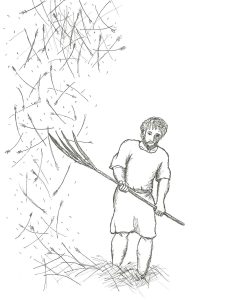
The Hebrew and Greek that is translated as “thresh” in English is illustrated for use in Bible translations in East Africa by Pioneer Bible Translators like this:
Image owned by PBT and Jonathan McDaniel and licensed with the Creative Commons Attribution 3.0 Unported License.
The Hebrew, Aramaic, Greek, and Latin that is translated as “threshing floor” in English is translated in Kim with twal or “termite mound” which are used to build threshing floors. (Source: Andy Warren-Rothlin)
Following are a number of back-translations of Luke 3:17:
Noongar: “He brings his dish and he will sift the seed. He will beat all the seeds and gather the good seeds into his grain house. But he will burn the husks in a fire. That fire burns forever.'” (Source: Warda-Kwabba Luke-Ang)
Uma: “He can be compared to a person who winnows rice. He separates the good rice [lit, rice that has contents] from the empty ones until it is clean. The good rice he puts into his granary, the empty he burns in a fire that blazes on forever.'” (Source: Uma Back Translation)
Yakan: “He will separate the good people and the bad people. He is figuratively like a person winnowing rice, he separates the kernels and the chaff. The kernels he will store in the storage-container (a huge basket) but the chaff he will burn with fire which cannot be put out.'” (Source: Yakan Back Translation)
Western Bukidnon Manobo: “Since He is separating the good people and the bad people. He is like the person winnowing rice, who removes the hull from the rice. The rice will put into the storehouse, but the hull, he will burn it with fire which cannot be put out,’ said John.” (Source: Western Bukidnon Manobo Back Translation)
Kankanaey: “He is compared to a person holding a winnowing-basket that he will use-to-winnow the pounded rice. Its meat (lit. fruit), he will go and store it in his house, but as for the husks, he will burn them in the fire that never-goes-out.'” (Source: Kankanaey Back Translation)
Tagbanwa: “He is the one who will judge the people. For it’s like he is holding his tossing-tool with which he will toss the grain-stalks. He will separate the grain to store in his silo. But the straw, he will throw it on the fire which can never go out till forever.'” (Source: Tagbanwa Back Translation)
Two kinds of wild wheat have grown in the open deciduous oak woodland in the northern part of the Fertile Crescent for several thousand years: Einkorn Wheat Triticum monococcum and Emmer Wheat Triticum dicoccum. Both came into cultivation together with barley. Just before the time of the Romans, the Naked Bread Wheat or Hard Wheat Triticum durum started replacing the hulled varieties. This then became the favorite type of wheat for bread and macaroni. Spelt is a sub-member of the Triticum aestivum species.
In NRSVue and some other versions, the generic Hebrew word bar has been rendered “wheat” in Jeremiah 23:28 et al. This is legitimate, since the grain referred to by bar was probably wheat. However, it might be better to say “grain” in these passages.
The most important early wheat for the Israelites was emmer, probably the only wheat known in Egypt, and referred to in Hebrew as chittah. However, according to Hepper (Baker Encyclopedia of Bible Plants: Flowers and Trees, Fruits and Vegetables, Ecology. Baker Book House, 1992), the seven-headed wheat of the Egyptian king’s dream (Genesis 41:5ff.) suggests that there may also have been Triticum turgidum (rivet wheat) in the emmer group. The Hebrew word kusemeth probably refers to a type of emmer wheat that the Egyptians called swt.
Wheat is a type of grass like rice and barley, growing to around 75 centimeters (2.5 feet) in height and having a head with many small grains in rows.
Bread made from wheat was the staple food for the people of ancient Israel, so God punished them by breaking “the staff of bread” (see, for example, Ezekiel 4:16).
If wheat is unfamiliar, translators can transliterate from a major language in non-rhetorical contexts (for example, English witi, Portuguese trigo, French ble or froment, Swahili ngano, Arabic kama/alkama). The transliteration may add a generic tag such as “grain.” The New Testament passages are mostly rhetorical, opening the possibility for a metaphorical equivalent.
God transcends gender, but most languages are limited to grammatical gender expressed in pronouns. In the case of English, this is traditionally confined to “he” (or in the forms “his,” “him,” and “himself”), “she” (and “her,” “hers,” and “herself”), and “it” (and “its” and “itself”).
Modern Mandarin Chinese, however, offers another possibility. Here, the third-person singular pronoun is always pronounced the same (tā), but it is written differently according to its gender (他 is “he,” 她 is “she,” and 它/牠 is “it” and their respective derivative forms). In each of these characters, the first (or upper) part defines the gender (man, woman, or thing/animal), while the second element gives the clue to its pronunciation.
In 1930, after a full century with dozens of Chinese translations, Bible translator Wang Yuande (王元德) coined a new “godly” pronoun: 祂. Chinese readers immediately knew how to pronounce it: tā. But they also recognized that the first part of that character, signifying something spiritual, clarified that each person of the Trinity has no gender aside from being God.
While the most important Protestant and Catholic Chinese versions respectively have opted not to use 祂, some Bible translations do and it is widely used in hymnals and other Christian materials. Among the translations that use 祂 to refer to “God” were early versions of Lü Zhenzhong’s (呂振中) version (New Testament: 1946, complete Bible: 1970). R.P. Kramers (in The Bible Translator 1956, p. 152ff. ) explains why later versions of Lü’s translation did not continue with this practice: “This new way of writing ‘He,’ however, has created a minor problem of its own: must this polite form be used whenever Jesus is referred to? Lü follows the rule that, wherever Jesus is referred to as a human being, the normal tā (他) is written; where he is referred to as divine, especially after the ascension, the reverential tā (祂) is used.”
In that system one kind of pronoun is used for humans (male and female alike) and one for natural elements, non-liquid masses, and some spiritual entities (one other is used for large animals and another one for miscellaneous items). While in these languages the pronoun for spiritual entities used to be employed when referring to God, this has changed into the use of the human pronoun.
Lynell Zogbo (in The Bible Translator 1989, p. 401ff. ) explains in the following way: “From informal discussions with young Christians especially, it would appear that, at least for some people, the experience and/or concepts of Christianity are affecting the choice of pronoun for God. Some people explain that God is no longer ‘far away,’ but is somehow tangible and personal. For these speakers God has shifted over into the human category.”
In Kouya, God (the Father) and Jesus are referred to with the human pronoun ɔ, whereas the Holy Spirit is referred to with a non-human pronoun. (Northern Grebo and Western Krahn make a similar distinction.)
Eddie Arthur, a former Kouya Bible translation consultant, says the following: “We tried to insist that this shouldn’t happen, but the Kouya team members were insistent that the human pronoun for the Spirit would not work.”
In Burmese, the pronoun ko taw (ကိုယ်တော်) is used either as 2nd person (you) or 3rd person (he, him, his) reference. “This term clearly has its root in the religious language in Burmese. No ordinary persons are addressed or known by this pronoun because it is reserved for Buddhist monks, famous religious teachers, and in the case of Christianity, the Trinity.” (Source: Gam Seng Shae in The Bible Translator 2002, p. 202ff. )
In Thai, the pronoun phra`ong (พระองค์) is used, a gender-neutral pronoun which must refer to a previously introduced royal or divine being. Similarly, in Northern Khmer, which is spoken in Thailand, “an honorific divine pronoun” is used for the pronoun referring to the persons of the Trinity (source: David Thomas in The Bible Translator 1993, p. 445 ). In Urak Lawoi’, another language spoken in Thailand, the translation often uses tuhat (ตูฮัด) — “God” — ”as a divine pronoun where Thai has phra’ong even though it’s actually a noun.” (Source for Thai and Urak Lawoi’: Stephen Pattemore)
The English “Contemporary Torah” addresses the question of God and gendered pronouns by mostly avoiding pronouns in the first five books of the Hebrew Bible/Old Testament (unless God is referred to as “lord,” “father,” “king,” or “warrior”). It does that by either using passive constructs (“He gave us” vs. “we were given”), by using the adjective “divine” or by using “God” rather than a pronoun.
Some Protestant and Orthodox English Bibles use a referential capitalized spelling when referring to the persons of the Trinity with “He,” “His,” “Him,” or “Himself.” This includes for instance the New American Standard Bible or The Orthodox New Testament, but most translations do not. Two other languages where this is also done (in most Bible translations) are the closely related Indonesian and Malay. In both languages this follows the language usage according to the Qur’an, which in turn predicts that usage (see Soesilo in The Bible Translator 1991, p. 442ff. and The Bible Translator 1997, p. 433ff. ).



Leave a Reply
You must be logged in to post a comment.