manger

The Greek that is typically translated in English as “manger” is translated in Mbe as édzábri, the term used for “old worn-out baskets that isn’t usable anymore, except to feed the animals.”

John Watters (in Wycliffe Bible Translators 2016, p. 19) tells the story how this word was chosen:

“In Nigeria, the Mbe translation team was translating the Gospel of Luke. They came to chapter 2, verse 7, which says, ‘She [Mary] gave birth to her firstborn son. She wrapped him snugly in strips of cloth and laid him in a manger, because there was no lodging available for them.’

“The translators took the time to ponder how to to translate some of the words, but not ‘manger.’ They immediately used the word ókpáng.

“As their translation consultant, I asked them, ‘What’s an ókpáng? Tell me what it looks like.’ One of the translators drew a picture on the whiteboard. It was essentially a cradle hung by ropes so that the newborn could be laid in it and swung.

“I suggested they check the collection of notes and commentaries we were using to help the translators whose first language isn’t English. The Mbе translators saw that ‘manger’ referred to animal feeding trough.

“Even as the Mbe team read the notes, they objected. ‘We have always used the word ókpáng. We have used it for years, and that’s what we should use.’ I pointed out to them that it wasn’t just a matter of tradition. God expects us to find the words that express the original meaning as accurately as possible. Furthermore, this word tells us something profound about God.

“‘When he came to live among us and bring salvation to us, he came in the lowliest way possible. He did not come and sleep in a nice ókpáng like every Mbe mother wants for her newborn. Instead, he showed us his unbelievable humility,’ I told them. ‘So we need to find your best word for an animal-feeding trough.’

“Suddenly the person who had argued most loudly for the traditional term offered, ‘We feed our animals out of an old worn-out basket that isn’t usable anymore, except to feed the animals. We call it édzábri!’

“‘Then try that term,’ I said.

As the Mbe people listened, they were visibly moved. Picturing the newborn baby lying in the animals’ feeding basket, they recognized in a new way that Jesus was willing to do whatever it took to reach them. As an adult, he would humble himself by washing the disciples’ feet and then by dying on the cross. And this humility started right from birth, when he was born to a young peasant woman under questionable social conditions and laid in an animal-feeding trough.”

See also Bethlehem.

cloth

The Greek that is translated as “cloth” or “swaddling clothes” in English is translated in Noongar as bwoka or “kangaroo skin.” (Source: Warda-Kwabba Luke-Ang)

See also cloak / shawl and clothes.

His birth brought joy to people of low status (image)

“The low social status of these men is indicated by the fact that they are wearing only one piece of cloth, all that they own. They are men of different ages working out in the fields raising animals. No one usually visits them.”

Drawing by Sawai Chinnawong who employs northern and central Thailand’s popular distinctive artistic style originally used to depict Buddhist moral principles and other religious themes; explanation by Paul DeNeui. From That Man Who Came to Save Us by Sawai Chinnawong and Paul H. DeNeui, William Carey Library, 2010.

For more images by Sawai Chinnawong in TIPs see here.

a sign to you (Luke 2:12)

The Greek in Luke 2:12 that is translated in many English versions as “this will be a sign to you” is translated with an existing figure of speech in Yagua, back-translated as “By it, you will know” (followed by a sign by which something will be known).

Source: Paul Powlison in Notes on Translation June 1979, p. 38-40.

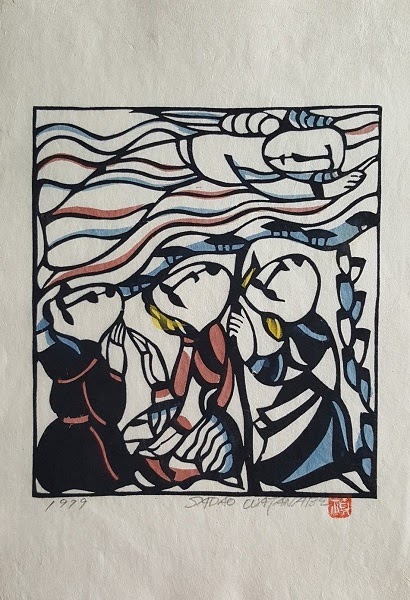
Good news to the shepherds (image)

Hand colored stencil print on washi by Sadao Watanabe (1979)

Image taken with permission from the SadaoHanga Catalogue where you can find many more images and information about Sadao Watanabe. For other images of Sadao Watanabe artworks in TIPs, see here.

Following is a painting by Chen Yuandu 陳緣督 (1902-1967):

Housed in the Société des Auxiliaires des Missions Collection – Whitworth University.

Image taken from Chinese Christian Posters . For more information on the “Ars Sacra Pekinensis” school of art, see this article , for other artworks of that school in TIPs, see here.

formal pronoun: angels addressing people

Like many languages (but unlike Greek or Hebrew or English), Tuvan uses a formal vs. informal 2nd person pronoun (a familiar vs. a respectful “you”). Unlike other languages that have this feature, however, the translators of the Tuvan Bible have attempted to be very consistent in using the different forms of address in every case a 2nd person pronoun has to be used in the translation of the biblical text.

As Voinov shows in Pronominal Theology in Translating the Gospels (in: The Bible Translator 2002, p. 210ff. ), the choice to use either of the pronouns many times involved theological judgment. While the formal pronoun can signal personal distance or a social/power distance between the speaker and addressee, the informal pronoun can indicate familiarity or social/power equality between speaker and addressee.

Here, angels address people with the formal pronoun, expressing respect.

In most Dutch as well as in Western Frisian and Afrikaans translations, the angels are addressing people with the informal pronoun.

See also angel.

sign

The Greek that is typically translated in English as “sign” is translated in Huehuetla Tepehua as “thing to be marveled at” (source: Larson 1889, p. 279) and in Mairasi as “big work” (source: Enggavoter 2004).

complete verse (Luke 2:12)

Following are a number of back-translations of Luke 2:12:

  • Noongar: “And you will see the truth: you will see the baby, wrapped in clothes (lit.: “Kangaroo skin”) and lying in a food box.” (Source: Warda-Kwabba Luke-Ang)
  • Uma: “This is the sign so that you know the truth of my words: you will find a baby wrapped up and laid to sleep in a manger.'” (Source: Uma Back Translation)
  • Yakan: “And this is the sign that this news is true: you will find the child wrapped in a blanket and laid in a box for feeding animals.'” (Source: Yakan Back Translation)
  • Western Bukidnon Manobo: “You will be able to tell the child because when you see a child wrapped in a blanket and laid down in the feeding-trough of a horse, that’s the One,’ he said.” (Source: Western Bukidnon Manobo Back Translation)
  • Kankanaey: “This is how-you -will-know that it is true. You will come-upon that baby wrapped-up and laid-down in the feeding-place of animals.'” (Source: Kankanaey Back Translation)
  • Tagbanwa: “The proof is, you will find a baby bound-round-and-round with pieces-of-cloth, just an animal feeder being where he was caused to lie.'” (Source: Tagbanwa Back Translation)