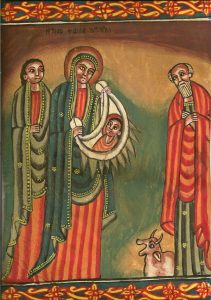
This is a contemporary tempera/gouache on leather painting by an unknown Ethiopian artist. Source: Sacred Art Pilgrim website .
Following is a painting by Chen Yuandu 陳緣督 (1902–1967):
Housed in the Société des Auxiliaires des Missions Collection – Whitworth University.
Image taken from Chinese Christian Posters . For more information on the “Ars Sacra Pekinensis” school of art, see this article , for other artworks of that school in TIPs, see here.
Following are a number of back-translations of Luke 2:29:
Noongar: “‘Lord, you kept your word, and now let your servant depart in peace.” (Source: Warda-Kwabba Luke-Ang)
Uma: “‘O Lord, even if I die, it no longer matters. My heart is satisfied, because you promise has beenfulfilled.” (Source: Uma Back Translation)
Yakan: “‘O God, now you can let your servant go home to the afterlife because it is fulfilled what you have promised me.” (Source: Yakan Back Translation)
Western Bukidnon Manobo: “He said, ‘Now, Lord, You have fulfilled Your promise to me, and it is now possible that You permit me to die because there is nothing else I am waiting for.” (Source: Western Bukidnon Manobo Back Translation)
Kankanaey: “‘Lord, it’s-all-right (lit. even-if) if you (sing.) allow the death of me your (sing.) slave, because my mind is at-peace. For here-now you (sing.) have fulfilled what you (sing.) promised me.” (Source: Kankanaey Back Translation)
Tagbanwa: “‘My Master, as for me who am your servant, (it’s okay) even if you reclaim my life now, in harmony with what you promised me.” (Source: Tagbanwa Back Translation)
Chichewa (interconfessional translation, 1999): “Lord God, now allow me your servant, let me go with peace, for you have really done those things you promised.” (Source: Wendland 1998, p. 157)
Click or tap here to see the rest of this insight.
Like a number of other East Asian languages, Japanese uses a complex system of honorifics, i.e. a system where a number of different levels of politeness are expressed in language via words, word forms or grammatical constructs. These can range from addressing someone or referring to someone with contempt (very informal) to expressing the highest level of reference (as used in addressing or referring to God) or any number of levels in-between. One way to do this is through the usage (or a lack) of an honorific prefix as shown here in the widely-used Japanese Shinkaiyaku (新改訳) Bible of 2017.
In these verses, the Hebrew and Greek that is translated as “word” or “bidding” in English is translated in the Shinkaiyaku Bible as o-kotoba (おことば), combining “word” (kotoba) with the respectful prefix o-. (Source: S. E. Doi, see also S. E. Doi in Journal of Translation, 18/2022, p. 37ff.
Living Water is produced for the Bible translation movement in association with Lutheran Bible Translators. Lyrics derived from the ESV® Bible (The Holy Bible, English Standard Version®).
In some languages, it may be more natural to put 2:29 after 2:32. See the General Comment on 2:29–32 at the end of the notes on 2:32b for an example.
2:29a
Sovereign Lord: The Greek word that the Berean Standard Bible translates as Sovereign Lord means “master” or “lord.” This is what a slave would call his master.
This is a different Greek word than the usual word for “lord,” but the meaning is similar. You may use the same term as you use for “lord,” or you may use another term with a similar meaning.
as You have promised: The Greek phrase that the Berean Standard Bible translates as as You have promised is literally “according to your word.” This refers back to 2:26. At some time in the past, the Holy Spirit had told Simeon that he would not die before he had seen the Christ.
God fulfilled his promise that Simeon would see the Christ when Simeon saw Jesus.
2:29b
You now dismiss Your servant in peace: The Greek word that the Berean Standard Bible translates as dismiss is literally “release” or “set free.” It is used in this clause as a euphemism, so that the clause means “you now allow your servant to die in peace.” Simeon implied that when the time came for him to die, he would die in peace. Simeon praised God with these words. The words do not imply that Simeon died that same day.
Some ways to translate this are:
• Use a euphemism in your language for dying. For example:
you are allowing your servant to leave in peace (God’s Word)
• Translate the meaning directly. For example:
I am your servant, and now I can die in peace (Contemporary English Version)
now: The word now refers to that exact time when Simeon saw Jesus. Simeon felt that whenever he might die after that time, he would die satisfied.
Your servant: When Simeon praised God, he referred to himself as Your servant. In some languages, it may be necessary to express this in a different way to make it clear that Simeon was referring to himself. For example:
you now dismiss me, your servant, in peace -or-
I am your servant, you now dismiss me in peace
servant: The Greek word that the Berean Standard Bible translates as servant also meant “slave.” This referred to someone who was owned by another person. He had no rights of his own and worked for his owner without receiving pay.
If the idea of slaves or servants is not known in your area, you can say:
I belong to you -or-
you who own me
Simeon expressed humility and his desire to serve God by referring to himself in this way.
in peace: In this context the phrase in peace describes an attitude of calmness and contentment. Simeon could die in peace because he had at last seen the Christ. Some other ways to say this are:



Leave a Reply
You must be logged in to post a comment.