
Click here to see the image in higher resolution.
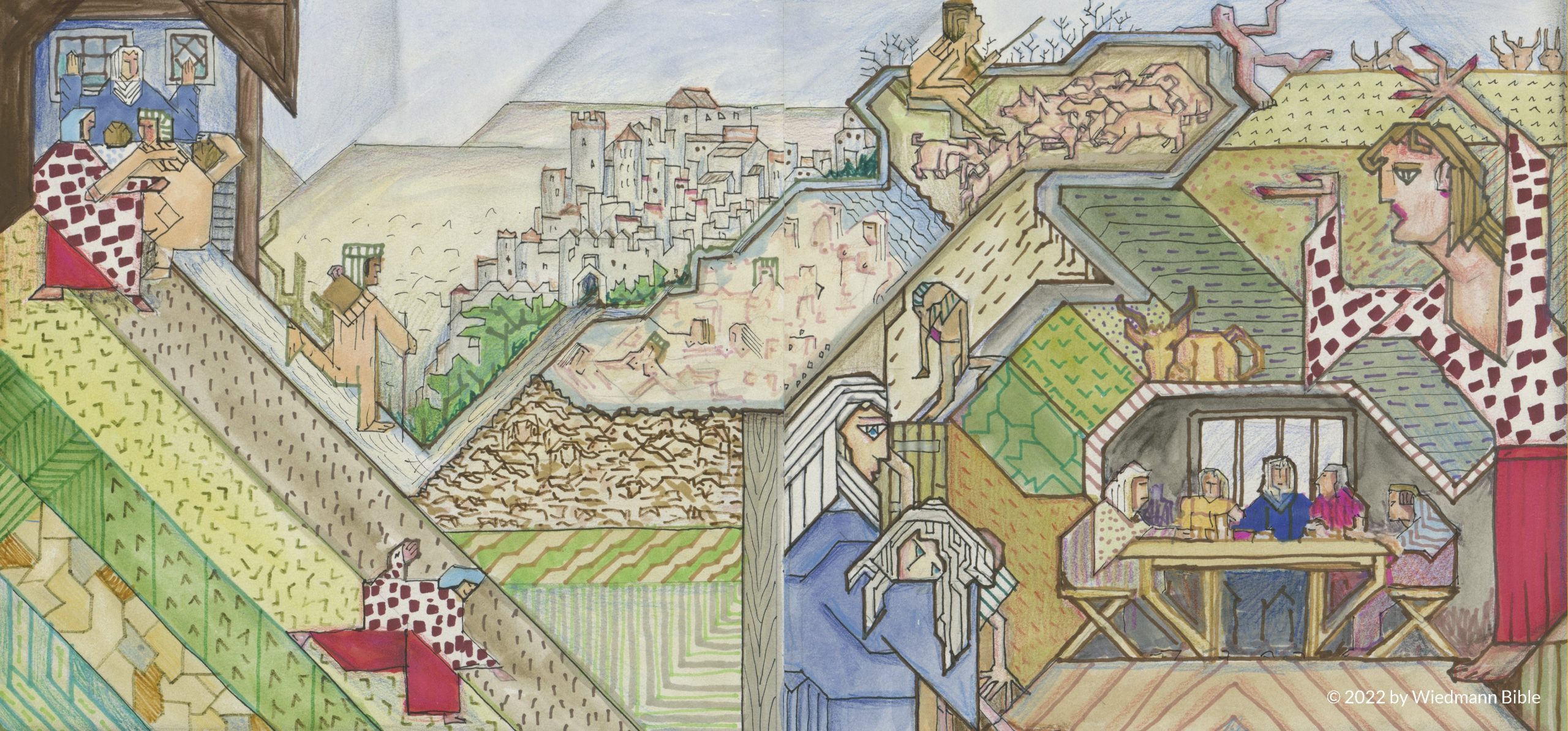
Image taken from the Wiedmann Bible. For more information about the images and ways to adopt them, see here .
For other images of Willy Wiedmann paintings in TIPs, see here.

εὐφρανθῆναι δὲ καὶ χαρῆναι ἔδει, ὅτι ὁ ἀδελφός σου οὗτος νεκρὸς ἦν καὶ ἔζησεν, καὶ ἀπολωλὼς καὶ εὑρέθη.
32But we had to celebrate and rejoice, because this brother of yours was dead and has come to life; he was lost and has been found.’ ”
The Greek that is often translated as “lost” in English is translated in Mairasi as “their faces lengthened.” (Source: Enggavoter 2004)
The Greek and Hebrew that is translated as “brother” in English is translated in Mandarin Chinese as dìdì (弟弟) or “younger brother.”
The Hebrew, Aramaic, and Greek that is typically translated in English as “joy” or “happiness” is translated in the Hausa Common Language Bible idiomatically as farin ciki or “white stomach.” In some cases, such as in Genesis 29:11, it is also added for emphatic purposes.
Other languages that use the same expression include Southern Birifor (pʋpɛl), Dera (popolok awo), Reshe (ɾipo ɾipuhã). (Source: Andy Warren-Rothlin)
See also Seat of the Mind / Seat of Emotions, rejoiced greatly / celebrated, the Mossi translation of “righteous”, and joy.
The following is a church window based on an image of Annie Vallotton. This is installed in a church of the Union des Églises Baptistes du Cameroun in Mowo (Mokong), Cameroon.

Photo and the following description by Ken Hollingsworth
“The windows are open with no screens or glass. The pictures were fabricated by projecting the picture using an overhead projector on a piece of plywood. They were drawn on the plywood with charcoal. Then the fabricator cut pieces of iron rebar to make the picture. Then the iron pieces were welded together. Later, when the pictures were installed, they were painted with different colors to help the people ‘see’ the picture.”
Following are a number of back-translations of Luke 15:32:
Like a number of other East Asian languages, Japanese uses a complex system of honorifics, i.e. a system where a number of different levels of politeness are expressed in language via words, word forms or grammatical constructs. These can range from addressing someone or referring to someone with contempt (very informal) to expressing the highest level of reference (as used in addressing or referring to God) or any number of levels in-between. One way Japanese shows different degree of politeness is through the choice of a second person pronoun (“you” and its various forms) as shown here in the widely-used Japanese Shinkaiyaku (新改訳) Bible of 2017. The most commonly used anata (あなた) is typically used when the speaker is humbly addressing another person.
In these verses, however, omae (おまえ) is used, a cruder second person pronoun, that Jesus for instance chooses when chiding his disciples. (Source: S. E. Doi, see also S. E. Doi in Journal of Translation, 18/2022, p. 37ff. )
See also first person pronoun with low register and third person pronoun with low register.
Barclay Newman, a translator on the teams for both the Good News Bible and the Contemporary English Version, translated passages of the New Testament into English and published them in 2014, “in a publication brief enough to be non-threatening, yet long enough to be taken seriously, and interesting enough to appeal to believers and un-believers alike.” The following is the translation of Luke 15:11-32:
Finally, Jesus told them this story:
A man’s younger son once said,
“Dad, give me my share of the family fortune!”
So his father divided everything
between him and his older brother.
Soon the younger son packed up everything
and left for a foreign country,
where he wasted every cent of his inheritance.
Then a terrible famine struck the land,
leaving him famished and without food.
So hungry was the young man that he took a job
feeding bean pods to nasty pigs,
and he would have eaten some of the pods himself,
if only the owner had turned his back.
At last, in desperation, he said to himself,
“My dad’s workers have more than enough to eat,
while I sit here with these pigs, starving to death.
Best thing I can do is to go home and make up with my dad.
I’ll say, “Dad, I’ve been a really lousy son,
worthless and useless to both you and God.
Fact is, I don’t deserve to be called your son —
just treat me like one of your servants.”
Before he even reached the road to the farmhouse,
his father saw him and felt so sorry that he ran over
and greeted the young man with hugs and kisses.
“Dad, I’ve been a really lousy son,” said the boy.
“I’m worthless and useless to both you and God.
Fact is, I don’t deserve to be called your son.”
But his father instructed the servants,
“Hurry! Bring him the best clothes.
Put a gold ring on his finger and sandals on his feet.
And prepare our choice beef, so we can celebrate!
My son was dead, and now he’s alive!
My son was lost, and now he’s found.”
Then the festivities began.
Meanwhile, the older brother was coming in from the fields,
when he heard the sound of music and dancing.
“What’s going on?” he asked one of the servants.
“Your younger brother has come home,” answered the servant,
“and your father ordered us
to prepare the choice beef for a feast.”
This made the older brother so angry
that he refused to go anywhere near the house.
His father went out and begged him to join the celebration,
but his son answered, “All my life I’ve obeyed you,
and I’ve worked like a slave.
Yet you’ve never even given me a small goat,
so I could throw a party for my friends.
This other son of yours blew all his money on hookers,
and now that he’s back home,
you’ve ordered our choice beef
to be killed for a feast in his honor.”
“My dear son,” replied his father, “You’re always here,
and everything I have is yours as well.
But don’t you think we should celebrate?
Your brother was dead, and now he’s alive.
He was lost, and now he’s found.”
No comments yet.
Leave a Reply
You must be logged in to post a comment.