
The Greek in Luke 15:17 that is translated as “starve” in English is translated in Mekeo as “I am seeing only the food of the dead.”
relationship of elder son and father in the Parable of the Prodigal Son
New Testament Greek is by Balinese standards an extremely impolite language. Consider, for example, the second person pronoun. When speaking to God, to a nobleman, to a friend, to a pupil, or to a slave, the same word is used. In Balinese this is completely different. In the above examples one would differentiate various social ranks and use terms which, more or less freely translated, mean “adored one” or “he who is borne on the head”, “feet of Your Highness”, “older (or younger) brother”, “little one”, and “you”. (…) In Balinese one has to cope with three vocabularies within the language, each of which, at a moderate estimate, includes some hundreds of words. One employs the ordinary common language (“Low Balinese”) when speaking with intimates, equals, or inferiors; polite terms must, however, be used as soon as one begins to speak to one’s superiors or to strangers; and “deferential” terms are obligatory in all cases when one is so bold as to speak of parts of the body, or the acts, possessions, and qualities of important people. The Balinese sums up the two last named vocabularies under the term alus (“fine”, or “noble”): we say “High Balinese”. (…)
In the parable of the Prodigal Son, the younger son, who feels himself less than a slave, speaks to his father in High Balinese; the elder son may use the intimate Low Balinese. When, however, the latter severs himself from the intimate family community, he uses High Balinese to express his contempt, thus placing a gulf between himself and his father.
Source: J.L. Swellengrebel in The Bible Translator 1950, p. 124ff.
bread, loaf
The Greek term that is translated in English as “bread” or “loaf” is translated in Samo, it is translated as “Sago,” which serves “like ‘bread’ for the Hebrews, as a generic for food in the Samo language. It is a near-perfect metonymy that has all the semantic elements necessary for effective communication.” (Source: Daniel Shaw in Scriptura 96/2007, p. 501ff.)
In Chol it is translated as waj, the equivalent of a tortilla. (Click or tap here to see the rest of this insight)
John Beekman (in The Bible Translator 1962, p. 180f. ) explains: “The word ‘bread’ in Scripture primarily occurs as either a specific term for bread (including the Lord’s Supper), or as a generic term for food. It is not surprising, however, the some aboriginal groups use something other than bread as the staff of life. The Chols, with their cultural focus in the cultivation of corn, use waj, a type of thin corn flake. Since a meal is not complete without this main item of food, the term has been extended to include any other foods which may be served along with waj. While bread is known to them, its use is limited to a few occasions during the year when it functions as a dessert. In translating this term in the Chol New Testament, consistent use has been made of the word waj whenever the function of bread as a basic food was in focus. John 6:35, “I am the bread of life,” was thus translated with this word. If the word for bread had been used, it was feared that the Chol would compare Christ to the desirable, but not absolutely necessary, dessert.”
Robert Bascom adds his thoughts to this in relation to other Mayan languages (in Omanson 2001, p. 260): “In many Mayan languages, ‘bread’ can be translated waj or kaxlan waj. The first term literally means anything made from corn meal, while the second term literally means ‘foreigner’s waj,’ and refers to the local wheat-based sweet breads which are so popular within the broader European-influenced culture of the region. On the one hand, waj would be a better dynamic equivalent in cases where ‘bread’ meant ‘food,’ but in cases where the focus is literal or the reference well-known, kaxlan waj would preserve a flour-based meaning (though in biblical times barley was more in use than wheat) and not insert corn into a time and place where it does not belong. On the other hand kaxlan waj is not the staff of life, but refers to a local delicacy. In cases such as these, it is even tempting to suggest borrowing pan, the Spanish word for ‘bread,’ but native speakers might respond that borrowing a foreign word is not necessary since both waj and kaxlan waj are native terms that cover the meaning (though in this case, perhaps not all that well).”
In Mairasi it is translated bread tubers. Tubers are the main food staple and are therefore synonymous with food. (Source: Enggavoter 2004). In Yagaria, Kâteand Yabem it is translated as “taro cake.” (Source: Renck, p. 101)
came to himself / came to his senses
The Greek in Luke 15:17 that is translated as “he came to himself” or “he came to his senses” is (back-) translated in a number of ways:
- Sranan Tongo: “he came to get himself”
- Tzeltal: “his heart arrived”
- Thai (translation of 1967): “he sensed himself” (implying realization that he had done wrong)
- Kekchí: “it fell into his heart”
- Tagalog: “his self came back”
- Yaka, Chuukese, Pohnpeian: “he came to wisdom (or: became wise)”
- Kituba: “he understood himself”
- Uab Meto: “his heart came to life again”
- Kaqchikel: “he came out of his stupor”
- Lomwe, Yao: “he was turned, or, aroused (as from sleep), in his heart”
- Javanese: “he became-aware of his own condition”
- Kele: “he thought again about his affair” (source for all above: Reiling / Swellengrebel)
- Mairasi: “his own liver’s sky split” (In Mairasi, the liver is the seat of emotions) (source: Enggavoter 2004)
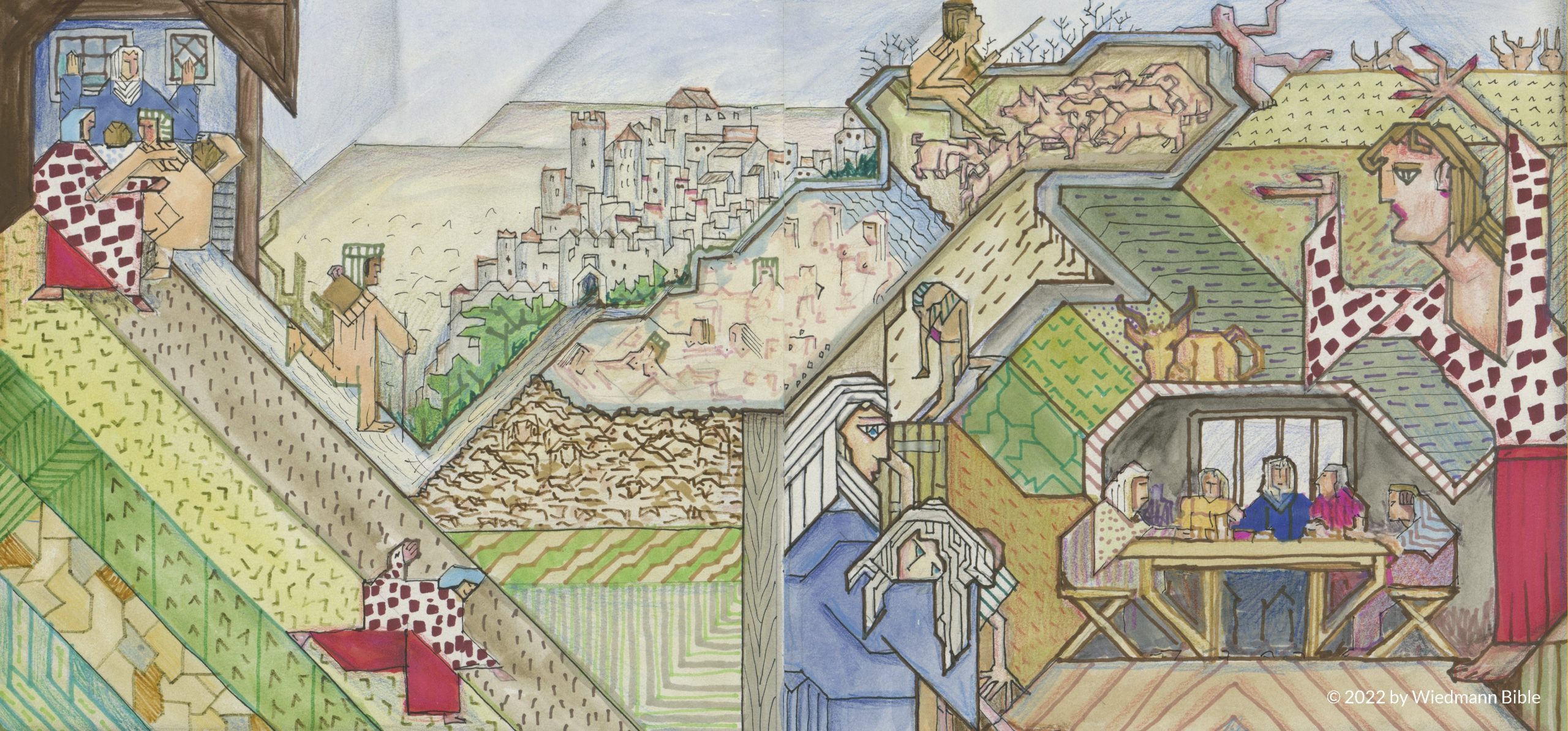
parable of the prodigal son (image)

my Father / our Father
The Greek that is translated as “my Father” in English is translated in Matumbi as Tati’ bangu’ or “my fathers.” “Our Father” is translated as “our Fathers” (and likewise “our ancestor” as “our ancestors”). Matumbi uses a majestic plural as an honorific when addressing parents. (Source: Tim Macsaveny)
See also addressing one’s or someone else’s father humbly / respectfully in Japanese (父) and Father (address for God).
complete verse (Luke 15:17)
Following are a number of back-translations of Luke 15:17:
- Noongar: “So then he began to think straight. ‘I am stupid. My father gives money to all his workers. They have more food than they can eat, and I sit in this place hungry.” (Source: Warda-Kwabba Luke-Ang)
- Uma: “‘Finally, he pondered, he said: ‘The workers in my father’s house, their food is greatly in excess. But as for me here, I am almost starved to death.” (Source: Uma Back Translation)
- Yakan: “Then he started to think about his foolishness and he said in his liver, ‘All the servants of my father their food is plentiful. And I am about to die here of starvation.” (Source: Yakan Back Translation)
- Western Bukidnon Manobo: “And after a long time, he began to thoroughly consider everything. He said, ‘All of the servants of my father, they have more food than they need. But as for me here, I’m about to die of hunger.” (Source: Western Bukidnon Manobo Back Translation)
- Kankanaey: “‘Then he came-to-his-senses (lit. became-thoughted) and said to himself, ‘All whom my father salaries, they have an excess to eat, and here by-contrast I am here dying from my hunger.” (Source: Kankanaey Back Translation)
- Tagbanwa: “When he thought-over what he had done like that, it came to his mind/inner-being, ‘Oh,’ he said, ‘all of Father’s paid-workers are supplied with the food they need, and even in excess. As for me, I’m starving here!” (Source: Tagbanwa Back Translation)
Scriptures Plain & Simple (Luke 15:11-32)
Barclay Newman, a translator on the teams for both the Good News Bible and the Contemporary English Version, translated passages of the New Testament into English and published them in 2014, “in a publication brief enough to be non-threatening, yet long enough to be taken seriously, and interesting enough to appeal to believers and un-believers alike.” The following is the translation of Luke 15:11-32:
Finally, Jesus told them this story:
A man’s younger son once said,
“Dad, give me my share of the family fortune!”
So his father divided everything
between him and his older brother.
Soon the younger son packed up everything
and left for a foreign country,
where he wasted every cent of his inheritance.
Then a terrible famine struck the land,
leaving him famished and without food.
So hungry was the young man that he took a job
feeding bean pods to nasty pigs,
and he would have eaten some of the pods himself,
if only the owner had turned his back.
At last, in desperation, he said to himself,
“My dad’s workers have more than enough to eat,
while I sit here with these pigs, starving to death.
Best thing I can do is to go home and make up with my dad.
I’ll say, “Dad, I’ve been a really lousy son,
worthless and useless to both you and God.
Fact is, I don’t deserve to be called your son —
just treat me like one of your servants.”
Before he even reached the road to the farmhouse,
his father saw him and felt so sorry that he ran over
and greeted the young man with hugs and kisses.
“Dad, I’ve been a really lousy son,” said the boy.
“I’m worthless and useless to both you and God.
Fact is, I don’t deserve to be called your son.”
But his father instructed the servants,
“Hurry! Bring him the best clothes.
Put a gold ring on his finger and sandals on his feet.
And prepare our choice beef, so we can celebrate!
My son was dead, and now he’s alive!
My son was lost, and now he’s found.”
Then the festivities began.
Meanwhile, the older brother was coming in from the fields,
when he heard the sound of music and dancing.
“What’s going on?” he asked one of the servants.
“Your younger brother has come home,” answered the servant,
“and your father ordered us
to prepare the choice beef for a feast.”
This made the older brother so angry
that he refused to go anywhere near the house.
His father went out and begged him to join the celebration,
but his son answered, “All my life I’ve obeyed you,
and I’ve worked like a slave.
Yet you’ve never even given me a small goat,
so I could throw a party for my friends.
This other son of yours blew all his money on hookers,
and now that he’s back home,
you’ve ordered our choice beef
to be killed for a feast in his honor.”
“My dear son,” replied his father, “You’re always here,
and everything I have is yours as well.
But don’t you think we should celebrate?
Your brother was dead, and now he’s alive.
He was lost, and now he’s found.”
Leave a Reply
You must be logged in to post a comment.