wolf

The Hebrew, Greek, and Latin that is translated in English as “wolf” is translated in Muna as da’u ngkahoku: “forest dog,” because there is no immediate lexical equivalent. (Source: René van den Berg)

In Asháninka, it is translated as “ferocious animal,” in Waffa and Kui as “wild dog,” and in Navajo (Dinė) as “Coyote” (source: M. Larson / B. Moore in Notes on Translation February 1970, p. 1-125), and in Odia as “tiger” (source for this and for Kui: Helen Evans in The Bible Translator 1954, p. 40ff. )

In Lingala it is translated as “leopard.” Sigurd F. Westberg (in The Bible Translator 1956, p. 117ff. ) explains: “The wolf, for example, does not exist here, but its relative the jackal does and we have a name for it. But the jackal does not prey on domestic animals as the wolf did in Palestine, nor is he as fierce. The equivalent from these points of view is the leopard. Hence in Genesis 49 Benjamin is likened to a ravenous leopard, and the basic meaning is approached more closely than if we had been governed by scientific classification.”

Mungaka also uses “leopard” (see also bear (animal)) (source: Nama 1990). Likewise in Klao and Dan (source: Don Slager).

In Elhomwe “fierce animal” is used. (Source: project-specific translation notes in Paratext)

Michel Kenmogne comments on this and comparable translations (in Noss 2007, p. 378 ff.): “Some exegetical solutions adopted by missionary translations may have been acceptable during that time frame, but weighed against today’s translation theory and procedures, they appear quite outdated and even questionable. For example, Atangana Nama approvingly mentions the translation into Mungaka of terms like ‘deer’ as ‘leopard’, ‘camel’ as ‘elephant’, and ‘wheat’ as ‘maize,’ where the target language has no direct equivalent to the source text. These pre-Nida translation options, now known as adaptations, would be declared unacceptable in modern practice, since they misrepresent the historico-zoological and agricultural realities in the Bible. Nowadays it is considered better to give a generalized term, like ‘grain,’ and where necessary specify ‘a grain called wheat,’ than to give an incorrect equivalence. Unknown animals such as bears, can be called ‘fierce animals,’ especially if the reference is a non-historical context.”

Click or tap here for the rest of the entry about “wolf” in United Bible Societies’ All Creatures Great and Small: Living things in the Bible.

There is no problem in identifying the Hebrew word with the Wolf Canis lupus, which was a common wild animal all over the land of Israel in the biblical period. Today it is almost extinct in Israel, but small numbers still exist in Lebanon, Syria, Iraq, and Iran. The Greek and Latin words are general words for the wolf, including European species as well as the Syrian one.

The wolf is the ancestor of the German shepherd dog, and all similar breeds. The Syrian wolf, however, unlike the European and North American breeds, does not have long thick fur. It is a light brown color with a typical long face, and it is about the size of the German shepherd dog. It looks similar to the jackal, but is much bigger. This type of wolf lived singly, in pairs, or occasionally in a small family group of three or four animals; but sometimes, when prey was scarce, neighboring wolves would come together temporarily to hunt in cooperation with each other. The varieties in North America and Europe, on the other hand, come together in packs in the winter and stay together until well into the spring.

In biblical times the Syrian wolf took hares, small gazelle, and partridges as its main prey, but it was also a constant threat to sheep and goats. Only extremely rarely would it attack a human being. It was nowhere near as dangerous to humans as the lion or the bear. On the other hand, the Syrian wolf was not afraid of humans, and once it had killed a sheep, it would fiercely protect its kill. A group of men was required if it was to be chased away. It was extremely clever at avoiding traps that had been set for it. It hunted at night and located other wolves early in the evening by howling loudly.

These wolves did not stay in one area but roamed constantly. Shepherds could thus never be confident that there were no wolves nearby. They could appear unexpectedly at any time, even in the villages where they were often mistaken for dogs.

To the biblical writers the wolf was a symbol of roaming, opportunistic, dangerous, fierce, and clever banditry. To refer to a person as a wolf would in some contexts indicate that he was a roaming, clever bandit, and in other contexts that he was a clever, dangerous opportunist. This latter usage usually referred to someone using a position of leadership for his own benefit at the expense of other people.

In Africa there are no wolves, but the Spotted Hyena Crocula crocuta, the Brown Hyena Hyaena brunnea, or the African Painted Hunting Dog Lycaon pictus are the local equivalents used in many translations. A problem with using these terms for the Syrian wolf is that these African animals may have a symbolic significance for the local readers which is very different from that intended by the biblical writers. For instance, the spotted hyena is associated with witchcraft in some societies. In cases where the local significance is sufficiently different, a footnote should be used to provide a guide to the readers.

In Argentina and Brazil the beautiful Maned Wolf Chrysocyon jubatus is a good local equivalent, or the Portuguese or Spanish words for wolf can be used. The coyote is another possible equivalent.

In India and in Central and Southeast Asia, the Indian (or red) wild dog, also known as the Dhole Cuon alpinus, is likewise a good local equivalent for the wolf.

In areas where there are no animals equivalent to wolves, a phrase like “large wild dog” can be used, or a word may be borrowed from the dominant language of the area.

Source: All Creatures Great and Small: Living things in the Bible (UBS Helps for Translators)
Scriptures Plain & Simple (Luke 10:1-12)

Barclay Newman, a translator on the teams for both the Good News Bible and the Contemporary English Version, translated passages of the New Testament into English and published them in 2014, “in a publication brief enough to be non-threatening, yet long enough to be taken seriously, and interesting enough to appeal to believers and un-believers alike.” The following is the translation of Luke 10:1-12:

Later the Lord chose seventy-two other followers
and sent them out two by two to every town and village
       that he intended to visit. He said to them:

       “So many crops in the field, and so few workers!
              Pray for the Lord of the harvest to send more workers.
       Now go, and remember I’m sending you out
              like lambs among hungry wolves.
       Take only the clothes you absolutely need,
              and don’t waste time just hanging loose!
       Ask God’s blessing upon every home
              where you are welcomed,
              but withhold it where you are rejected.
       Stay with the first family that invites you,
       eating and drinking whatever they provide,
              without moving from place to place.
       Remember you are worth what you receive,
              if you work really hard.

       “When a town welcomes you, heal their sick and say,
              ‘The Ultimate Kingdom will soon be here!’
       But when a town rejects you,
              stand on the top of a soap box and shout,
       ‘This is your final warning!
              The Ultimate Kingdom will soon be here!’

       “My followers, I tell you now
       that no town will be judged more harshly
              than those that reject you!”

complete verse (Luke 10:3)

Following are a number of back-translations of Luke 10:3:

  • Noongar: “‘Go! I am sending you, like little sheep among dingos.” (Source: Warda-Kwabba Luke-Ang)
  • Uma: “‘Go, but be careful, because I order you to go in the middle of evil people. You will be like sheep in the middle of serigala.” (Source: Uma Back Translation)
  • Yakan: “Na, go now. But be careful for I send you to bad people, you are like the offspring of sheep going among a crowd of fierce dogs.” (Source: Yakan Back Translation)
  • Western Bukidnon Manobo: “You leave now, but be on your guard because I am sending you to a harmful people. You are like young sheep, and they are like lions.” (Source: Western Bukidnon Manobo Back Translation)
  • Kankanaey: “Go! But be careful, because I am sending you to evil/malicious people as if you are sheep going to where fierce dogs are.” (Source: Kankanaey Back Translation)
  • Tagbanwa: “Well, you go now. I am sending you like sheep in a mass of wild dogs.” (Source: Tagbanwa Back Translation)

formal pronoun: Jesus addressing his disciples and common people

Like many languages (but unlike Greek or Hebrew or English), Tuvan uses a formal vs. informal 2nd person pronoun (a familiar vs. a respectful “you”). Unlike other languages that have this feature, however, the translators of the Tuvan Bible have attempted to be very consistent in using the different forms of address in every case a 2nd person pronoun has to be used in the translation of the biblical text.

As Voinov shows in Pronominal Theology in Translating the Gospels (in: The Bible Translator 2002, p. 210ff. ), the choice to use either of the pronouns many times involved theological judgment. While the formal pronoun can signal personal distance or a social/power distance between the speaker and addressee, the informal pronoun can indicate familiarity or social/power equality between speaker and addressee.

Here, Jesus is addressing his disciples, individuals and/or crowds with the formal pronoun, showing respect.

In most Dutch translations, Jesus addresses his disciples and common people with the informal pronoun, whereas they address him with the formal form.

1st person pronoun referring to God (Japanese)

Click or tap here to see the rest of this insight.

Like a number of other East Asian languages, Japanese uses a complex system of honorifics, i.e. a system where a number of different levels of politeness are expressed in language via words, word forms or grammatical constructs. These can range from addressing someone or referring to someone with contempt (very informal) to expressing the highest level of reference (as used in addressing or referring to God) or any number of levels in-between.

One way Japanese shows different degree of politeness is through the choice of a first person singular and plural pronoun (“I” and “we” and its various forms) as shown here in the widely-used Japanese Shinkaiyaku (新改訳) Bible of 2017. The most commonly used watashi/watakushi (私) is typically used when the speaker is humble and asking for help. In these verses, where God / Jesus is referring to himself, watashi is also used but instead of the kanji writing system (私) the syllabary hiragana (わたし) is used to distinguish God from others.

(Source: S. E. Doi, see also S. E. Doi in Journal of Translation, 18/2022, p. 37ff. )

See also pronoun for “God”.

formal 2nd person plural pronoun (Japanese)

Click or tap here to see the rest of this insight.

Like a number of other East Asian languages, Japanese uses a complex system of honorifics, i.e. a system where a number of different levels of politeness are expressed in language via words, word forms or grammatical constructs. These can range from addressing someone or referring to someone with contempt (very informal) to expressing the highest level of reference (as used in addressing or referring to God) or any number of levels in-between.

One way Japanese shows different degree of politeness is through the choice of a formal plural suffix to the second person pronoun (“you” and its various forms) as shown here in the widely-used Japanese Shinkaiyaku (新改訳) Bible of 2017. In these verses, anata-gata (あなたがた) is used, combining the second person pronoun anata and the plural suffix -gata to create a formal plural pronoun (“you” [plural] in English).

(Source: S. E. Doi, see also S. E. Doi in Journal of Translation, 18/2022, p. 37ff. )

sheep / lamb

Before the time of Abraham at least five breeds of sheep had already been developed in Mesopotamia. From mummified remains (that is, preserved dead bodies) and ancient art it is also known that at least two different breeds had reached Egypt by about 2000 B.C. Thus it is likely that the sheep mentioned in the Bible were of more than one breed.

The Hebrew word kar seems to be used of imported foreign sheep and may refer to a special breed but some scholars think it refers to a wether (castrated ram), since this word is never used in the context of sacrifice. This word is also used for a battering ram, that is, a heavy pole suspended on a rope, used in war for breaking down walls. ’Ayil is the word for a ram or adult male sheep, rachel is a breeding ewe or female sheep, and taleh is a very young lamb, probably still unweaned. The remaining Hebrew words refer to sheep in general.

The Greek word probaton is the general word for sheep, or flocks that may include goats. Krios is the Greek word for a ram or male sheep. Pascha is a technical name for the Passover lamb exclusively, and the remaining Greek words all mean lamb. Ovis is the Latin word for sheep.

Click or tap here for the rest of this entry in United Bible Societies’ All Creatures Great and Small: Living things in the Bible.

The early Hebrews were nomadic shepherds to whom sheep were the most important domestic animal. While goats eat almost any vegetation, sheep are much more selective about the grasses and plants they eat. This meant that suitable grazing for them was not always easy to find, and shepherds had to keep moving their flocks from place to place. This led to a nomadic lifestyle, with movable tents rather than houses being the normal household shelter. It was not until the occupation of Canaan after the Exodus that the lifestyle of the Israelites changed, and they became settled village-dwelling farmers and fruit growers.

However, even then, most households owned sheep, and some family members would function as shepherds, often living away from home for fairly long periods.

Sheep in the Bible were a source of meat, milk, wool, hides, and horns, and it seems likely that various strains were bred selectively to enhance production of these commodities. Wool is mentioned in the Bible as early as the Mosaic Law, which forbade the weaving of cloth containing both wool and plant fibers. The shearing of sheep is mentioned even earlier, in Genesis 31:19. Wool was in fact the most common and available fiber known to the people of Israel.

There was a very extensive wool trade in biblical times, stretching from Egypt to China. In the Middle East wool was cheaper than cotton or linen, which were the other common fibers. (Silk was known by the time of Solomon, but it was extremely expensive as it was produced in China and handled by numerous traders on its way west.) It would be a mistake to think of all wool at that time as being white, as Genesis 30 indicates quite clearly that there were also dark colored sheep and sheep that had dark and light patches, probably varying combinations of black, white, and brown.

We can be fairly sure that one breed of sheep known to the Israelites was the Fat-tailed Sheep Ovis laticaudata and that its fatty tail is referred to in Exodus 29:22, Leviticus 3:9 et al.

Rams’ horns had a variety of uses. Whole ram horns were used as drinking vessels, jars, and trumpets. But pieces of horn were used as handles for knives and other household implements, and for jewelry such as bracelets and beads. Needles too, and probably also arrow heads, were made from horn, as well as from bone and later from bronze and iron.

Sheep were also very important in Israelite religion. They were a very important element in the sacrificial system and in the traditional religious feasts, especially the Feast of Passover.

Sheep and goats belong to the same general family. They differ in that sheep produce wool, which is a special type of soft hair, among the ordinary hairs on their bodies. A ram’s horns too differ in shape from a goat’s horns, those of a ram curling down in a tight spiral beside its face, with those of a goat curving more gently back towards its shoulders. The sheep of biblical times produced much shorter wool than is common with wool-bearing breeds of today.

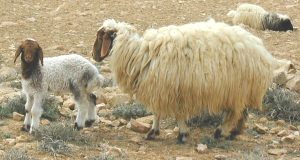
The fat-tailed or broad-tailed sheep is a smallish breed usually brown and white with a very broad tail. Like most other breeds of sheep in the Middle East it has large floppy ears.

Sheep are generally fairly timid animals, lacking the self-confidence and adaptability of goats. While goats will spread out in their search for food and then regroup without much difficulty, sheep become very insecure when they are separated from other sheep and tend to stay bunched together. They thus require a lot of shepherding. In the Middle East the method of shepherding involves training the dominant ram to follow the shepherd. The remaining sheep then follow this dominant ram, which often wears a wooden clapper or a bell. As they feed, the sheep usually keep within earshot of this sound. It is likely that this method is centuries old.

In most modern breeds only male sheep have horns, but in most ancient breeds female sheep had short horns too. This made separating sheep from goats in a single flock more difficult than it is today.

Of all animals the sheep was the most important for the Israelite nation. It had great religious, social, and economic importance.

In the Bible sheep are a common metaphor for the people of Israel and perhaps for people in general. Like sheep the people are seen as easily going astray (Psalms 119:176; Isaiah 53:6; Jeremiah 50:6; 1 Peter 2:25), as being in need of guidance and protection (1 Kings 22:17; 2 Chronicles 18:16; Matthew 9:36; Mark 6:34), as being very defenseless (Isaiah 52:7), and as being destined to an early death (Psalms 44:22; Jeremiah 12:3; Romans 8:36).

The metaphor of a lamb is used in the New Testament to refer to Christ, with an emphasis on his being a sacrifice for the sin of the world. This is especially the case in John’s gospel and Revelation. In the latter book the metaphor is introduced in a very striking way. In Revelation 5:5 as the writer is mourning the fact that no one can be found to open the scroll, he is comforted by one of the elders who tells him that “the Lion of the tribe of Judah” has triumphed and can thus open the scroll. Then the writer, expecting to see the Lion, sees instead a Lamb that looks as if it has been killed for sacrifice. The remainder of the book is then concerned with describing the triumph of this Lamb over the forces of evil.

In the gospels Jesus also refers to his disciples as “sheep” and “lambs” (Matthew 10:17; John 10:1 et al.).

The metaphor of the shepherd is extended to God himself who is the ultimate “Shepherd of Israel” (Psalms 23:1; 80:1). Then those who are responsible for the nurture, guidance, ruling, and protection of Israel, be it kings, prophets, or priests, are also likened to shepherds (Isaiah 56:11; Jeremiah 23:4; 49:19; Ezekiel 34:2; Zechariah 10:2).

The Messiah is also called a shepherd (Isaiah 40:11), and Jesus refers to himself as “the good shepherd” (John 10:11). In Hebrews 13:20 he is referred to as “the great shepherd of the sheep” and in 1 Peter 2:25 he is called “the Shepherd and Guardian of your lives”.

In languages that have a word for sheep, it is advisable to translate according to the meanings given above. If possible, the feminine forms should be translated as “female lamb” or “female sheep”. In languages in which sheep are not known, a word has usually been coined or borrowed by the time Bible translation begins, and this word should be used. It is not advisable to substitute another locally well-known animal in this case, since doing so negates the ritual and symbolic importance that sheep had for the biblical cultures.

In translating Psalms 23:1 it is extremely important to make sure that the phrase “my shepherd” preserves the relationship intended by the writer and reflects the psalmist’s theme that Yahweh is his benefactor, protector, and guide. There are really two metaphors involved in the opening verse-the caring shepherd (God) and by clear implication, the dependent sheep (the psalmist). In many languages the literal phrase “my shepherd” depicts a wrong relationship, meaning something like “the one who looks after my sheep” or “the one I employ to watch my sheep.” In many African languages unwary translators have produced a rendering that means “The Chief is (nothing more than) my herdsman.” It is often necessary to restructure the whole verse as something like “I am a sheep, and the lord is my shepherd.”

Sheep with lamb, photo by Ray Pritz

Source: All Creatures Great and Small: Living things in the Bible (UBS Helps for Translators)

See also sheep, lamb, and shepherd.