The Hebrew qorbān (קָרְבָּ) originally means “that which is brought near.” Most English Bibles translate it as “offering.” The Hebraic English translation of Everett Fox uses near-offering and likewise the German translation by Buber-Rosenzweig has (the neologism) Darnahung.
“Sheep are known throughout most of the world, even though, as in Central Africa, they are a far cry from the fleecy wool-producing animals of colder climates. Where such animals are known, even by seemingly strange names, e.g. ‘cotton deer’ (Yucateco) or ‘woolly goat’ (Inupiaq), such names should be used. In some instances, one may wish to borrow a name and use a classifier, e.g. ‘an animal called sheep’. In still other instances translators have used ‘animal which produces wool’, for though people are not acquainted with the animals they are familiar with wool.” (Source: Bratcher / Nida)
In Dëne Súline, it is usually translated as “an evil little caribou.” To avoid the negative connotation, a loan word from the neighboring South Slavey was used. (Source: NCEM, p. 70)
Note that the often-alleged Inuktitut translation of “sheep” with “seal” is an urban myth (source Nida 1947, p. 136).
The Hebrew and Greek that is typically translated as “sin” in English has a wide variety of translations.
The Greek ἁμαρτάνω (hamartanō) carries the original verbatim meaning of “miss the mark” and likewise, many translations contain the “connotation of moral responsibility.”
Loma: “leaving the road” (which “implies a definite standard, the transgression of which is sin”)
Navajo (Dinė): “that which is off to the side” (source for this and above: Bratcher / Nida)
Toraja-Sa’dan: kasalan, originally meaning “transgression of a religious or moral rule” and in the context of the Bible “transgression of God’s commandments” (source: H. van der Veen in The Bible Translator 1950, p. 21ff. )
Bariai: “bad behavior” (source: Bariai Back Translation)
Sandawe: “miss the mark” (like the original meaning of the Greek term) (source for this and above: Ursula Wiesemann in Holzhausen / Riderer 2010, p. 36ff., 43)
In Shipibo-Conibo the term is hocha. Nida (1952, p. 149) tells the story of its choosing: “In some instances a native expression for sin includes many connotations, and its full meaning must be completely understood before one ever attempts to use it. This was true, for example, of the term hocha first proposed by Shipibo-Conibo natives as an equivalent for ‘sin.’ The term seemed quite all right until one day the translator heard a girl say after having broken a little pottery jar that she was guilty of ‘hocha.’ Breaking such a little jar scarcely seemed to be sin. However, the Shipibos insisted that hocha was really sin, and they explained more fully the meaning of the word. It could be used of breaking a jar, but only if the jar belonged to someone else. Hocha was nothing more nor less than destroying the possessions of another, but the meaning did not stop with purely material possessions. In their belief God owns the world and all that is in it. Anyone who destroys the work and plan of God is guilty of hocha. Hence the murderer is of all men most guilty of hocha, for he has destroyed God’s most important possession in the world, namely, man. Any destructive and malevolent spirit is hocha, for it is antagonistic and harmful to God’s creation. Rather than being a feeble word for some accidental event, this word for sin turned out to be exceedingly rich in meaning and laid a foundation for the full presentation of the redemptive act of God.”
Martin Ehrensvärd, one of the translators for the DanishBibelen 2020, comments on the translation of this term: “We would explain terms, such that e.g. sin often became ‘doing what God does not want’ or ‘breaking God’s law’, ‘letting God down’, ‘disrespecting God’, ‘doing evil’, ‘acting stupidly’, ‘becoming guilty’. Now why couldn’t we just use the word sin? Well, sin in contemporary Danish, outside of the church, is mostly used about things such as delicious but unhealthy foods. Exquisite cakes and chocolates are what a sin is today.” (Source: Ehrensvärd in HIPHIL Novum 8/2023, p. 81ff. )
Following are a number of back-translations as well as a sample translation for translators of Leviticus 4:32:
Kupsabiny: “If a person wants to bring a sheep to be used as a sacrifice for sweeping away his/her sin, he needs to bring a female one without blemish.” (Source: Kupsabiny Back Translation)
Newari: “If someone brings a lamb as their Purification Sacrifice, he must bring a female that has no defects.” (Source: Newari Back Translation)
Hiligaynon: “If a person offers a sheep for his becoming-clean, (it is) necessary that this (be) a female with no defects.” (Source: Hiligaynon Back Translation)
English: “‘If that person brings a lamb to be his offering for sin, he must bring a female lamb that has no defects.” (Source: Translation for Translators)
Before the time of Abraham at least five breeds of sheep had already been developed in Mesopotamia. From mummified remains (that is, preserved dead bodies) and ancient art it is also known that at least two different breeds had reached Egypt by about 2000 B.C. Thus it is likely that the sheep mentioned in the Bible were of more than one breed.
The Hebrew word kar seems to be used of imported foreign sheep and may refer to a special breed but some scholars think it refers to a wether (castrated ram), since this word is never used in the context of sacrifice. This word is also used for a battering ram, that is, a heavy pole suspended on a rope, used in war for breaking down walls. ’Ayil is the word for a ram or adult male sheep, rachel is a breeding ewe or female sheep, and taleh is a very young lamb, probably still unweaned. The remaining Hebrew words refer to sheep in general.
The Greek word probaton is the general word for sheep, or flocks that may include goats. Krios is the Greek word for a ram or male sheep. Pascha is a technical name for the Passover lamb exclusively, and the remaining Greek words all mean lamb. Ovis is the Latin word for sheep.
Click or tap here for the rest of this entry in United Bible Societies’ All Creatures Great and Small: Living things in the Bible.
The early Hebrews were nomadic shepherds to whom sheep were the most important domestic animal. While goats eat almost any vegetation, sheep are much more selective about the grasses and plants they eat. This meant that suitable grazing for them was not always easy to find, and shepherds had to keep moving their flocks from place to place. This led to a nomadic lifestyle, with movable tents rather than houses being the normal household shelter. It was not until the occupation of Canaan after the Exodus that the lifestyle of the Israelites changed, and they became settled village-dwelling farmers and fruit growers.
However, even then, most households owned sheep, and some family members would function as shepherds, often living away from home for fairly long periods.
Sheep in the Bible were a source of meat, milk, wool, hides, and horns, and it seems likely that various strains were bred selectively to enhance production of these commodities. Wool is mentioned in the Bible as early as the Mosaic Law, which forbade the weaving of cloth containing both wool and plant fibers. The shearing of sheep is mentioned even earlier, in Genesis 31:19. Wool was in fact the most common and available fiber known to the people of Israel.
There was a very extensive wool trade in biblical times, stretching from Egypt to China. In the Middle East wool was cheaper than cotton or linen, which were the other common fibers. (Silk was known by the time of Solomon, but it was extremely expensive as it was produced in China and handled by numerous traders on its way west.) It would be a mistake to think of all wool at that time as being white, as Genesis 30 indicates quite clearly that there were also dark colored sheep and sheep that had dark and light patches, probably varying combinations of black, white, and brown.
We can be fairly sure that one breed of sheep known to the Israelites was the Fat-tailed Sheep Ovis laticaudata and that its fatty tail is referred to in Exodus 29:22, Leviticus 3:9 et al.
Rams’ horns had a variety of uses. Whole ram horns were used as drinking vessels, jars, and trumpets. But pieces of horn were used as handles for knives and other household implements, and for jewelry such as bracelets and beads. Needles too, and probably also arrow heads, were made from horn, as well as from bone and later from bronze and iron.
Sheep were also very important in Israelite religion. They were a very important element in the sacrificial system and in the traditional religious feasts, especially the Feast of Passover.
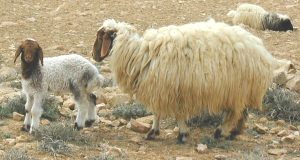
Sheep and goats belong to the same general family. They differ in that sheep produce wool, which is a special type of soft hair, among the ordinary hairs on their bodies. A ram’s horns too differ in shape from a goat’s horns, those of a ram curling down in a tight spiral beside its face, with those of a goat curving more gently back towards its shoulders. The sheep of biblical times produced much shorter wool than is common with wool-bearing breeds of today.
The fat-tailed or broad-tailed sheep is a smallish breed usually brown and white with a very broad tail. Like most other breeds of sheep in the Middle East it has large floppy ears.
Sheep are generally fairly timid animals, lacking the self-confidence and adaptability of goats. While goats will spread out in their search for food and then regroup without much difficulty, sheep become very insecure when they are separated from other sheep and tend to stay bunched together. They thus require a lot of shepherding. In the Middle East the method of shepherding involves training the dominant ram to follow the shepherd. The remaining sheep then follow this dominant ram, which often wears a wooden clapper or a bell. As they feed, the sheep usually keep within earshot of this sound. It is likely that this method is centuries old.
In most modern breeds only male sheep have horns, but in most ancient breeds female sheep had short horns too. This made separating sheep from goats in a single flock more difficult than it is today.
Of all animals the sheep was the most important for the Israelite nation. It had great religious, social, and economic importance.
The metaphor of a lamb is used in the New Testament to refer to Christ, with an emphasis on his being a sacrifice for the sin of the world. This is especially the case in John’s gospel and Revelation. In the latter book the metaphor is introduced in a very striking way. In Revelation 5:5 as the writer is mourning the fact that no one can be found to open the scroll, he is comforted by one of the elders who tells him that “the Lion of the tribe of Judah” has triumphed and can thus open the scroll. Then the writer, expecting to see the Lion, sees instead a Lamb that looks as if it has been killed for sacrifice. The remainder of the book is then concerned with describing the triumph of this Lamb over the forces of evil.
In the gospels Jesus also refers to his disciples as “sheep” and “lambs” (Matthew 10:17; John 10:1 et al.).
The metaphor of the shepherd is extended to God himself who is the ultimate “Shepherd of Israel” (Psalms 23:1; 80:1). Then those who are responsible for the nurture, guidance, ruling, and protection of Israel, be it kings, prophets, or priests, are also likened to shepherds (Isaiah 56:11; Jeremiah 23:4; 49:19; Ezekiel 34:2; Zechariah 10:2).
The Messiah is also called a shepherd (Isaiah 40:11), and Jesus refers to himself as “the good shepherd” (John 10:11). In Hebrews 13:20 he is referred to as “the great shepherd of the sheep” and in 1 Peter 2:25 he is called “the Shepherd and Guardian of your lives”.
In languages that have a word for sheep, it is advisable to translate according to the meanings given above. If possible, the feminine forms should be translated as “female lamb” or “female sheep”. In languages in which sheep are not known, a word has usually been coined or borrowed by the time Bible translation begins, and this word should be used. It is not advisable to substitute another locally well-known animal in this case, since doing so negates the ritual and symbolic importance that sheep had for the biblical cultures.
In translating Psalms 23:1 it is extremely important to make sure that the phrase “my shepherd” preserves the relationship intended by the writer and reflects the psalmist’s theme that Yahweh is his benefactor, protector, and guide. There are really two metaphors involved in the opening verse-the caring shepherd (God) and by clear implication, the dependent sheep (the psalmist). In many languages the literal phrase “my shepherd” depicts a wrong relationship, meaning something like “the one who looks after my sheep” or “the one I employ to watch my sheep.” In many African languages unwary translators have produced a rendering that means “The Chief is (nothing more than) my herdsman.” It is often necessary to restructure the whole verse as something like “I am a sheep, and the lord is my shepherd.”
He brings …: the subject of the sentence here is the guilty person. This should be made clear in translation.
A lamb: the term used in Hebrew in this verse refers to an animal of the sheep species without reference to age or sex. The fact that it is a female is made clear later in the verse.
Without blemish: see 1.3 and 22.17-25.
As in verses 23 and 28, it may be a good idea to make explicit the fact that the sacrifice is made “to obtain forgiveness from God for unintentional sins.”
Quoted with permission from Péter-Contesse, René and Ellington, John. A Handbook on Leviticus. (UBS Helps for Translators). New York: UBS, 1990. For this and other handbooks for translators see here .

Leave a Reply
You must be logged in to post a comment.