thresh (illustration)

The Hebrew and Greek that is translated as “thresh” in English is illustrated for use in Bible translations in East Africa by Pioneer Bible Translators like this:
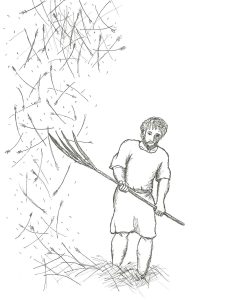
Image owned by PBT and Jonathan McDaniel and licensed with the Creative Commons Attribution 3.0 Unported License.

See also threshing floor.

complete verse (Leviticus 26:5)

Following are a number of back-translations as well as a sample translation for translators of Leviticus 26:5:

  • Kupsabiny: “Then you shall be harvesting until the day when the grapes are picked and you shall pick grapes until the days of sowing. Food will be enough for you and you shall relax in your land.” (Source: Kupsabiny Back Translation)
  • Newari: “You will be reaping the harvest up to the time for gathering grapes. You will still be picking grapes when it is time to plant grain. you will enough foods and you will live in peace your own country.” (Source: Newari Back Translation)
  • Hiligaynon: “Your (plur.) crops will-be so exceedingly abundant/plentiful that even then your (plur.) threshing/trampling-upon the heads-of-grain will-continue until the harvest-season-of-picking of grapes, and your picking of grapes will-continue until your (plur.) harvest-season-of — planting-seeds-(of-grain). So you (plur.) can-have-as-much-as- you (plur.) -want of your (plur.) food and yet/also you (plur.) will-live in peace in your place/(land).” (Source: Hiligaynon Back Translation)
  • English: “You will continue harvesting and threshing grain until it is time to harvest grapes, and you will continue to harvest grapes until it is time to start planting things in the following year. And you will have all the food that you want to eat, and you will live safely in your land.” (Source: Translation for Translators)

formal 2nd person plural pronoun (Japanese)

Click or tap here to see the rest of this insight.

Like a number of other East Asian languages, Japanese uses a complex system of honorifics, i.e. a system where a number of different levels of politeness are expressed in language via words, word forms or grammatical constructs. These can range from addressing someone or referring to someone with contempt (very informal) to expressing the highest level of reference (as used in addressing or referring to God) or any number of levels in-between.

One way Japanese shows different degree of politeness is through the choice of a formal plural suffix to the second person pronoun (“you” and its various forms) as shown here in the widely-used Japanese Shinkaiyaku (新改訳) Bible of 2017. In these verses, anata-gata (あなたがた) is used, combining the second person pronoun anata and the plural suffix -gata to create a formal plural pronoun (“you” [plural] in English).

(Source: S. E. Doi, see also S. E. Doi in Journal of Translation, 18/2022, p. 37ff. )

Translation commentary on Leviticus 26:5

Your threshing shall last to the time of vintage, and the vintage shall last to the time for sowing: these are images of abundant harvest. The fields will produce so much grain that the people must work until the grapes are ripe in order to separate the grain from the straw. Then the grapes will be so plentiful that the task of picking them will last until it was time to plant for the next grain crop. This is not intended to give the impression that the people are overworked, but that there was more than enough to eat and drink. Good News Translation has made this more explicit by introducing this verse with “Your crops will be so plentiful that….” Compare Amos 9.13.

You shall eat your bread to the full: the word bread here is intended to represent foods of all kinds. In many languages it will give the wrong idea if translated literally. This is especially true where bread is not a common element in the diet. Here it is better translated as “you will receive all the food you need” or “you will have food to eat in abundance” (New American Bible).

Dwell in your land securely: see 25.18, 19.

Quoted with permission from Péter-Contesse, René and Ellington, John. A Handbook on Leviticus. (UBS Helps for Translators). New York: UBS, 1990. For this and other handbooks for translators see here .