The Hebrew and Greek that is transliterated in English as “hyssop” is translated in Lokạạ as yisoki. Yisoki “is the name of a local bitter herb that is used for ritual cleansing in the traditional religion. It was, therefore, perceived by the translators as functionally adequate for ‘hyssop.’ The translation is thus symbolic in that it uses an indigenous Lokạạ botanical term and simultaneously indexical in that the translators believed that the translation points to the functional significance of the incipient term.” (Source: J.A. Naudé, C.L. Miller Naudé, J.O. Obono in Acta Theologica 43/2, 2023, p. 129ff. )
Likewise in Kweremfumbasi is used, a local plant that both looked similar to hyssop and is traditionally used for sprinkling in rituals. (Source: Pioneer Bible Translators, project-specific translation notes in Paratext)
The Phoenician Juniper Juniperus phoenicea is a lower-altitude cousin of the Grecian juniper. At present it is found scattered throughout the mountains of northern Sinai and southern Jordan, and Hepper notes that it occurs throughout the higher parts of Sinai and Arabia. In ancient times it may have been found throughout the Negev. Deuteronomy 2:36 refers to a town on the edge of the Wadi Arnon called Aroer, which is probably cognate with the Hebrew word ‘ar‘ar, indicating that these trees may have grown there. The identification of ‘ar‘ar/‘aro‘er as the Phoenician juniper is supported by the fact that Arabs in several countries call this juniper ‘ar‘ar. Since it is closely related to the cedars, some people also call it the “Phoenician cedar.” Note that Hebrew uses the same word ’erez to cover both the Phoenician juniper and the mighty cedar of Lebanon.
The Phoenician juniper is a short shrub or tree that may reach 5 meters (17 feet). It has tiny leathery leaflets and small berry-like cones.
We advocate translating ’erez as “juniper” in Leviticus and Numbers, if that species is known, or using a transliteration from a major language. The reference to ‘ar‘ar in Jeremiah 17:6 is poetic, and a cultural equivalent may be used; in a more literal version a transliteration may be used. Some scholars take the Hebrew word ‘aro‘er in the last line of Jeremiah 48:6 as meaning “juniper.”
The Hebrew and Greek that is typically translated as “sin” in English has a wide variety of translations.
The Greek ἁμαρτάνω (hamartanō) carries the original verbatim meaning of “miss the mark” and likewise, many translations contain the “connotation of moral responsibility.”
Loma: “leaving the road” (which “implies a definite standard, the transgression of which is sin”)
Navajo (Dinė): “that which is off to the side” (source for this and above: Bratcher / Nida)
Toraja-Sa’dan: kasalan, originally meaning “transgression of a religious or moral rule” and in the context of the Bible “transgression of God’s commandments” (source: H. van der Veen in The Bible Translator 1950, p. 21ff. )
Bariai: “bad behavior” (source: Bariai Back Translation)
Sandawe: “miss the mark” (like the original meaning of the Greek term) (source for this and above: Ursula Wiesemann in Holzhausen / Riderer 2010, p. 36ff., 43)
In Shipibo-Conibo the term is hocha. Nida (1952, p. 149) tells the story of its choosing: “In some instances a native expression for sin includes many connotations, and its full meaning must be completely understood before one ever attempts to use it. This was true, for example, of the term hocha first proposed by Shipibo-Conibo natives as an equivalent for ‘sin.’ The term seemed quite all right until one day the translator heard a girl say after having broken a little pottery jar that she was guilty of ‘hocha.’ Breaking such a little jar scarcely seemed to be sin. However, the Shipibos insisted that hocha was really sin, and they explained more fully the meaning of the word. It could be used of breaking a jar, but only if the jar belonged to someone else. Hocha was nothing more nor less than destroying the possessions of another, but the meaning did not stop with purely material possessions. In their belief God owns the world and all that is in it. Anyone who destroys the work and plan of God is guilty of hocha. Hence the murderer is of all men most guilty of hocha, for he has destroyed God’s most important possession in the world, namely, man. Any destructive and malevolent spirit is hocha, for it is antagonistic and harmful to God’s creation. Rather than being a feeble word for some accidental event, this word for sin turned out to be exceedingly rich in meaning and laid a foundation for the full presentation of the redemptive act of God.”
Martin Ehrensvärd, one of the translators for the DanishBibelen 2020, comments on the translation of this term: “We would explain terms, such that e.g. sin often became ‘doing what God does not want’ or ‘breaking God’s law’, ‘letting God down’, ‘disrespecting God’, ‘doing evil’, ‘acting stupidly’, ‘becoming guilty’. Now why couldn’t we just use the word sin? Well, sin in contemporary Danish, outside of the church, is mostly used about things such as delicious but unhealthy foods. Exquisite cakes and chocolates are what a sin is today.” (Source: Ehrensvärd in HIPHIL Novum 8/2023, p. 81ff. )
While the Greek word strouthion is certainly the name for the sparrow, the Hebrew tsippor is actually an inclusive word that refers to sparrow-sized birds in general. These small birds, especially sparrows, were caught in nets and traps and were an important part of the diet of poor people.
There are three types of sparrow that are common in Israel, the House Sparrow Passer domesticus, the Spanish Sparrow Passer hispaniolensis, and the Dead Sea Sparrow Passer moabiticus. All three are small speckled brown birds. Additional small birds that abound around towns and settlements are members of the bunting, finch, and tit families. Sparrows in particular are usually found in fairly large numbers roosting and nesting together. All are seed eaters and live mainly on grass seeds and grain.
Sparrows were considered clean birds and were associated with the poor.
Sparrows or sparrow-like small birds are found all over the world. Finding a local word is not usually difficult. The reference to “a lonely bird on the housetop” in Psalms 102:7 takes on additional meaning if the sparrow was intended, since it is a bird that is seldom seen alone. It would then indicate the psalmist’s sense of loneliness at being separated from those with whom he belongs.
Following are a number of back-translations as well as a sample translation for translators of Leviticus 14:49:
Kupsabiny: “And in order for him to cleanse the house, he shall take two birds and (some) cedar wood, a red thread and a branch of hyssop.” (Source: Kupsabiny Back Translation)
Newari: “Then, to cleanse the house, the priest will say to bring two clean birds, a branch of cedar wood, some red thread and a hyssop plant.” (Source: Newari Back Translation)
Hiligaynon: “And in-order to-consider the house clean, the priest is-to-take two birds, cedar wood, red string, and hyssop.” (Source: Hiligaynon Back Translation)
English: “But before people are allowed to live in it, the priest must take two small birds and some cedar wood and some red/scarlet yarn and some hyssop.” (Source: Translation for Translators)
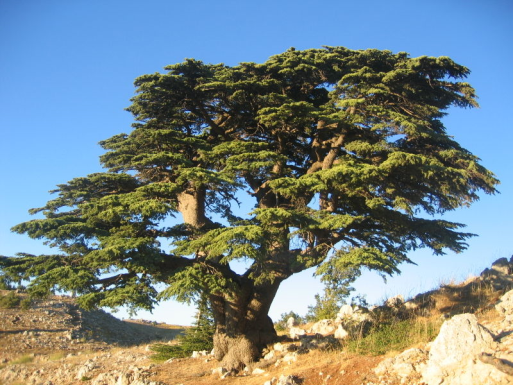
Long ago the majestic cedars of Lebanon (Cedrus libani) completely covered the upper slopes of the Lebanon Mountains on the western and northern sides. Now only a few pockets of these mighty cedars remain. At that time they were mixed, as they are today, with other trees such as Cilician fir, Grecian juniper, cypress, and Calabrian pine.
We know from 1 Kings that Solomon used cedar wood in his palace and in the Temple. Cedar was used for beams, boards, pillars, and ceilings. Historians tell us that the Assyrians also hauled cedars to their land for use in buildings. Nebuchadnezzar of Babylon also imported cedars from Lebanon. In some versions of Isaiah we read that people made idols of cedar and oak (44:14-20). Finally, when the Temple was rebuilt by the returning exiles (Ezra 3:7), they again cut down cedar trees to grace the house of God.
In 2 Samuel, 1-2 Kings, 1-2 Chronicles and Ezra, when Lebanon is specifically mentioned, there can be no doubt that ’erez is Cedrus libani, the “cedar of Lebanon,” although it is possible that sometimes the word was used loosely to include various evergreen trees.
In the description of the purification rituals (Leviticus 14:4 at al.), the word ’erez probably refers to the Phoenician juniper tree, since that was the only cedar-like tree in the Sinai Desert.
Description Cedar trees can reach 30 meters (100 feet) high with a trunk more than 2 meters (7 feet) in diameter. The leaves of true cedars are not flat like those of most trees, but consist of tufts of dark green, shiny spines. (The cedars in North America have a flatter type of spine than the biblical cedar.) The wood is fragrant and resistant to insects. Cedars bear cones and can live to be two or three thousand years old.
The cedar of Lebanon is famous for its large size (see Isaiah 2:13 et al.), and for the fragrance of its wood. Psalm 92:12 links the cedar to righteousness, that is, presumably, to its straightness and height above other trees. The cedar is the national emblem of Lebanon.
Cedrus species are found in the mountains of North Africa, in the Himalayas, in India, and in North America. Translators in these places, should, of course, use the local name in nonfigurative references. In sub Saharan Africa, translators can transliterate from Hebrew (’erez), Greek (kedar), English (sedar), or another major language, or they can take a generic solution such as “large, beautiful tree.” In poetic passages (wisdom literature and prophecy), some translators may wish to use a cultural equivalent with these traits. In Africa, according to Burkhill (The Useful Plants of West Tropical Africa, volume 4. Kew: Royal Botanic Gardens, 1985), the Pink Mahogany Guarea cedrata is also called the pink African cedar because of the cedar-like scent of its timber. Likewise, some people in India and Australia use “cedar” to refer to the toon because of its reddish wood. I do not recommend such substitutes in historical passages, since the ’erez is not related to these trees. In some figurative passages, however, the substitution could be effective, since all are large trees with reddish wood. However, each passage has to be evaluated to determine the intended effect of the image.
On verses 49-53, compare verses 4-9 and 20 earlier in this chapter. Although less detail is given here, the ritual was probably the same.
He: this pronoun may be understood as an impersonal form, but it is more likely that it refers to the priest in this context.
Two small birds: the size of the birds is considered unimportant by most scholars. But if the receptor language requires a choice between small birds and larger ones, then it will be better to translate small birds. The word is the same as used in 14.4, although the qualifying words “clean” and “living” are not found in this context. However, these words are probably implied, since all the other elements are identical with those used in the ritual of purification for a person having had the dreaded skin disease in 14.4.
Quoted with permission from Péter-Contesse, René and Ellington, John. A Handbook on Leviticus. (UBS Helps for Translators). New York: UBS, 1990. For this and other handbooks for translators see here .


Leave a Reply
You must be logged in to post a comment.