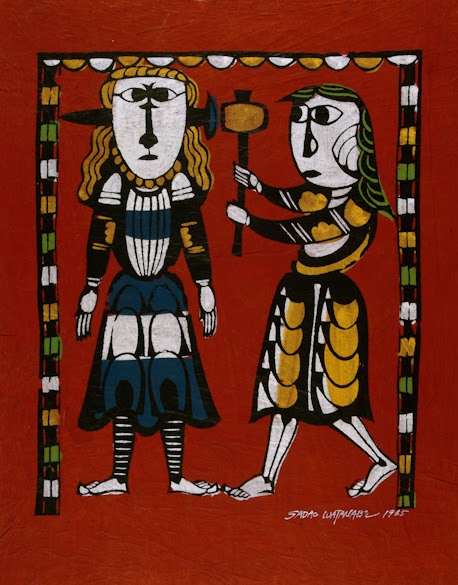
21But Jael wife of Heber took a tent peg and took a hammer in her hand and went softly to him and drove the peg into his temple, until it went down into the ground—he was lying fast asleep from weariness—and he died.
Following are a number of back-translations as well as a sample translation for translators of Judges 4:21:
Kupsabiny: “Sisera fell into a very deep sleep because he was tired. Then Jael sneaked to him having/holding a tent peg and a hammer. (She) nailed the peg into the temple of the head of that man until it passed through on the other side pinning (him) to the ground. So, that man died like that.” (Source: Kupsabiny Back Translation)
Newari: “But Jael, Heber’s wife took a nail and a hammer and went quietly in front of Sisera. Because Sisera was tired, he was sleeping very deeply. Then when she pounded the iron nail into his temple like this, the iron nail pierced and sank into the ground. In this way she killed Sisera.” (Source: Newari Back Translation)
Hiligaynon: “Because of great tiredness of Sisera, he fell-asleep deeply. When Jael saw that he had- already -fallen-asleep, he took a hammer and the peg of a tent and went-very-slowly near to Sisera. Then he hammered-the-peg-into the temple-of-the-head of Sisera until (it) pierced and drove-through/went-through to the ground, and Sisera died.” (Source: Hiligaynon Back Translation)
English: “Sisera was very exhausted, so he soon was asleep. While he was sleeping, Jael crept quietly to him, holding a hammer and a tent peg. She pounded the peg into his skull, and all the way through his head into the ground, and he died.” (Source: Translation for Translators)
Following are two English oral translations of Judges 4. The first is by Janet Stahl and the second by Bronven Cleaver. Both were produced as part of Cleaver’s PhD dissertation .
The storyteller now reaches the climax of the story. The audience has been wondering how an Israelite woman can dare to protect an enemy of Israel. Jael now shows her real motives. Because of her courage here, she will eventually become more famous than Barak, as predicted in verse 4.9. The end of the dialogue and the appearance of a long noun phrase, Jael the wife of Heber, shows a new paragraph is beginning here.
But Jael the wife of Heber …: But renders well the Hebrew waw conjunction here, since it shows that Jael will do something different from what Sisera requested. New American Bible uses the connector “Instead,” which indicates even more clearly that Jael will not follow Sisera’s instructions. The full name Jael the wife of Heber is given once again (see verse 4.17). In some languages, at story climaxes, pronouns are used to refer to characters, but in this Hebrew narrative the hero is named, possibly to ensure the audience will remember her name. Translators may prefer to shorten this phrase or even use a pronoun if it is the way to signal climax in their language.
Took a tent peg, and took a hammer in her hand: The details have been presented here as if these are just normal events, but all the while, Jael is planning murder! This attention to detail is not as great as in the previous Ehud episode, but the same principle is at work here. The special effect is that it slows down the story ever so slightly, allowing the suspense to build before the final blow.
The verb took occurs twice in Revised Standard Version, but it renders two different Hebrew verbs. The first time it translates the general verb meaning “take,” which was seen previously (verse 3.21). The second time it renders the verb meaning “put.” Translators should choose verbs in their language that fit the context here.
A tent peg is literally “a peg of the tent.” The Hebrew word for peg can refer to any pin or peg fastened in the wall to hang objects on. However, a tent peg is the pointed stick or stake made of wood or metal, driven into the ground to hold the tent in place. Again, in cultures where tents are unknown, this phrase could pose some problems. Here it may be necessary to be more specific by saying “sharp stick [holding down] the tent.”
The hammer or mallet is used to drive in the tent peg, probably of the type used by blacksmiths and stonemasons. The earliest hammers were made of stone alone, but in later biblical times, a handle was added. Most languages will have some word for hammer. Otherwise, translators might have to say “[sharpened] stone.” Jael’s use of these tools is not surprising, since the job of putting up tents was apparently women’s work.
Once again the word hand, along with small ordinary tools that fit in the hand, plays a crucial role in the Israelite victory. In the poetic version it is made clear that she took the hammer in her right hand (verse 5.26), which would be normal for a right-handed person.
And went softly to him is literally “and she came to him in secrecy.” Later in the text we learn that Sisera is asleep. Jael approaches him quietly so as to not awaken him. Revised English Bible says “creeping up on him,” while New Jewish Publication Society’s Tanakh has “she approached him stealthily.” Contemporary English Version omits this clause, but it is a very important part of the story, as the narrator builds up suspense. Translators should be able to find an idiomatic way to express this idea.
And drove the tent peg into his temple: The Hebrew verb rendered drove is the same one used to describe Ehud’s killing of King Eglon (see verse 3.21, where it is translated “thrust”). Nothing is left to the imagination here. Each step is carefully described. Drove means pushed down into with force. Languages will certainly have a term to describe a knife or nail being driven into a surface.
There is wordplay here since the Hebrew expression for into his temple (beraqato) sounds very much like Barak’s name. At the same time that Jael is disposing of Israel’s enemy, Sisera, she is also destroying Barak’s reputation, just as Deborah said. Several versions render this phrase as “through his temple” (New International Version, New Jewish Publication Society’s Tanakh), which seems logical in light of the following clause. The temple is the side of the head, so Good News Translation says “through the side of his head.” Contemporary English Version simply says “through his head.” Many languages will have a special term for this part of the head which can be used here.
Till it went into the ground is literally “and it went down into the ground.” The peg went right through Sisera’s head and even stuck into the ground. Went into renders a Hebrew verb meaning “stick into” or “pierce.” In English we might say “went right through.” The Hebrew word translated ground (ʾerets) is the same one used for “floor” to describe King Eglon sprawled dead on the ground (verse 3.25). There is irony here, since this is also the same word used throughout the Scriptures to refer to the Promised Land.
Altogether, five separate verbs are used to describe this scene (took, took, went, drove, went down). Such a succession of verbs has the effect of dramatizing this event that happens very rapidly, and translators may be able to preserve this effect by using short sentences, rather than a single long one. In this final climactic section of the story, both Jael and Sisera are referred to mostly by pronominal suffixes in Hebrew. Translators should study stories in their own language to see what stylistic devices are used in climactic passages. Like Hebrew, many languages prefer pronouns at this point.
As he was lying fast asleep from weariness renders two clauses in Hebrew, which is literally “but he [emphatic] was sleeping and he was exhausted.” Finally the audience is told that Sisera is sleeping soundly. He drank a cup of milk, asked Jael to stand watch for him, and then he went to sleep. He was exhausted from the battle and his escape on foot. The narrator links these two clauses with what follows (So he died), with almost an ironic tone. Many versions prefer to reverse these two clauses by saying “Sisera was so tired that he fell sound asleep” (Good News Translation; similarly Contemporary English Version). Others choose to place the two clauses earlier in the verse, which makes more sense logically. For example, New Jewish Publication Society’s Tanakh says “When he was fast asleep from exhaustion, she approached him stealthily and drove the pin through his temple till it went down to the ground” (similarly New International Version, New American Bible). But the narrator may have placed the last three clauses of this verse in a row to create a special mocking effect. Translators can reflect on how best to present these events, if possible expressing an ironic or mocking tone.
So he died: Sisera’s death does not come as a shock. As in the Ehud episode (verse 3.25), the Hebrew verb meaning “die” occurs at the very end of the sentence, expressing the finality of the event. So may not be the best translation of the Hebrew waw conjunction here. In some languages “And” (New Revised Standard Version, Contemporary English Version) or “and so” (New Jerusalem Bible) may be more appropriate. Others may prefer to leave the conjunction untranslated by rendering this clause as “Sisera was dead.”
By Jael’s swift act, Israel’s oppression at the hand of Jabin, king of Hazor, comes to an end. Once again, the ruse or quick thinking of a single individual has saved the nation.
Translation models for this verse are:
• But Jael, Heber’s wife, took a tent peg and hammer, went silently to Sisera, fast asleep due to exhaustion, and drove the tent peg through the side of his head and into the ground. Sisera was dead!
• But Jael picked up a tent peg in one hand, grabbed a hammer in the other, and crept silently over to Sisera. He lay there exhausted and in a deep sleep. She drove the tent peg straight through his head and into the ground, and thus he died.
Quoted with permission from Zogbo, Lynell and Ogden, Graham S. A Handbook on Judges. (UBS Helps for Translators). Miami: UBS, 2019. For this and other handbooks for translators see here .

Leave a Reply
You must be logged in to post a comment.