
The Hebrew in Joshua 2:14 that is rendered in English versions as “our life for yours!” (meaning “if you let us live, we’ll let you live”) is translated into Bukusu as “our lives are on you, and your life is on us.”
tribe
The Greek and Hebrew that is translated as “tribe” in English when referring to the “12 tribes of Israel” is translated in some East African languages, including Taita and Pökoot, with the equivalent of “clan” instead.
Aloo Mojola explains (in The Bible Translator 1989, p. 208ff. ) (click or tap here to see the rest of this insight):
“A number of Bible translation teams in East Africa have been baffled and intrigued by the use of the term ‘tribe’ in the English translations of the Bible. The usage employed in these translations does not reflect any of the popular meanings associated with the term ‘tribe’ in present-day English. Neither does it reflect popular conceptions of the meaning of this term in East Africa or in other parts of Africa and elsewhere. This raises the question: is the term tribe the best translation of the Hebrew terms shebeth and matteh or the Greek term phyle? What is a tribe anyway? Are the twelve tribes of Israel tribes in the sense this term is currently understood? How can this term be translated in East African languages?
“It is easy to see that there is no consistent definition of the term tribe which applies exclusively and consistently to the communities to which it is currently applied. Why, for example, are the Somali or the Baganda called a tribe, but not the Irish or the Italians? Why do the Yoruba or Hausa qualify, but not the Portuguese or the Russians? Why the Bakongo and the Oromo, but not the Germans or the Scots? Why the Eritreans, but not the French or Dutch-speaking Belgians? Why the Zulu or the Xhosa, but not the South African Boers (Afrikaners) or the South African English? The reason for the current prejudices, it would seem, has nothing to do with language, physical type, common territory, common cultural values, type of political and social organization or even population size. Ingrained prejudices and preconceived ideas about so-called “primitive” peoples have everything to do with it.
“The term ‘tribe’ is used to refer to a universal and world-wide phenomenon of ethnic identification which may draw on any of the following bases: identification in terms of one’s first or dominant language of communication (linguistic), in terms of one’s place of origin (regional), in terms of one’s presumed racial, biological or genetic type (racial), or in terms of one’s ideological or political commitments (ideological), and so on. Communities may choose one or more of these bases as criteria for membership. Any of these may change over time. Moreover forms of ethnic identification are dynamic or in a state of flux, changing in response to new environments and circumstances. Essentially forms of ethnic association reflect a people’s struggle for survival through adaptation to changing times. This is inextricably intertwined with the production and distribution of vital resources, goods and services as well as the distribution of power, class and status in society.
“At the base of any ethnic group is the nuclear family which expands to include the extended family. The extended family consists of more than two families related vertically and horizontally: parents and their offspring, cousins, uncles, aunts, nephews, and others, extending to more than two generations. A lineage is usually a larger group than an extended family. It includes a number of such families who trace descent through the male or female line to a common ancestor. A clan may be equivalent to or larger than a lineage. Where it is larger than a lineage, it brings together several lineages which may or may not know the precise nature of their relationships, but which nevertheless claim descent from a common ancestor. A clan is best thought of as a kind of sub-ethnic unit whose members have some unifying symbol such as totem, label, or myth. In most cases the clan is used to determine correct marriage lines, but this is not universally so. Above the clan is the ethnic group, usually referred to inconsistently as the tribe. Members of an ethnic group share feelings of belonging to a common group. The basis of ethnic identity is not always derived from a common descent, real or fictional; it may draw on any of the bases mentioned above.
“The Israelites identified themselves as one people sharing a common descent, a common religious and cultural heritage, a common language and history. There is no doubt that they constitute what would nowadays be called an ethnic group, or by some people a tribe. The twelve subunits of the Israelite ethnic group or tribe, (Hebrew shebeth or matteh, or Greek phyle) are clearly equivalent to clans. In fact this is what seems to make sense to most African Bible translators in the light of their understanding of these terms and the biblical account. Referring to a shebeth as a tribe or an ethnic group and to Israel as a collection of twelve tribes creates unnecessary confusion. Translating each of the terms shebeth, matteh, and phyle as clan seems to solve this problem and to be consistent with current usage in African languages.”
See also family / clan / house.
Rahab (image)
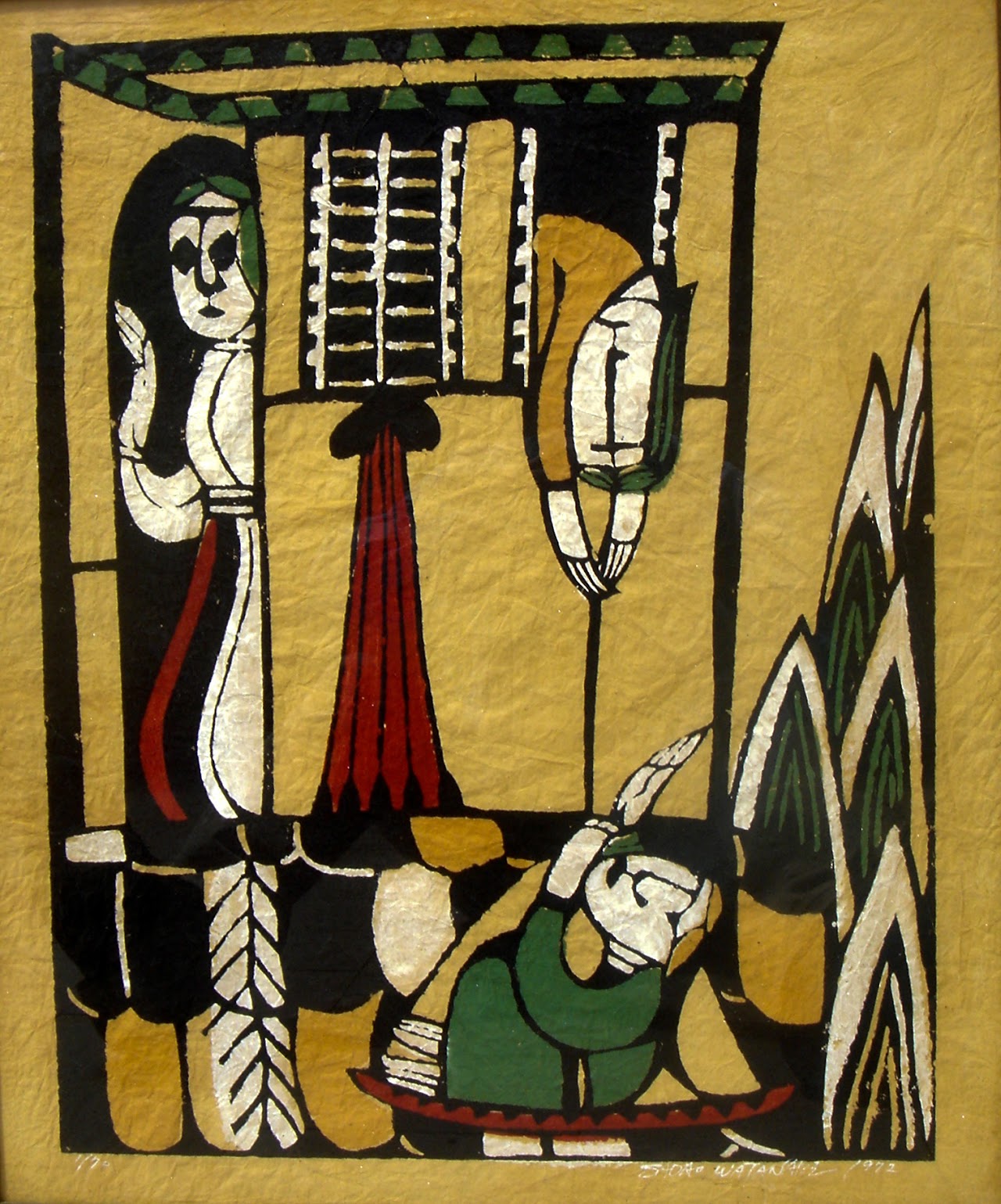
Hand colored stencil print on momigami by Sadao Watanabe (1972).
Image taken with permission from the SadaoHanga Catalogue where you can find many more images and information about Sadao Watanabe.
For other images of Sadao Watanabe art works in TIPs, see here.
See also Rahab.
mercy
The Hebrew, Aramaic, Greek, and Latin terms that are typically translated as “mercy” (or “compassion” or “kindness”) in English are translated in various ways. Bratcher / Nida classify them in (1) those based on the quality of heart, or other psychological center, (2) those which introduce the concept of weeping or extreme sorrow, (3) those which involve willingness to look upon and recognize the condition of others, or (4) those which involve a variety of intense feelings.
While the English mercy originates from the Latin merces, originally “price paid,” Romance languages (Italian, Spanish, Corsican, Catalan, Friulian) and other Germanic languages (German, Swedish, Danish — Barmherzigkeit, barmhärtighet and barmhjertighed, respectively) tend to follow the Latin misericordia, lit. “misery-heart.”
Here are some other (back-) translations:
- Ngäbere: “tender heart”
- Mískito: “white heart”
- Amganad Ifugao: “what arises from a kind heart”
- Vai: “purity of heart”
- Western Kanjobal: “his abdomen weeps”
- Kipsigis: “cry inside”
- Shilluk: “cry continually within”
- Navajo (Dinė): “feel great sorrow” (“with the connotation of being about to cry”)
- Kpelle: “see misery”
- Toro So Dogon: “know misery”
- Western Highland Purepecha: “be in pain for”
- San Miguel El Grande Mixtec: “be very sorry for”
- Mezquital Otomi: “have increasing love for”
- Tepeuxila Cuicatec: “showing undeserved goodness” (“closely identified with grace”) (source for this and all above: Bratcher / Nida)
- Yatzachi Zapotec: “pity-love”
- Central Mazahua: “very much pity people”
- Alekano: “help people who are suffering”
- Guhu-Samane: “feeling sorry for men” (source for this and three above: Ellis Deibler in Notes on Translation July, 1967, p. 5ff.)
- Warao: “kobe (= the abdominal region, including the heart) hurts” (source: Henry Osborn in The Bible Translator 1969, p. 74ff. )
- Latvian: žēlastība, the same term that is also used for grace (source: Katie Roth)
- Iloko: asi — also means “pity” and is used for a love of the poor and helpless (source: G. Henry Waterman in The Bible Translator 1960, p. 24ff. )
- Bilua: “forgiving love” (source: Carl Gross)
- Luang: “inside goodness” (source: Kathy and Mark Taber in Kroneman [2004], p. 533)
- Mairasi: “have good intestines” (see Seat of the Mind) (source: Lloyd Peckham)
- Bariai: “have a wounded interior” (source: Bariai Back Translation)
See also steadfast love.
inclusive vs. exclusive pronoun (Josh 2:14)
Many languages distinguish between inclusive and exclusive first-person plural pronouns (“we”). (Click or tap here to see more details)
The inclusive “we” specifically includes the addressee (“you and I and possibly others”), while the exclusive “we” specifically excludes the addressee (“he/she/they and I, but not you”). This grammatical distinction is called “clusivity.” While Semitic languages such as Hebrew or most Indo-European languages such as Greek or English do not make that distinction, translators of languages with that distinction have to make a choice every time they encounter “we” or a form thereof (in English: “we,” “our,” or “us”).
For this verse, the Jarai and the Adamawa Fulfulde translation both use the exclusive pronoun, excluding Rahab.
Aaron
The name that is transliterated as “Aaron” in English is translated in Catalan Sign Language and Spanish Sign Language as “stones on chest plate” (according to Exodus 28:15-30) (Source: John Elwode in The Bible Translator 2008, p. 78ff. )
“Aaron” in Spanish Sign Language, source: Sociedad Bíblica de España
In Colombian Sign Language, Honduras Sign Language, and American Sign Language, the chest plate is outlined (in ASL it is outlined using the letter “A”):
“Aaron” in ASL (source )
For more information on translations of proper names with sign language see Sign Language Bible Translations Have Something to Say to Hearing Christians .
See also Moses, more information on Aaron , and this lectionary in The Christian Century .
Judah, Judea
The name that is transliterated as “Judah” or “Judea” in English (referring to the son of Jacob, the tribe, and the territory) is translated in Spanish Sign Language as “lion” (referring to Genesis 49:9 and Revelation 5:5). This sign for lion is reserved for regions and kingdoms. (Source: John Elwode in The Bible Translator 2008, p. 78ff. and Steve Parkhurst)
“Judah” and “Judea” in Spanish Sign Language, source: Sociedad Bíblica de España
For more information on translations of proper names with sign language see Sign Language Bible Translations Have Something to Say to Hearing Christians .
See also Judah, Judah (son of Jacob) , and Tribe of Judah .
complete verse (Joshua 2:14)
Following are a number of back-translations as well as a sample translation for translators of Joshua 2:14:
- Kupsabiny: “Then those people said to that woman, ‘If you truly do not tell on us and God gives us this country to be ours, we shall help you. But if we do not do like that, we shall also die.” (Source: Kupsabiny Back Translation)
- Newari: “Your lives in place of our lives! the men promised her. "If you do not speak of this work to anyone, we will deal with you kindly and faithfully when the LORD gives us this land."” (Source: Newari Back Translation)
- Hiligaynon: “The two spies said to Rahab, ‘We (excl.) will-guarantee our (excl.) lives for you (plur.)! If you (sing.) just do- not -tell-about/spread-word-about our (excl.) spying here, we (excl.) will- surely -show you (sing.) kindness/goodness. We will- really -fulfill this when the LORD will- now -give this land to us (excl.).’” (Source: Hiligaynon Back Translation)
- English: “The two men replied, ‘We desire that God will cause us to die if we do not do as we say! If you do not tell others what we are planning to do, we will act kindly toward you all when Yahweh enables us to possess the land.’” (Source: Translation for Translators)
Leave a Reply
You must be logged in to post a comment.