
The Greek in John 4:28 that is translated as “left her water-jar” or similar in English is translated in Dagbani very explicitly as “left her water-jar standing.” Without the addition of “standing,” the phrase might indicate forgetfulness. (Source: André Wilson in The Bible Translator 1972, p. 135ff. )
complete verse (John 4:28)
Following are a number of back-translations of John 4:28:
- Uma: “From there, that woman left her water-fetching-container behind there, went right to the village and said to her fellow-townspeople:” (Source: Uma Back Translation)
- Yakan: “So-then the woman left her jar for putting in water and went back to the town. When she arrived there she talked to the people there.” (Source: Yakan Back Translation)
- Western Bukidnon Manobo: “And then the woman left behind her water vessel, and she returned to the village. She told the people, she said,” (Source: Western Bukidnon Manobo Back Translation)
- Kankanaey: “That being so, the woman abruptly-set-down what she had used-to-get-water and immediately-returned to the town. She said to the people who were there,” (Source: Kankanaey Back Translation)
- Tagbanwa: “What that woman did was, she left her drawing-vessel behind and went to the town. She told the people,” (Source: Tagbanwa Back Translation)
- Tenango Otomi: “The woman left behind her jar and went to the town. She told her fellow-inhabitants.” (Source: Tenango Otomi Back Translation)
He deliberately took time to draw near to social outcasts (image)
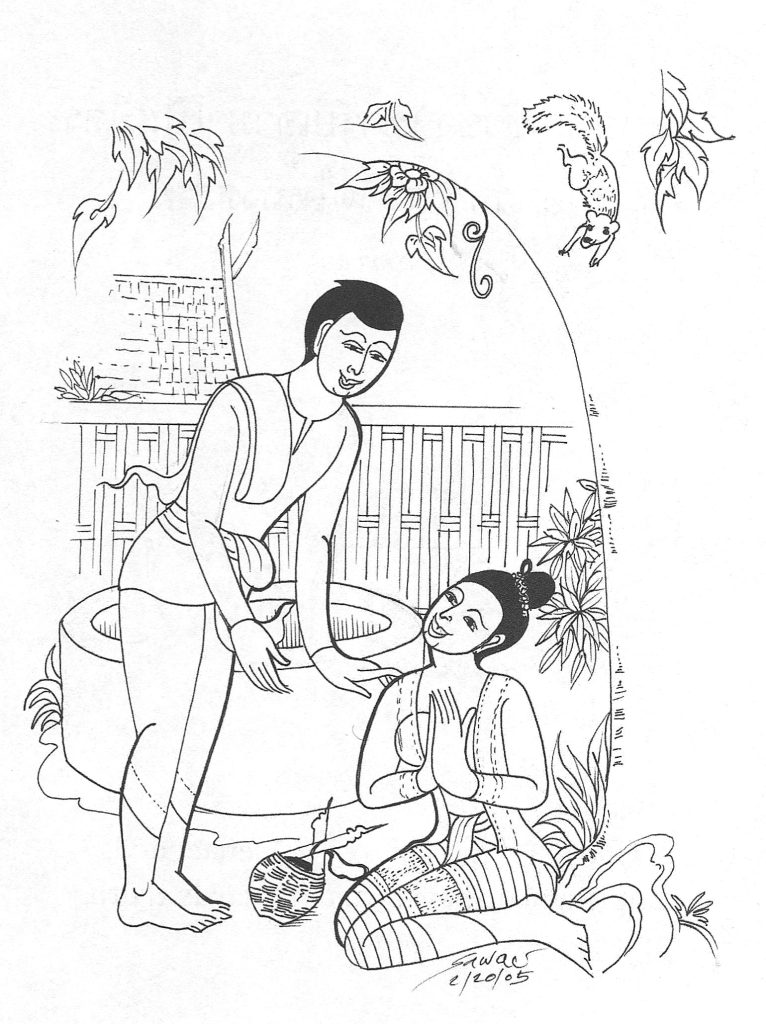
“Jesus is dressed in a different style of clothing than the style of the woman who is shown as a Lanna Thai northerner. It is unusual for him to talk to a person from a different region, especially a woman. The clothes, the roof of the house in the background, and the dipper for water all indicate that this is in northern Thailand.”
Drawing by Sawai Chinnawong who employs northern and central Thailand’s popular distinctive artistic style originally used to depict Buddhist moral principles and other religious themes; explanation by Paul DeNeui. From That Man Who Came to Save Us by Sawai Chinnawong and Paul H. DeNeui, William Carey Library, 2010. . For more images by Sawai Chinnawong in TIPs see here.
See also The woman at the well (image).
Learn more on Bible Odyssey: Woman at the Well .
The woman at the well (image)
Following is a painting in the Hamzanama style:

The woman at the well, 2017-2018, Paul Abraham with Manish Soni, Opaque watercolour and natural pigments on hand-made paper, © Sarmaya Arts Foundation. (2018.33.5)
See also He deliberately took time to draw near to social outcasts (image).
Sung version of John 4
Translation commentary on John 4:28
To the people is literally “to the men,” but all translations agree that “men” is here used in a generic sense.
Quoted with permission from Newman, Barclay M. and Nida, Eugene A. A Handbook on the Gospel of John. (UBS Handbook Series). New York: UBS, 1980. For this and other handbooks for translators see here .
Leave a Reply
You must be logged in to post a comment.