
The Greek that is translated as “in spirit and truth” in English is translated in Aguaruna as “praising in his heart, thinking truly” and in North Alaskan Inupiatun as “not merely by outward habits, but by spirit and by truth.” (Source: M. Larson / B. Moore in Notes on Translation February 1970, p. 1-125)
truth
The Greek, Latin and Hebrew that is usually translated in English as “truth” is translated in Luchazi with vusunga: “the quality of being straight” (source: E. Pearson in The Bible Translator 1954, p. 160ff. ), in Obolo as atikọ or “good/correct talk” (source: Enene Enene), and in Ekari as maakodo bokouto or “enormous truth” (esp. in John 14:6 and 17; bokouto — “enormous” — is being used as an attribute for abstract nouns to denote that they are of God [see also here]; source: Marion Doble in The Bible Translator 1963, p. 37ff. ).
The translation committee of the Malay “Good News Bible” (Alkitab Berita Baik, see here ) wrestled with the translation of “truth” in the Gospel of John (for more information click or tap here):
“Our Malay Committee also concluded that ‘truth’ as used in the Gospel of John was used either of God himself, or of God’s revelation of himself, or in an extended sense as a reference to those who had responded to God’s self-disclosure. In John 8:32 the New Malay translation reads ‘You will know the truth about God, and the truth about God will make you free.’ In John 8:44 this meaning is brought out by translating, ‘He has never been on the side of God, because there is no truth in him.’ Accordingly Jesus ‘tells the truth about God’ in 8:45, 46 (see also 16:7 and 8:37a). Then, ‘I am the way, the truth, and the life’ becomes ‘I am the one who leads men to God, the one who reveals who and what God is, and the one who gives men life.” At 3:21 the translation reads ” … whoever obeys the truth, that is God himself, comes to the light …’; 16:13a appears as ‘he will lead you into the full truth about God’; and in 18:37 Jesus affirms ‘I came into the world to reveal the truth about God, and whoever obeys God listens to me.’ On this basis also 1:14 was translated ‘we saw his glory, the glory which he had as the Father’s only Son. Through him God has completely revealed himself (truth) and his love for us (grace)’; and 1:17 appears as ‘God gave the law through Moses; but through Jesus Christ he has completely revealed himself (truth) and his love for us (grace).'” (Source: Barclay Newman in The Bible Translator 1974, p. 432ff. )
Helen Evans (in The Bible Translator 1954, p. 40ff. ) tells of the translation into Kui which usually is “true-thing.” In some instances however, such as in the second part of John 17:17 (“your word is truth” in English), the use of “true-thing” indicated that there might be other occasions when it’s not true, so here the translation was a a form of “pure, holy.”
worship
The Hebrew, Aramaic and Greek terms that are often translated as “worship” (also, “kneel down” or “bow down”) are likewise translated in other languages in certain categories, including those based on physical activity, those which incorporate some element of “speaking” or “declaring,” and those which specify some type of mental activity.
Following is a list of (back-) translations (click or tap for details):
- Javanese: “prostrate oneself before”
- Malay: “kneel and bow the head”
- Kaqchikel: “kneel before”
- Loma (Liberia): “drop oneself beneath God’s foot”
- Tepeuxila Cuicatec: “wag the tail before God” (using a verb which with an animal subject means “to wag the tail,” but with a human subject)
- Tzotzil: “join to”
- Kpelle: “raise up a blessing to God”
- Kekchí: “praise as your God”
- Cashibo-Cacataibo: “say one is important”
- San Blas Kuna: “think of God with the heart”
- Rincón Zapotec: “have one’s heart go out to God”
- Tabasco Chontal: “holy-remember” (source of this and all above: Bratcher / Nida)
- Bariai: “lift up God’s name” (source: Bariai Back Translation)
- Q’anjob’al: “humble oneself before” (source: Newberry and Kittie Cox in The Bible Translator 1950, p. 91ff. )
- Alur: rwo: “complete submission, adoration, consecration” (source: F. G. Lasse in The Bible Translator 1956, p. 22ff. )
- Obolo: itọtọbọ ebum: “express reverence and devotion” (source: Enene Enene)
- Ngäbere: “cut oneself down before” (“This figure of speech comes from the picture of towering mahoganies in the forest which, under the woodman’s ax, quiver, waver, and then in solemn, thunderous crashing bury their lofty heads in the upstretched arms of the surrounding forest. This is the experience of every true worshiper who sees ‘the Lord, high and lifted up.’ Our own unworthiness brings us low. As the Valientes say, ‘we cut ourselves down before’ His presence. Our heads, which have been carried high in self-confidence, sink lower and lower in worship.)
- Tzeltal: “end oneself before God.” (“Only by coming to the end of oneself can one truly worship. The animist worships his deities in the hope of receiving corresponding benefits, and some pagans in Christendom think that church attendance is a guarantee of success in this life and good luck in the future. But God has never set a price on worship except the price that we must pay, namely, ‘coming to the end of ourselves.'”) (Source of this and the one above: Nida 1952, p. 163)
- Folopa: “die under God” (“an idiom that roughly back-translates “dying under God” which means lifting up his name and praising him and to acknowledge by everything one does and thanks that God is superior.”) (Source: Anderson / Moore, p. 202)
- Chokwe: kuivayila — “rub something on” (“When anyone goes into the presence of a king or other superior, according to native law and custom the inferior gets down on the ground, takes a little earth in the fingers of his right hand, rubs it on his own body, and then claps his hands in homage and the greeting of friendship. It is a token of veneration, of homage, of extreme gratitude for some favor received. It is also a recognition of kingship, lordship, and a prostrating of oneself in its presence. Yet it simply is the applicative form of ‘to rub something on oneself’, this form of the verb giving the value of ‘because of.’ Thus in God’s presence as king and Lord we metaphorically rub dirt on ourselves, thus acknowledging Him for what He really is and what He has done for us.”) (Source: D. B. Long in The Bible Translator 1952, p. 87ff. )
In Luang it is translated with different shades of meaning:
- For Mark 15:19 and Matt. 2:8 and 2:11: “uh’idma-rrama llia’ara” — “to kiss the fingernail and lick the heel”
- For Acts 16:14: ra’uli-rawedi — “to praise-talk about”
- For Acts 14:15, 15:20, 17:16, 17:25: hoi-tani — “serve right hand – serve left”
- For Acts 13:16 and 13:26: una-umta’ata — “respect-fear”
- For 2 Thess. 2:4: kola tieru awur nehla — “hold waist – hug neck”
Source: Kathy Taber in Notes on Translation 1/1999, p. 9-16.
complete verse (John 4:23)
Following are a number of back-translations of John 4:23:
- Uma: “But the time will come–and this is the time–people who really worship God the Father, must worship him with the power of the Holy Spirit and following the true way. Worship like this is what God the Father likes.” (Source: Uma Back Translation)
- Yakan: “But the time is coming and it is now hep, that the people who truly worship, they worship our (incl.) Father God from inside their liver and their worship is really true. Like that is what our (incl.) Father God wants for-worship to him.'” (Source: Yakan Back Translation)
- Western Bukidnon Manobo: “This is already the time the people who want to worship God our Father, they must worship by means of their whole breath, and their worship of him must be true. These are the people that God will accept to worship him.” (Source: Western Bukidnon Manobo Back Translation)
- Kankanaey: “The truth of it is, the time has already arrived when the true/proper worshipper of God the Father, sincere/heartfelt will be his worship of him through his Spirit based-on his true godhood. Because God wants that that be the way in which people worship him.” (Source: Kankanaey Back Translation)
- Tagbanwa: “But the time is arriving, this right now, when as for those whose worship of God the Father is genuine, they will worship with focused mind/inner-being and in harmony with the truth which comes from him, because this really is the will of the Father for those worshipping him.” (Source: Tagbanwa Back Translation)
- Tenango Otomi: “But the day and time will come when those who truly worship the Father will truly from the heart worship.” (Source: Tenango Otomi Back Translation)
He deliberately took time to draw near to social outcasts (image)
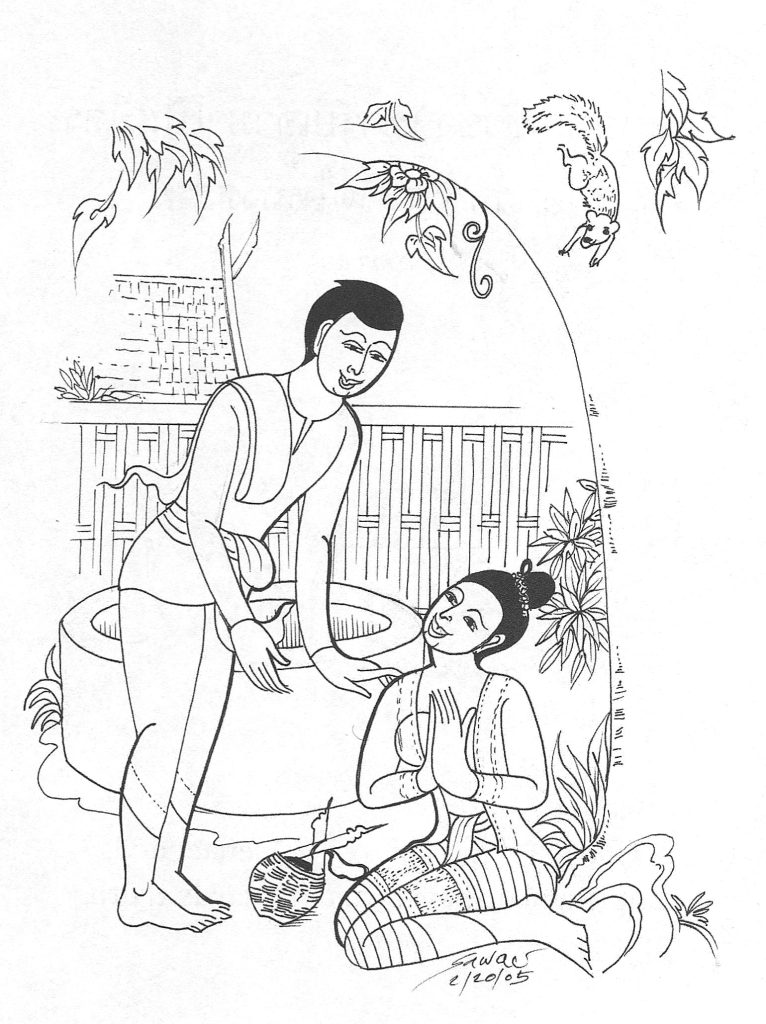
“Jesus is dressed in a different style of clothing than the style of the woman who is shown as a Lanna Thai northerner. It is unusual for him to talk to a person from a different region, especially a woman. The clothes, the roof of the house in the background, and the dipper for water all indicate that this is in northern Thailand.”
Drawing by Sawai Chinnawong who employs northern and central Thailand’s popular distinctive artistic style originally used to depict Buddhist moral principles and other religious themes; explanation by Paul DeNeui. From That Man Who Came to Save Us by Sawai Chinnawong and Paul H. DeNeui, William Carey Library, 2010. . For more images by Sawai Chinnawong in TIPs see here.
See also The woman at the well (image).
Learn more on Bible Odyssey: Woman at the Well .
The woman at the well (image)
Following is a painting in the Hamzanama style:

The woman at the well, 2017-2018, Paul Abraham with Manish Soni, Opaque watercolour and natural pigments on hand-made paper, © Sarmaya Arts Foundation. (2018.33.5)
See also He deliberately took time to draw near to social outcasts (image).
pronoun for "God"
God transcends gender, but most languages are limited to grammatical gender expressed in pronouns. In the case of English, this is traditionally confined to “he” (or in the forms “his,” “him,” and “himself”), “she” (and “her,” “hers,” and “herself”), and “it” (and “its” and “itself”).
Modern Mandarin Chinese, however, offers another possibility. Here, the third-person singular pronoun is always pronounced the same (tā), but it is written differently according to its gender (他 is “he,” 她 is “she,” and 它/牠 is “it” and their respective derivative forms). In each of these characters, the first (or upper) part defines the gender (man, woman, or thing/animal), while the second element gives the clue to its pronunciation.
In 1930, after a full century with dozens of Chinese translations, Bible translator Wang Yuande (王元德) coined a new “godly” pronoun: 祂. Chinese readers immediately knew how to pronounce it: tā. But they also recognized that the first part of that character, signifying something spiritual, clarified that each person of the Trinity has no gender aside from being God.
While the most important Protestant and Catholic Chinese versions respectively have opted not to use 祂, some Bible translations do and it is widely used in hymnals and other Christian materials. Among the translations that use 祂 to refer to “God” were early versions of Lü Zhenzhong’s (呂振中) version (New Testament: 1946, complete Bible: 1970). R.P. Kramers (in The Bible Translator 1956, p. 152ff. ) explains why later versions of Lü’s translation did not continue with this practice: “This new way of writing ‘He,’ however, has created a minor problem of its own: must this polite form be used whenever Jesus is referred to? Lü follows the rule that, wherever Jesus is referred to as a human being, the normal tā (他) is written; where he is referred to as divine, especially after the ascension, the reverential tā (祂) is used.”
In Kouya, Godié, Northern Grebo, Eastern Krahn, Western Krahn, and Guiberoua Béte, all languages of the Kru family in Western Africa, a different kind of systems of pronouns is used (click or tap here to read more):
In that system one kind of pronoun is used for humans (male and female alike) and one for natural elements, non-liquid masses, and some spiritual entities (one other is used for large animals and another one for miscellaneous items). While in these languages the pronoun for spiritual entities used to be employed when referring to God, this has changed into the use of the human pronoun.
Lynell Zogbo (in The Bible Translator 1989, p. 401ff. ) explains in the following way: “From informal discussions with young Christians especially, it would appear that, at least for some people, the experience and/or concepts of Christianity are affecting the choice of pronoun for God. Some people explain that God is no longer ‘far away,’ but is somehow tangible and personal. For these speakers God has shifted over into the human category.”
In Kouya, God (the Father) and Jesus are referred to with the human pronoun ɔ, whereas the Holy Spirit is referred to with a non-human pronoun. (Northern Grebo and Western Krahn make a similar distinction.)
Eddie Arthur, a former Kouya Bible translation consultant, says the following: “We tried to insist that this shouldn’t happen, but the Kouya team members were insistent that the human pronoun for the Spirit would not work.”
In Burmese, the pronoun ko taw (ကိုယ်တော်) is used either as 2nd person (you) or 3rd person (he, him, his) reference. “This term clearly has its root in the religious language in Burmese. No ordinary persons are addressed or known by this pronoun because it is reserved for Buddhist monks, famous religious teachers, and in the case of Christianity, the Trinity.” (Source: Gam Seng Shae in The Bible Translator 2002, p. 202ff. )
In Thai, the pronoun phra`ong (พระองค์) is used, a gender-neutral pronoun which must refer to a previously introduced royal or divine being. Similarly, in Northern Khmer, which is spoken in Thailand, “an honorific divine pronoun” is used for the pronoun referring to the persons of the Trinity (source: David Thomas in The Bible Translator 1993, p. 445 ). In Urak Lawoi’, another language spoken in Thailand, the translation often uses tuhat (ตูฮัด) — “God” — ”as a divine pronoun where Thai has phra’ong even though it’s actually a noun.” (Source for Thai and Urak Lawoi’: Stephen Pattemore)
The English “Contemporary Torah” addresses the question of God and gendered pronouns by mostly avoiding pronouns in the first five books of the Hebrew Bible/Old Testament (unless God is referred to as “lord,” “father,” “king,” or “warrior”). It does that by either using passive constructs (“He gave us” vs. “we were given”), by using the adjective “divine” or by using “God” rather than a pronoun.
Some Protestant and Orthodox English Bibles use a referential capitalized spelling when referring to the persons of the Trinity with “He,” “His,” “Him,” or “Himself.” This includes for instance the New American Standard Bible or The Orthodox New Testament, but most translations do not. Two other languages where this is also done (in most Bible translations) are the closely related Indonesian and Malay. In both languages this follows the language usage according to the Qur’an, which in turn predicts that usage (see Soesilo in The Bible Translator 1991, p. 442ff. and The Bible Translator 1997, p. 433ff. ).
See also first person pronoun referring to God.
Learn more on Bible Odyssey: Gender of God .
Translation: Chinese
在现代汉语中,第三人称单数代词的读音都是一样的(tā),但是写法并不一样,取决于性别以及是否有生命,即男性为“他”,女性为“她”,动物、植物和无生命事物为“它”(在香港和台湾的汉语使用,动物则为“牠”)。这些字的部首偏旁表明了性别(男人、女人、动物、无生命事物),而另一偏旁通常旁提示发音。
到1930年为止,基督教新教《圣经》经过整整一百年的翻译已经拥有了十几个译本,当时的一位圣经翻译者王元德新造了一个“神圣的”代词“祂”,偏旁“礻”表示神明。一般汉语读者会立即知道这字的发音是tā,而这个偏旁表示属灵的事物,因此他们明白这个字指出,三位一体的所有位格都没有性别之分,而单单是上帝。
然而,最重要的新教圣经译本(1919年的《和合本》)和天主教圣经译本(1968年的《思高圣经》)都没有采用“祂”;虽然如此,许多其他的圣经译本采用了这个字,另外还广泛出现在赞美诗和其他基督信仰的书刊中。(资料来源:Zetzsche)
《吕振中译本》的几个早期版本也使用“祂”来指称“上帝”;这个译本的《新约》于1946年译成,整部《圣经》于1970年完成。克拉默斯(Kramers)指出:“‘他’的这种新写法(即‘祂’)产生了一个小问题,就是在指称耶稣的时候,是否一律使用这个敬语代词?《吕振中译本》遵循的原则是,在称呼耶稣这个人的时候,用一般的‘他’,而在称呼耶稣神性的时候,特别是升天之后的耶稣,则用尊称‘祂’。”
Translator: Simon Wong
Father (address for God)
The Greek that is translated with the capitalized “Father” in English when referring to God is translated in Highland Totonac with the regular word for (biological) father to which a suffix is added to indicate respect. The same also is used for “Lord” when referring to Jesus. (Source: Hermann Aschmann in The Bible Translator 1950, p. 171ff. )
Click or tap here to see the rest of this insight.
Like a number of other East Asian languages, Japanese uses a complex system of honorifics, i.e. a system where a number of different levels of politeness are expressed in language via words, word forms or grammatical constructs. These can range from addressing someone or referring to someone with contempt (very informal) to expressing the highest level of reference (as used in addressing or referring to God) or any number of levels in-between. In the widely-used Japanese Shinkaiyaku (新改訳) Bible of 2017, God the Father is addressed with mi-chichi (御父). This form has the “divine” honorific prefix mi– preceding the archaic honorific form chichi for “father.”
If, however, Jesus addresses his Father, he is using chichi-o (父を) which is also highly respectful but does not have the “divine” honorific. (Source: S. E. Doi, see also S. E. Doi in Journal of Translation, 18/2022, p. 37ff. )
See also Lord and my / our Father.
Leave a Reply
You must be logged in to post a comment.