The Hebrew and Greek that is translated as “thirst” or “thirsty” in English is translated in Kituba as “hungry for water.” (Source: Donald Deer in The Bible Translator 1973, p. 207ff. )
See also thirst (figuratively).

λέγει πρὸς αὐτὸν ἡ γυνή, Κύριε, δός μοι τοῦτο τὸ ὕδωρ, ἵνα μὴ διψῶ μηδὲ διέρχωμαι ἐνθάδε ἀντλεῖν.
15The woman said to him, “Sir, give me this water, so that I may never be thirsty or have to keep coming here to draw water.”
The Hebrew and Greek that is translated as “thirst” or “thirsty” in English is translated in Kituba as “hungry for water.” (Source: Donald Deer in The Bible Translator 1973, p. 207ff. )
See also thirst (figuratively).
Following are a number of back-translations of John 4:15:
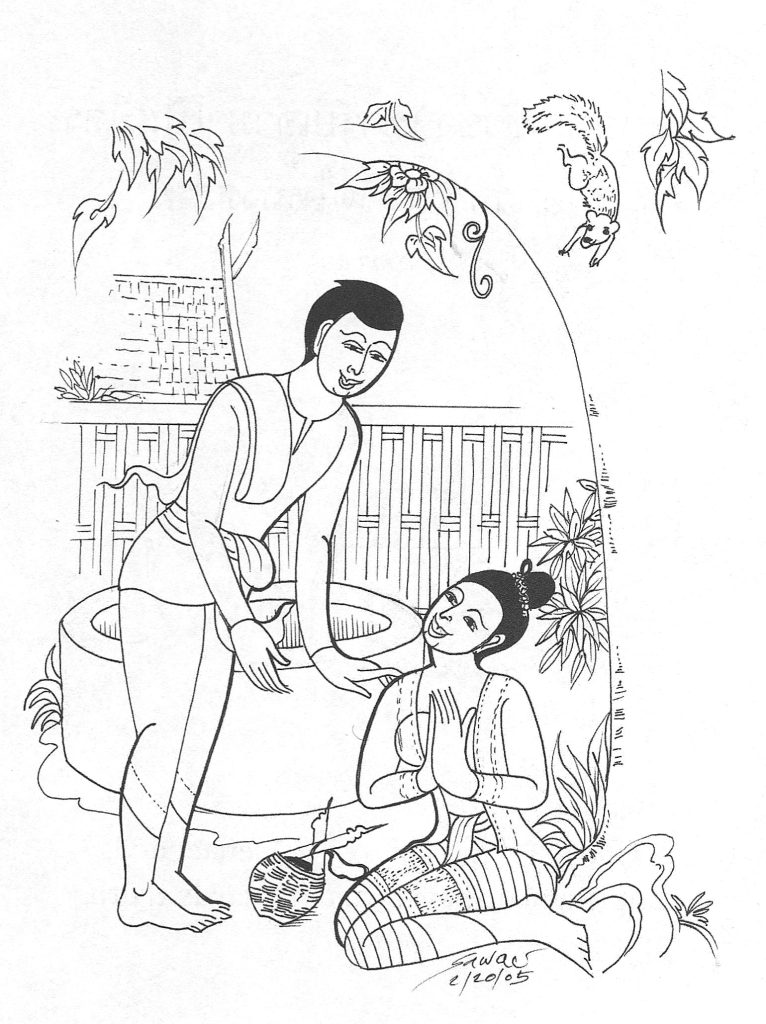
“Jesus is dressed in a different style of clothing than the style of the woman who is shown as a Lanna Thai northerner. It is unusual for him to talk to a person from a different region, especially a woman. The clothes, the roof of the house in the background, and the dipper for water all indicate that this is in northern Thailand.”
Drawing by Sawai Chinnawong who employs northern and central Thailand’s popular distinctive artistic style originally used to depict Buddhist moral principles and other religious themes; explanation by Paul DeNeui. From That Man Who Came to Save Us by Sawai Chinnawong and Paul H. DeNeui, William Carey Library, 2010. . For more images by Sawai Chinnawong in TIPs see here.
See also The woman at the well (image).
Learn more on Bible Odyssey: Woman at the Well .
Following is a painting in the Hamzanama style:

The woman at the well, 2017-2018, Paul Abraham with Manish Soni, Opaque watercolour and natural pigments on hand-made paper, © Sarmaya Arts Foundation. (2018.33.5)
See also He deliberately took time to draw near to social outcasts (image).
Like a number of other East Asian languages, Japanese uses a complex system of honorifics, i.e. a system where a number of different levels of politeness are expressed in language via words, word forms or grammatical constructs. These can range from addressing someone or referring to someone with contempt (very informal) to expressing the highest level of reference (as used in addressing or referring to God) or any number of levels in-between.
One way to do this is through the usage of lexical honorific forms, i.e., completely different words, as shown here in the widely-used Japanese Shinkaiyaku (新改訳) Bible of 2017. In these verses, kudasaru (下さる), a respectful form of kureru (くれる) or “give” is used.
(Source: S. E. Doi, see also S. E. Doi in Journal of Translation, 18/2022, p. 37ff. )
See also respectful form of “give” (tamawaru) and give (Japanese honorifics).
The word Sir is the same word used in verse 11 (see there).
Said is literally “said to him,” but in English “to him” is unnecessary in the context.
Quoted with permission from Newman, Barclay M. and Nida, Eugene A. A Handbook on the Gospel of John. (UBS Handbook Series). New York: UBS, 1980. For this and other handbooks for translators see here .
No comments yet.
Leave a Reply
You must be logged in to post a comment.