The Greek term that is translated in English as “bread” or “loaf” is translated in Samo, it is translated as “Sago,” which serves “like ‘bread’ for the Hebrews, as a generic for food in the Samo language. It is a near-perfect metonymy that has all the semantic elements necessary for effective communication.” (Source: Daniel Shaw in Scriptura 96/2007, p. 501ff.)
In Chol it is translated as waj, the equivalent of a tortilla. (Click or tap here to see the rest of this insight)
John Beekman (in The Bible Translator 1962, p. 180f. ) explains: “The word ‘bread’ in Scripture primarily occurs as either a specific term for bread (including the Lord’s Supper), or as a generic term for food. It is not surprising, however, the some aboriginal groups use something other than bread as the staff of life. The Chols, with their cultural focus in the cultivation of corn, use waj, a type of thin corn flake. Since a meal is not complete without this main item of food, the term has been extended to include any other foods which may be served along with waj. While bread is known to them, its use is limited to a few occasions during the year when it functions as a dessert. In translating this term in the Chol New Testament, consistent use has been made of the word waj whenever the function of bread as a basic food was in focus. John 6:35, “I am the bread of life,” was thus translated with this word. If the word for bread had been used, it was feared that the Chol would compare Christ to the desirable, but not absolutely necessary, dessert.”
Robert Bascom adds his thoughts to this in relation to other Mayan languages (in Omanson 2001, p. 260): “In many Mayan languages, ‘bread’ can be translated waj or kaxlan waj. The first term literally means anything made from corn meal, while the second term literally means ‘foreigner’s waj,’ and refers to the local wheat-based sweet breads which are so popular within the broader European-influenced culture of the region. On the one hand, waj would be a better dynamic equivalent in cases where ‘bread’ meant ‘food,’ but in cases where the focus is literal or the reference well-known, kaxlan waj would preserve a flour-based meaning (though in biblical times barley was more in use than wheat) and not insert corn into a time and place where it does not belong. On the other hand kaxlan waj is not the staff of life, but refers to a local delicacy. In cases such as these, it is even tempting to suggest borrowing pan, the Spanish word for ‘bread,’ but native speakers might respond that borrowing a foreign word is not necessary since both waj and kaxlan waj are native terms that cover the meaning (though in this case, perhaps not all that well).”
In Mairasi it is translated bread tubers. Tubers are the main food staple and are therefore synonymous with food. (Source: Enggavoter 2004). In Yagaria, Kâteand Yabem it is translated as “taro cake.” (Source: Renck, p. 101)
In the Yatzachi Zapotec translation of the Gospel of John, any reference to the evangelist and presumed narrator is done in the first person.
The translator Inez Butler explains (in: Notes on Translation, September 1967, pp. 10ff.):
“In revising the Gospel of John in Yatzachi Zapotec we realized from the start that the third person references of Jesus to himself as Son of Man had to be converted into first person references, but only more recently have we decided that similar change is necessary in John’s references to himself as ‘the disciple whom Jesus loved.’ As I worked on those changes and questioned the informant about his understanding of other passages in the Gospel, I discovered that the reader misses the whole focus of the book as an eyewitness account unless every reference to the disciples indicates the writer’s membership in the group. In view of that we went back through the entire book looking for ways to cue in the reader to the fact that John was an eyewitness and a participant in a many of the events, as well as the historian.
“When the disciples were participants in events along with Jesus, it was necessary to make explicit the fact that they accompanied him, although in the source language that is left implicit, since otherwise our rendering would imply that they were not present.”
In this verse, the Yatzachi Zapotec says: “And when we arrived at the shore, we got out of the boat, and we saw a fire of coals . . .”
Following are a number of back-translations of John 21:9:
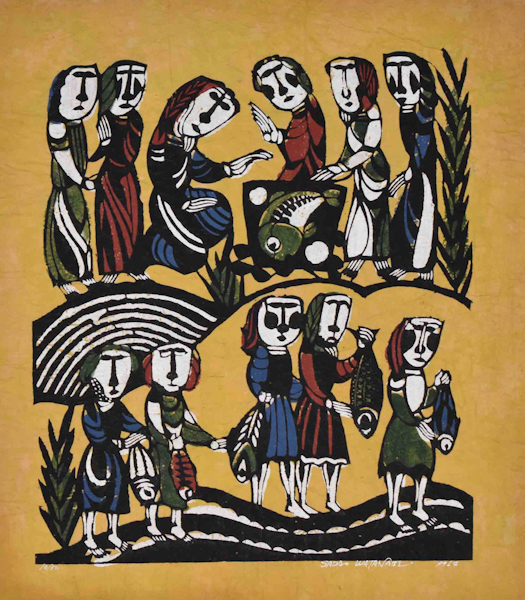
Uma: “When they came down at the shore, they saw there was a fire that had been lighted there with glowing coals, and on the fire there was fish and there was also bread.” (Source: Uma Back Translation)
Yakan: “When they got out at the shore, they saw fish roasting on embers and there was also bread.” (Source: Yakan Back Translation)
Western Bukidnon Manobo: “And when they had come ashore they saw a charcoal fire, and there was there fish and bread being toasted.” (Source: Western Bukidnon Manobo Back Translation)
Kankanaey: “When they got-out-of the boat, they saw fish being-roasted on glowing coals. There was also bread.” (Source: Kankanaey Back Translation)
Tagbanwa: “When they came ashore there at the edge, they looked and there was a fire which had fish already roasting and there were a few units of bread set down.” (Source: Tagbanwa Back Translation)
Tenango Otomi: “When they arrived at the shore, there was a fire burning there. Some fish were on it to cook. Also there was bread.” (Source: Tenango Otomi Back Translation)
Living Water is produced for the Bible translation movement in association with Lutheran Bible Translators. Lyrics derived from the ESV® Bible (The Holy Bible, English Standard Version®).
Charcoal fire is the same word used in 18.18; it occurs nowhere else in the New Testament.
The word used for fish is the same word used in 6.9,11. Although in Chapter 6 the word seems to have the meaning “dried fish” or “pickled fish,” in this and the following verse the reference is evidently to the fresh fish which had just been caught. The English word fish may be either singular or plural when applied to food, but the Greek text uses a singular here (New American Bible “a fish”). It is possible to understand the Greek text to mean that both the fish and bread were on the fire, but most translations indicate that only the fish were being cooked.
Quoted with permission from Newman, Barclay M. and Nida, Eugene A. A Handbook on the Gospel of John. (UBS Handbook Series). New York: UBS, 1980. For this and other handbooks for translators see here .

Leave a Reply
You must be logged in to post a comment.