The Hebrew, Latin and Greek that is translated into English as “chariot” is translated into Anuak as “canoe pulled by horse.” “Canoe” is the general term for “vehicle” (source: Loren Bliese). Similarly it is translated in Lokạạ as ukwaa wạ nyanyang ntuuli or “canoe that is driven by horses.” (Source: J.A. Naudé, C.L. Miller Naudé, J.O. Obono in Acta Theologica 43/2, 2023, p. 129ff. )
Other translations include:
Chichicapan Zapotec: “ox cart” (in Acts 8) (ox carts are common vehicles for travel) (source: Loren Bliese)
Chichimeca-Jonaz, it is translated as “little house with two feet pulled by two horses” (source: Viola Waterhouse in Notes on Translation August 1966, p. 86ff.)
HausaCommon Language Bible as keken-doki or “cart of donkey” (source: Andy Warren-Rothlin)
A tall evergreen, the Grecian Juniper Juniperus excelsa, also known as the Eastern Savin, grew in the mountains of Lebanon along with cedars, firs, and cypress (the Hebrew word berosh probably covered all three of these trees). The association of berosh with Mount Senir in Ezekiel 27:5 argues for the Grecian juniper there, since Mount Senir was known to have plenty of Grecian junipers. Lebanese people up to today refer to the juniper as brotha, a likely cognate with berosh. King Solomon undoubtedly hauled these trees to Jerusalem along with cedars and firs to use in constructing his palace and the Temple of Yahweh.
The Grecian juniper is a conical tree reaching a height of 20 meters (65 feet). Its “leaves” are round rather than flat, and the fruit is an inedible seed-bearing, fleshy cone.
There is no single Hebrew or Greek word that refers specifically to the Grecian juniper. In our discussion of cypress and fir, we have advocated translating berosh generically or as “fir” or “juniper” in 1-2 Kings and 2 Chronicles (where it is typically associated with Lebanon or cedar). If no generic word is available in the receptor language, a descriptive phrase such as “strong, beautiful tree/wood” can be used. In poetical passages, local poetic equivalents could be considered.
Following are a number of back-translations as well as a sample translation for translators of Isaiah 37:24:
Kupsabiny: “You insulted God through your people saying, ‘I climbed with my many chariots every mountain and I forced my way to every hill of Lebanon. I cut down the tall cedars of that place and the straight podo trees. I entered inside the forest where no one has touched its trees.” (Source: Kupsabiny Back Translation)
Newari: “By your messengers you have severely disgraced the LORD. You have spoken like this, ‘Taking many chariots and going, I have conquered the very high mountains and the very remote peaks of Lebanon. I cut down its tallest cedars tree and good cypress trees And I went its remotest heights and its thick forests.” (Source: Newari Back Translation)
Hiligaynon: “Through your (sing.) servants, you (sing.) have-mocked me. You (sing.) still said, ‘With my many chariots I have-gone/[lit. climbed] up the high mountains, the peaks of the mountains of Lebanon. I have-cut-down its tallest cedar and finest pine/[sipres]. I have-reached its peak that has the thickest trees.” (Source: Hiligaynon Back Translation)
English: “The messengers whom you sent made fun of me. You said, ‘With my many chariots I have gone to the highest mountains, even to the highest mountains in Lebanon. We have cut down its tallest cedar trees and its nicest pine/cypress trees. We have been to the most distant/remote peaks and to its densest forests.” (Source: Translation for Translators)
The Hebrew adonai in the Old Testament typically refers to God. The shorter adon (and in two cases in the book of Daniel the Aramaic mare [מָרֵא]) is also used to refer to God but more often for concepts like “master,” “owner,” etc. In English Bible translations all of those are translated with “Lord” if they refer to God.
In English Old Testament translations, as in Old Testament translations in many other languages, the use of Lord (or an equivalent term in other languages) is not to be confused with Lord (or the equivalent term with a different typographical display for other languages). While the former translates adonai, adon and mare, the latter is a translation for the tetragrammaton (YHWH) or the Name of God. See tetragrammaton (YHWH) and the article by Andy Warren-Rothlin in Noss / Houser, p. 618ff. for more information.
In the New Testament, the Greek term kurios has at least four different kinds of use:
referring to “God,” especially in Old Testament quotations,
meaning “master” or “owner,” especially in parables, etc.,
as a form of address (see for instance John 4:11: “Sir, you have no bucket”),
or, most often, referring to Jesus
In the first and fourth case, it is also translated as “Lord” in English.
Most languages naturally don’t have one word that covers all these meanings. According to Bratcher / Nida, “the alternatives are usually (1) a term which is an honorific title of respect for a high-ranking person and (2) a word meaning ‘boss’, ‘master’, or ‘chief.’ (…) and on the whole it has generally seemed better to employ a word of the second category, in order to emphasize the immediate personal relationship, and then by context to build into the word the prestigeful character, since its very association with Jesus Christ will tend to accomplish this purpose.”
When looking at the following list of back-translations of the terms that translators in the different languages have used for both kurios and adonai to refer to God and Jesus respectively, it might be helpful for English readers to recall the etymology of the English “Lord.” While this term might have gained an exalted meaning in the understanding of many, it actually comes from hlaford or “loaf-ward,” referring to the lord of the castle who was the keeper of the bread (source: Rosin 1956, p. 121).
Click or tap here to see the rest of this insight
Following are some of the solutions that don’t rely on a different typographical display (see above):
Iyansi: Mwol. Mwol is traditionally used for the “chief of a group of communities and villages” with legal, temporal, and spiritual authority (versus the “mfum [the term used in other Bantu languages] which is used for the chief of one community of people in one village”). Mwol is also used for twins who are “treated as special children, highly honored, and taken care of like kings and queens.” (Source: Kividi Kikama in Greed / Kruger, p. 396ff.)
Binumarien: Karaambaia: “fight-leader” (Source: Oates 1995, p. 255)
Warlpiri: Warlaljamarri (owner or possessor of something — for more information tap or click here)
We have come to rely on another term which emphasizes God’s essential nature as YHWH, namely jukurrarnu (see tetragrammaton (YHWH)). This word is built on the same root jukurr– as is jukurrpa, ‘dreaming.’ Its basic meaning is ‘timelessness’ and it is used to describe physical features of the land which are viewed as always being there. Some speakers view jukurrarnu in terms of ‘history.’ In all Genesis references to YHWH we have used Kaatu Jukurrarnu. In all Mark passages where kurios refers to God and not specifically to Christ we have also used Kaatu Jukurrarnu.
New Testament references to Christ as kurios are handled differently. At one stage we experimented with the term Watirirririrri which refers to a ceremonial boss of highest rank who has the authority to instigate ceremonies. While adequately conveying the sense of Christ’s authority, there remained potential negative connotations relating to Warlpiri ceremonial life of which we might be unaware.
Here it is that the Holy Spirit led us to make a chance discovery. Transcribing the personal testimony of the local Warlpiri pastor, I noticed that he described how ‘my Warlaljamarri called and embraced me (to the faith)’. Warlaljamarri is based on the root warlalja which means variously ‘family, possessions, belongingness’. A warlaljamarri is the ‘owner’ or ‘possessor’ of something. While previously being aware of the ‘ownership’ aspect of warlaljamarri, this was the first time I had heard it applied spontaneously and naturally in a fashion which did justice to the entire concept of ‘Lordship’. Thus references to Christ as kurios are now being handled by Warlaljamarri.” (Source: Stephen Swartz, The Bible Translator 1985, p. 415ff. )
Mairasi: Onggoao Nem (“Throated One” — “Leader,” “Elder”) or Enggavot Nan (“Above-One”) (source: Enggavoter 2004)
Obolo: Okaan̄-ene (“Owner of person(s)”) (source: Enene Enene)
Lotha Naga: Opvui (“owner of house / field / cattle”) — since both “Lord” and YHWH are translated as Opvui there is an understanding that “Opvui Jesus is the same as the Opvui of the Old Testament”
Seediq: Tholang, loan word from Min Nan Chinese (the majority language in Taiwan) thâu-lâng (頭儂): “Master” (source: Covell 1998, p. 248)
Thai: phra’ phu pen cao (พระผู้เป็นเจ้า) (divine person who is lord) or ong(kh) cao nay (องค์เจ้านาย) (<divine classifier>-lord-boss) (source: Stephen Pattemore)
Arabic often uses different terms for adonai or kurios referring to God (al-rabb الرب) and kurios referring to Jesus (al-sayyid الـسـيـد). Al-rabb is also the term traditionally used in Arabic Christian-idiom translations for YHWH, and al-sayyid is an honorary term, similar to English “lord” or “sir” (source: Andy Warren-Rothlin).
Tamil also uses different terms for adonai/kurios when referring to God and kurios when referring to Jesus. The former is Karttar கர்த்தர், a Sanskrit-derived term with the original meaning of “creator,” and the latter in Āṇṭavar ஆண்டவர், a Tamil term originally meaning “govern” or “reign” (source: Natarajan Subramani).
Burunge: Looimoo: “owner who owns everything” (in the Burunge Bible translation, this term is only used as a reference to Jesus and was originally used to refer to the traditional highest deity — source: Michael Endl in Holzhausen / Riderer 2010, p. 48)
Yagaria: Souve, originally “war lord” (source: Renck, p. 94)
Aguacateco: Ajcaw ske’j: “the one to whom we belong and who is above us” (source: Rita Peterson in Holzhausen / Riderer 2010, p. 49)
Konkomba: Tidindaan: “He who is the owner of the land and reigns over the people” (source: Lidorio 2007, p. 66)
Chichewa: AmbuyeAmbuye comes from the singular form Mbuye which is used to refer to: (1) someone who is a guardian or protector of someone or group of people — a grandparent who has founded a community or village; (2) someone who is a boss or master over a group of people or servants and has absolute control over them; (3) owner of something, be it a property, animals and people who are bound under his/her rule — for people this was mostly commonly used in the context of slaves and their owner. In short, Mbuye is someone who has some authorities over those who call him/her their “Mbuye.” Now, when the form Ambuye is used it will either be for honorific when used for singular or plural when referring to more than one person. When this term is used in reference to God, it is for respect to God as he is acknowledged as a guardian, protector, and ruler of everything. (Source: Mawu a Mulungu mu Chichewa Chalero Back Translation).
Hdi uses rveri (“lion”) as a title of respect and as such it regularly translates adon in the Old Testament. As an address, it’s most often with a possessive pronoun as in rvera ɗa (“my lion” = “my lord” or “sir”). So, for example, Genesis 15:2 (“O Lord God”) is Rvera ɗa Yawe (“My lion Yahweh”) or Ruth to Boaz in Ruth 2:13: “May I find your grace [lit. good-stomach] my lion.” This ties in nicely with the imagery of the Lord roaring like a lion (Hosea 11:10; Amos 3:8; Joel 3:16). Better still, this makes passages like Revelation 5:5 even richer when we read about rveri ma taba məndəra la Yuda, “the Lion of the tribe of Judah”. In Revelation 19:16, Jesus is rveri ta ghəŋa rveriha “the lion above lions” (“lord of lords”). (Source: Drew Maust)
Law (2013, p. 97) writes about how the Ancient GreekSeptuagint‘s translation of the Hebrew adonai was used by the New Testament writers as a bridge between the Old and New Testaments: “Another case is the use of kurios referring to Jesus. For Yahweh (in English Bibles: ‘the Lord‘), the Septuagint uses kurios. Although the term kurios usually has to do with one’s authority over others, when the New Testament authors use this word from the Septuagint to refer to Jesus, they are making an extraordinary claim: Jesus of Nazareth is to be identified with Yahweh.”
Click or tap here to see the rest of this insight.
Like a number of other East Asian languages, Japanese uses a complex system of honorifics, i.e. a system where a number of different levels of politeness are expressed in language via words, word forms or grammatical constructs. These can range from addressing someone or referring to someone with contempt (very informal) to expressing the highest level of reference (as used in addressing or referring to God) or any number of levels in-between. One way Japanese shows different degree of politeness is through the choice of a second person pronoun (“you” and its various forms) as shown here in the widely-used Japanese Shinkaiyaku (新改訳) Bible of 2017. The most commonly used anata (あなた) is typically used when the speaker is humbly addressing another person.
In these verses, however, omae (おまえ) is used, a cruder second person pronoun, that Jesus for instance chooses when chiding his disciples. (Source: S. E. Doi, see also S. E. Doi in Journal of Translation, 18/2022, p. 37ff. )
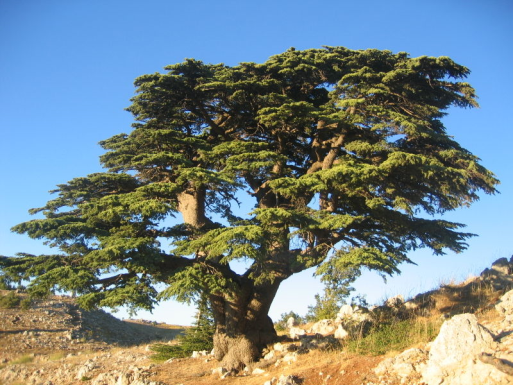
Long ago the majestic cedars of Lebanon (Cedrus libani) completely covered the upper slopes of the Lebanon Mountains on the western and northern sides. Now only a few pockets of these mighty cedars remain. At that time they were mixed, as they are today, with other trees such as Cilician fir, Grecian juniper, cypress, and Calabrian pine.
We know from 1 Kings that Solomon used cedar wood in his palace and in the Temple. Cedar was used for beams, boards, pillars, and ceilings. Historians tell us that the Assyrians also hauled cedars to their land for use in buildings. Nebuchadnezzar of Babylon also imported cedars from Lebanon. In some versions of Isaiah we read that people made idols of cedar and oak (44:14-20). Finally, when the Temple was rebuilt by the returning exiles (Ezra 3:7), they again cut down cedar trees to grace the house of God.
In 2 Samuel, 1-2 Kings, 1-2 Chronicles and Ezra, when Lebanon is specifically mentioned, there can be no doubt that ’erez is Cedrus libani, the “cedar of Lebanon,” although it is possible that sometimes the word was used loosely to include various evergreen trees.
In the description of the purification rituals (Leviticus 14:4 at al.), the word ’erez probably refers to the Phoenician juniper tree, since that was the only cedar-like tree in the Sinai Desert.
Description Cedar trees can reach 30 meters (100 feet) high with a trunk more than 2 meters (7 feet) in diameter. The leaves of true cedars are not flat like those of most trees, but consist of tufts of dark green, shiny spines. (The cedars in North America have a flatter type of spine than the biblical cedar.) The wood is fragrant and resistant to insects. Cedars bear cones and can live to be two or three thousand years old.
The cedar of Lebanon is famous for its large size (see Isaiah 2:13 et al.), and for the fragrance of its wood. Psalm 92:12 links the cedar to righteousness, that is, presumably, to its straightness and height above other trees. The cedar is the national emblem of Lebanon.
Cedrus species are found in the mountains of North Africa, in the Himalayas, in India, and in North America. Translators in these places, should, of course, use the local name in nonfigurative references. In sub Saharan Africa, translators can transliterate from Hebrew (’erez), Greek (kedar), English (sedar), or another major language, or they can take a generic solution such as “large, beautiful tree.” In poetic passages (wisdom literature and prophecy), some translators may wish to use a cultural equivalent with these traits. In Africa, according to Burkhill (The Useful Plants of West Tropical Africa, volume 4. Kew: Royal Botanic Gardens, 1985), the Pink Mahogany Guarea cedrata is also called the pink African cedar because of the cedar-like scent of its timber. Likewise, some people in India and Australia use “cedar” to refer to the toon because of its reddish wood. I do not recommend such substitutes in historical passages, since the ’erez is not related to these trees. In some figurative passages, however, the substitution could be effective, since all are large trees with reddish wood. However, each passage has to be evaluated to determine the intended effect of the image.
The Hebrew word berosh probably covered cypress, fir, and juniper; we are including here only those instances of berosh that possibly refer specifically to the cypress. The Cypress Cupressus sempervirens, native to Israel, was once common in the mountains of Judea. It also grew abundantly in Lebanon along with cedars, firs, and Grecian junipers. Cypresses also grew in Judea, Gilead and Edom, and do so up to the present day.
A comparison of English versions reflects the disagreement among scholars on the identification of the coniferous trees. For example, the Hebrew word berosh in 1 Kings 5:8 is translated as “cypress,” “pine,” “juniper,” or “fir.”
The disagreement here arises from the fact that berosh is probably a generic term, and it should probably be translated generically, if possible, or differently according to the context. We take the word berosh in 1-2 Kings and 2 Chronicles, where it is usually paired with ’erez (“cedar”) and/or Lebanon, to refer to the Cilician fir or to the Grecian juniper rather than to the cypress (see fir and Grecian juniper). In the few other places where it occurs, it may refer to any one of the three conifers. The logic here is that since cypresses grew in Judea, King Solomon would not need to import them from Lebanon. However, it could also be argued that Lebanon may have produced better specimens than King Solomon could find in Israel and he might have imported some of them. In either case, this does not argue against berosh as a generic term.
Closely related to the pines, firs and cedars, the cypress may reach 9-15 meters (30-50 feet) high. It has small scale-like leaves and round cones. The tall, narrow specimens that are common today in Israel and other countries are a modern variety (pyramidalis) that has been specially developed.
Cypress, photo by Ray PritzCypress branch with seed cones, photo by Nigel Hepper
In verses 24-25 God notes the many arrogant claims that Sennacherib made.
By your servants you have mocked the Lord: Sennacherib used his officials to mock God. The parallel passage of 2 Kgs 19.23 has “messengers” instead of servants. Even though servants and “messengers” are close in meaning, translators should not harmonize these two passages on this point unless there are inadequate terms in the receptor language. For mocked see Isa 37.4. The Lord is not the divine name Yahweh, but the title meaning “my master” (see the comments on 1.2). Since he is speaking here, Contemporary English Version says “me, the Lord,” which may be helpful for other languages. Good News Translation says simply “me.”
And you have said …: Translators may use indirect speech for Sennacherib’s words, as in Good News Translation (see the second example below). This is the fourth level of quotation in Isaiah’s speech. See the introductory comments on verses 21-38.
With my many chariots I have gone up the heights of the mountains, to the far recesses of Lebanon: This is an arrogant claim made by Sennacherib through his officials. Although Assyria had many chariots, he is exaggerating here since chariots could normally be used only on good roads and generally in level country, not in mountainous areas. It is unlikely he could have taken them on mountains, where there were no roads. For chariots see 2.7. The far recesses of Lebanon is parallel to the heights of the mountains. It refers to the highest mountains of Lebanon, which were the most difficult places to access, so Sennacherib exaggerates even more. New Jewish Publication Society’s Tanakh has “the remotest parts of the Lebanon,” while New International Version says “the utmost heights of Lebanon.” For Lebanon see 2.13.
I felled its tallest cedars, its choicest cypresses: Sennacherib had the tallest and best trees of Lebanon cut down, probably for his building projects in Assyria. The pronoun its refers to Lebanon. The mountains of Lebanon were famous for their cedar and cypress trees. For cedars see 2.13, and for cypresses see 14.8.
I came to its remotest height is literally “and I came to its highest end.” Sennacherib reemphasizes his claim that he went to the highest mountains of Lebanon.
Its densest forest is literally “the forest of its fertile land.” The Hebrew word for “fertile land” is karmel, which can refer to a flourishing garden (10.18; 16.10) or the tree-covered mountain that lies along the southern side of the Jezreel Valley on the Israelite coast (33.9; 35.2). Here it refers to the dense trees of Lebanon’s forests.
Translation examples for this verse are:
• You have used your servants to scorn [me,] the Lord,
saying, ‘I have driven my many chariots up the high mountains,
to the furthest reaches of Lebanon.
I have cut down its tallest cedar trees and best cypresses;
I went to its highest points,
its deepest forests.
• Your servants, [Sennacherib,] have mocked the Lord,
boasting that you have ridden your numerous chariots to the top of the mountains,
to Lebanon’s tallest heights;
that you have cut down its tallest cedars and its best pine trees,
and reached its most lush forests.
Quoted with permission from Ogden, Graham S. and Sterk, Jan. A Handbook on Isaiah. (UBS Helps for Translators). New York: UBS, 2011. For this and other handbooks for translators see here .




Leave a Reply
You must be logged in to post a comment.