
The Hebrew in Hosea 10:11 that is translated in English translations as “a trained heifer that loved to thresh” is translated into Afar as “As a camel that goes by its nose follows a person” (no threshing in Afar culture, but a camel with a rope around its mouth obediently follows the person leading it.)
thresh (illustration)
The Hebrew and Greek that is translated as “thresh” in English is illustrated for use in Bible translations in East Africa by Pioneer Bible Translators like this:
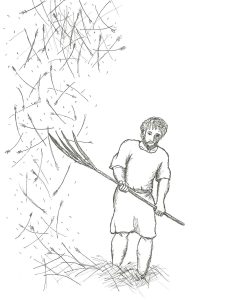
Image owned by PBT and Jonathan McDaniel and licensed with the Creative Commons Attribution 3.0 Unported License.
See also threshing floor.
Judah, Judea
The name that is transliterated as “Judah” or “Judea” in English (referring to the son of Jacob, the tribe, and the territory) is translated in Spanish Sign Language as “lion” (referring to Genesis 49:9 and Revelation 5:5). This sign for lion is reserved for regions and kingdoms. (Source: John Elwode in The Bible Translator 2008, p. 78ff. and Steve Parkhurst)
“Judah” and “Judea” in Spanish Sign Language, source: Sociedad Bíblica de España
For more information on translations of proper names with sign language see Sign Language Bible Translations Have Something to Say to Hearing Christians .
See also Judah, Judah (son of Jacob) , and Tribe of Judah .
Ephraim
The Hebrew and Greek that is transliterated as “Ephraim” in English is translated in Spanish Sign Language with the sign for “palm tree” referring to the palm of Deborah in the land of Ephraim (see Judges 4:5. (Source: Steve Parkhurst)
“Ephraim” in Spanish Sign Language, source: Sociedad Bíblica de España
For more information on translations of proper names with sign language see Sign Language Bible Translations Have Something to Say to Hearing Christians .
For Deborah, see here.
More information about Ephraim and the Tribe of Ephraim .
complete verse (Hosea 10:11)
Following are a number of back-translations as well as a sample translation for translators of Hosea 10:11:
- Kupsabiny: “Ephraim is like a cow that liked to thresh
but I will put a yoke on its beautiful neck.
Judah will be ploughing
and Israel make furrows in the farm.” (Source: Kupsabiny Back Translation) - Newari: “Ephraim is like a trained heifer,
who is delighted at grain threshing time,
but I will put a yoke
on her beautiful shoulders.
I will drive Ephraim.
Judah will plow and Jacob will beat the clumps of earth.” (Source: Newari Back Translation) - Hiligaynon: “In-time-past you (plur.) are- just -relaxing; you (plur.) (are) like a heifer that was-trained to thresh and likes this work. But now I will-have- you (plur.) -work-hard who come-from-Israel and as-well-as those- (who) -come-from-Juda; you (plur.) will-be like a heifer to-be-tied-up with yoke to his neck that has no callus, and then (he is) made-to-plow.” (Source: Hiligaynon Back Translation)
- English: “Israel is like a well-trained heifer/young cow
that likes to thresh grain.
So now you will become slaves.
It will be as though I will put a yoke on your neck,
and you will be forced to work hard for your enemies in their fields.
You people of Israel and Judah will be forced to go to Assyria;
there you will pull plows to break up the ground for planting seeds.” (Source: Translation for Translators)
1st person pronoun referring to God (Japanese)
Click or tap here to see the rest of this insight.
Like a number of other East Asian languages, Japanese uses a complex system of honorifics, i.e. a system where a number of different levels of politeness are expressed in language via words, word forms or grammatical constructs. These can range from addressing someone or referring to someone with contempt (very informal) to expressing the highest level of reference (as used in addressing or referring to God) or any number of levels in-between.
One way Japanese shows different degree of politeness is through the choice of a first person singular and plural pronoun (“I” and “we” and its various forms) as shown here in the widely-used Japanese Shinkaiyaku (新改訳) Bible of 2017. The most commonly used watashi/watakushi (私) is typically used when the speaker is humble and asking for help. In these verses, where God / Jesus is referring to himself, watashi is also used but instead of the kanji writing system (私) the syllabary hiragana (わたし) is used to distinguish God from others.
(Source: S. E. Doi, see also S. E. Doi in Journal of Translation, 18/2022, p. 37ff. )
See also pronoun for “God”.
Translation commentary on Hosea 10:11
In 10.11-13 the text uses farm related metaphors. This verse describes the Israelites at the time when they were elected as God’s people. In 10.12 they are given challenges, and in 10.13 their disobedience is described.
This verse begins with the Hebrew waw conjunction (literally “And” [King James Version]), which Revised Standard Version, Good News Translation, and most other versions omit. We recommend leaving it untranslated at the beginning of this new unit.
Ephraim was a trained heifer that loved to thresh: Here Israel is compared to a heifer (Good News Translation “young cow”), which renders the Hebrew word for a cow that has not yet given birth to a calf. This word is the same one used in 10.5 for the calf-idol at Beth-aven. However, there does not seem to be any connection in terms of meaning. Good News Translation changes this metaphor into a simile by saying “Israel was once like a well-trained young cow.” Translators must decide whether a metaphor or simile communicates best in the receptor language.
As often done, Good News Translation uses “Israel” instead of Ephraim (see comments on 4.17). The Hebrew word for trained seems to have been more specific in the dialect of northern Israel. There it referred to training cattle to wear a yoke and obey the person guiding them. Here it more clearly pictures the trained animal normally wearing a yoke, but not when threshing grain.
Cattle were trained to walk on piles of harvested grain stalks to thresh out the kernels of grain. According to Deut 25.4, cattle that did this threshing were not muzzled and so were free to take bites of grain as they walked. So it was not surprising that a young cow loved to thresh. This threshing may be a picture of the Israelites’ service to God in the beginning of their nationhood in the wilderness, when they were taught to wear God’s yoke and were supplied by God.
The translator should carefully consider if the intended meaning of the figure (whether metaphor or simile) is clear in the receptor culture. In cultures where the use of animals for agricultural activities such as threshing is unknown, it may be necessary to make the point of the comparison explicit, for example, “In the past Israel obeyed me just like a cow that loves to thresh grain obeys the farmer.”
And I spared her fair neck: The Hebrew verb here normally means spared, but the context speaks of God not sparing Israel, but placing requirements on it. Therefore Good News Translation emends the Hebrew text to read “But I decided to put a yoke on her beautiful neck” (similarly New International Version, New Living Translation, NET Bible, New Jewish Publication Society’s Tanakh). Good News Translation thinks this emendation is necessary for the correct meaning in the context. Work with a yoke is harder than threshing, and this may point to Israel’s more difficult life in Canaan. However, Hebrew Old Testament Text Project supports the Hebrew text by rendering it as “I passed by her who had a lovely neck” (an {A} decision, meaning there is little or no doubt). Hebrew Old Testament Text Project understands this line to refer to Yahweh’s early relations with Israel when they were still in the wilderness. De Nieuwe Bijbelvertaling follows the Hebrew with “When I saw her beautiful neck,” which we recommend.
But I will put Ephraim to the yoke, Judah must plow, Jacob must harrow for himself: The three farming activities in this verse begin with threshing, which is easy work for the heifer. A yoke may or may not be used. Plowing is mentioned next, which requires a strong yoke so that the heifer can properly pull the plow through the fields to turn over rows of soil in preparation for planting. But after the plowing, the soil is uneven, so the heifer needs to harrow the soil by pulling a large rake over the broken soil so that the soil will be level, and the large lumps of soil will be broken into smaller pieces. This also requires that the heifer wear a yoke for pulling the equipment to level the soil. See also Isa 28.24.
Revised Standard Version follows the Hebrew by using three names in these last three lines: Ephraim (that is, the northern kingdom), Judah (that is, the southern kingdom), and Jacob (that is, the whole nation). Good News Translation uses the pronoun “her” (referring to Israel), “Judah,” and “Israel.” But “Israel” in Good News Translation here renders Jacob, the whole nation, while at the beginning of the verse “Israel” refers to the northern kingdom. So a clear and meaningful translation of Jacob, the last proper noun in the verse, may be “the whole nation.”
A translation model for this verse is:
• Ephraim was obedient
like a well-trained cow
that loved to thresh.
Seeing her beautiful neck,
I thought I would harness Ephraim.
Judah must plow.
Jacob must level the soil.
Quoted with permission from Dorn, Louis & van Steenbergen, Gerrit. A Handbook on Hosea. (UBS Helps for Translators). Miami: UBS, 2020. For this and other handbooks for translators see here .
SIL Translator’s Notes on Hosea 10:11
Paragraph 10:11
In this paragraph, the LORD continues to speak. He describes Israel by using an extended animal metaphor.
10:11a
Ephraim is a well-trained heifer that loves to thresh: This clause is a metaphor that compares Ephraim to a heifer. Ephraim in its early years was similar to a well-trained heifer. Both of them were willing to obey and both had easy lives with only light work to do.
Here are some ways to translate this figure of speech:
• Use a metaphor. Make one or more similarities explicit if it will be helpful. For example:
Ephraim was a well-trained heifer that loved to thresh grain (NET Bible)
-or-
Israel was a young heifer that loved the easy work of threshing grain.
• Use a simile. Make one or more similarities explicit if it will be helpful. For example:
Israel was like an obedient heifer. She was well-trained and enjoyed the easy work of treading out the grain.
In Hebrew, this clause is more literally “and Ephraim a trained heifer lover of to thresh.” The clause could refer to past, present or future.
Here are the two main interpretations:
(1) It refers to a time in the past. For example:
“Israel was once like a well-trained young cow, ready and willing to thresh grain. (Good News Translation)
(2) It refers to the present. For example:
Ephraim is a well-trained heifer that loves to tread the grain. (New Jerusalem Bible)
It is recommended that you follow interpretation (1). It matches the pattern of other metaphors in the chapters and verses surrounding this one. Those metaphors depict Israel in her early years, when the LORD chose her to be his people. The metaphors contrast this with Israel in her later years, when the people rebelled against the LORD.
Ephraim: The tribe of Ephraim is probably a figure of speech (synecdoche) that represents all the people of the nation of Israel. Some versions make “Israel” explicit here. For example:
Israel was once like a well-trained young cow (Good News Translation)
well-trained heifer: The word heifer refers to a young (female) cow that has not yet given birth. A well-trained heifer is gentle, follows commands, and is easy to control.
loves to thresh: Probably the heifer separated stalks from grain by walking on them. It enjoyed threshing, because the work was easy and it was able to eat while it threshed.
10:11b
but I will place a yoke on her fair neck: This clause continues the metaphor of the heifer. There is a textual issue here:
(1) Some scholars think that the original text was “and I put a yoke on its fair neck.” For example:
But I decided to put a yoke on her beautiful neck (Good News Translation)
(2) The Masoretic Text has “and I passed over the fairness of its neck.” This clause refers to the time before a yoke was placed on the heifer’s neck. For example:
and I spared her fair neck (New Revised Standard Version)
Some versions are ambiguous. For example, the King James Version may or may not imply that a yoke was placed upon the heifer’s neck:
but I passed over upon her fair neck (King James Version)
It is recommended that you follow option (1) along with the most versions. This clause indicates that the easy life of the heifer is finished. It introduces the time for heavy work to begin.
but I: In this context, there are two main ways to interpret the function of the word that begins this clause:
(1) The word indicates contrast. For example:
But I will put a heavy yoke on her tender neck. (New Living Translation (2004))
(2) The word indicates result. For example:
so I will put a yoke on her fair neck (New International Version)
It is recommended that you follow interpretation (1) along with most versions. Several versions leave the connection implied. These versions have not been listed.
yoke: A yoke is a bar or frame that is attached to the necks of (normally) two work animals. In the context of 11c–e, the yoke is attached by a harness so that they can pull a plow or harrow.
fair neck: This phrase is literally “goodness of its neck.” It refers to the neck of an animal that has not yet been yoked to do hard work, but is well suited for it. Versions translate “goodness” in a variety of ways:
• Most versions use a term that refers mainly to appearance. For example:
fair (English Standard Version)
-or-
beautiful (Good News Translation)
-or-
sleek (Tanakh: The Holy Scriptures)
• The New Jerusalem Bible has “fine.” This term could refer to appearance or strength.
• The Contemporary English Version has “powerful.”
Try to use a term or combination of terms that can refer to both appearance and strength.
10:11c–e
Notice the parallel parts that are similar in meaning:
11c
I will harness Ephraim,
11d
Judah will plow,
11e and Jacob will break the hard ground.
I will harness Ephraim, Judah will plow, and Jacob will break the hard ground: This part of the metaphor compares Ephraim, Judah and Jacob implicitly to farm animals that do heavy work. The similarity is that their lives will soon become more difficult.
Here are some ways to translate this figure of speech:
• Use a metaphor. Make the implicit similarity explicit if it will be helpful. For example:
I will harness her for harder work. I will make Judah pull the plow and Israel pull the harrow.
• Use a simile. Make one or more similarities explicit if it will be helpful. For example:
Like hard-working farm animals I will make Ephraim break up the hard ground. Judah must plow, and Jacob must harrow.
Ephraim, Judah…Jacob: These three names represent all the people of Israel. Ephraim represents those in the northern kingdom. Judah represents those in the southern kingdom. Jacob may represent the entire kingdom, both north and south.
10:11c
I will harness Ephraim: This clause is literally “I will cause to draw/harness Ephraim.” It means to attach the yoke and harness to the plow and then make the animal pull it. It implies that a farmer drives or directs the animal.
Here are some other ways to translate this line:
I will make Ephraim break the ground (New Revised Standard Version)
-or-
I shall put Ephraim into harness (New Jerusalem Bible)
-or-
…make her work hard in the field (New Century Version)
10:11d
Judah will plow: To plow is to drag a farm implement that digs into the hard soil and breaks it into bigger chunks that can then be harrowed.
10:11e
Jacob will break the hard ground: The Hebrew phrase is more literally, “Jacob will harrow for itself.” To harrow is to break up the clods after plowing and to level the soil to prepare it for planting.
In the Masoretic Text, this clause ends with the Hebrew phrase “for/by himself.” This phrase may mean for his own benefit or that he is alone. You may translate it either way. You may follow versions that leave implicit the Hebrew phrase “for/by himself.” Or you may follow versions that translate it literally. For example:
Jacob must harrow for himself. (New Revised Standard Version)
© 2021 by SIL International®
Made available under the terms of a Creative Commons Attribution-ShareAlike 4.0 License (CC BY-SA) creativecommons.org/licenses/by-sa/4.0.
All Scripture quotations in this publication, unless otherwise indicated, are from The Holy Bible, Berean Standard Bible.
BSB is produced in cooperation with Bible Hub, Discovery Bible, OpenBible.com, and the Berean Bible Translation Committee.
Leave a Reply
You must be logged in to post a comment.