The Hebrew and Greek that is translated as “bow” or “rainbow” is translated in Yagaria with a term — fugigina — that is also used as a term for “glory.” (Source: Renck, p. 94)
In Maltese it is translated with qawsalla, literally “bow of God” and in Southern Samo as “snake up above” (source: Lynell Zogbo).
Natügu: nzesz’tikr drtwr: “oneness of mind” (source: Brenda Boerger in Beerle-Moor / Voinov, p. 164)
Tagalog: tipan: mutual promising on the part of two persons agreeing to do something (also has a romantic touch and denotes something secretive) (source: G. Henry Waterman in The Bible Translator 1960, p. 24ff. )
Tagbanwa: “initiated-agreement” (source: Tagbanwa Back Translation)
Guhu-Samane: “The concept [in Mark 14:24 and Matthew 16:28] is not easy, but the ritual freeing of a fruit and nut preserve does afford some reference. Thus, ‘As they were drinking he said to them, ‘On behalf of many this poro provision [poro is the traditional religion] of my blood is released.’ (…) God is here seen as the great benefactor and man the grateful recipient.” (Source: Ernest Richert in The Bible Translator, 1965, p. 81ff. )
Chichewa: pangano. This word can also be translated as a contract, agreement, or a treaty between two parties. In Chewa culture, two people or groups enter into an agreement to help each other in times of need. When entering into an agreement, parties look at the mutual benefits which will be gained. The agreement terms are mostly kept as a secret between the parties and the witnesses involved. (Source: Mawu a Mulungu mu Chichewa Chalero Back Translation)
Law (2013, p. 95) writes about how the Ancient GreekSeptuagint‘s translation of the Hebrew berith was used by the New Testament writers as a bridge between the Old and New Testaments (click or tap here to read more):
“Right from the start we witness the influence of the Septuagint on the earliest expressions of the Christian faith. In the New Testament, Jesus speaks of his blood being a kaine diatheke, a ‘new covenant.’ The covenant is elucidated in Hebrews 8:8-12 and other texts, but it was preserved in the words of Jesus with this language in Luke 22:20 when at the Last Supper Jesus said, ‘This cup that is poured out for you is the new covenant in my blood. Jesus’s blood was to provide the grounds for the ‘new covenant,’ in contrast to the old one his disciples knew from the Jewish scriptures (e.g., Jeremiah 31:31-34). Thus, the earliest Christians accepted the Jewish Scriptures as prophecies about Jesus and in time began to call the collection the ‘Old Testament’ and the writings about Jesus and early Christianity the ‘New Testament,’ since ‘testament’ was another word for ‘covenant.’ The covenant promises of God (berith in Hebrew) were translated in the Septuagint with the word diatheke. In classical Greek diatheke had meant ‘last will, testament,’ but in the Septuagint it is the chosen equivalent for God’s covenant with his people. The author of Hebrews plays on the double meaning, and when Luke records Jesus’ announcement at the Last Supper that his blood was instituting a ‘new covenant,’ or a ‘new testament,’ he is using the language in an explicit contrast with the old covenant, found in the Jewish scriptures. Soon, the writings that would eventually be chosen to make up the texts about the life and teachings of Jesus and the earliest expression of the Christian faith would be called the New Testament. This very distinction between the Old and New Testaments is based on the Septuagint’s language.”
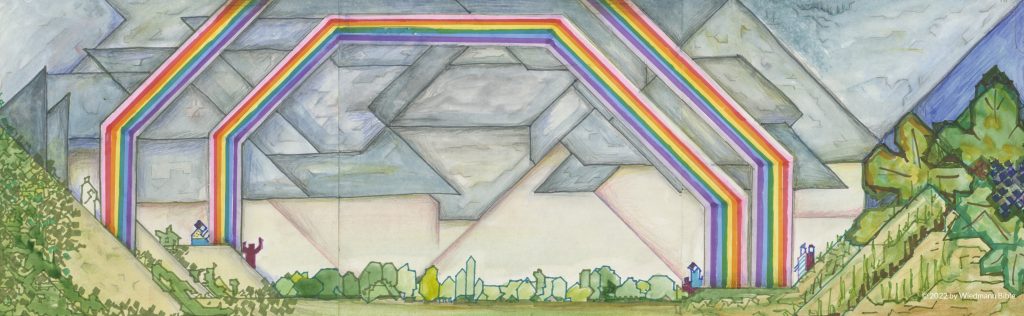
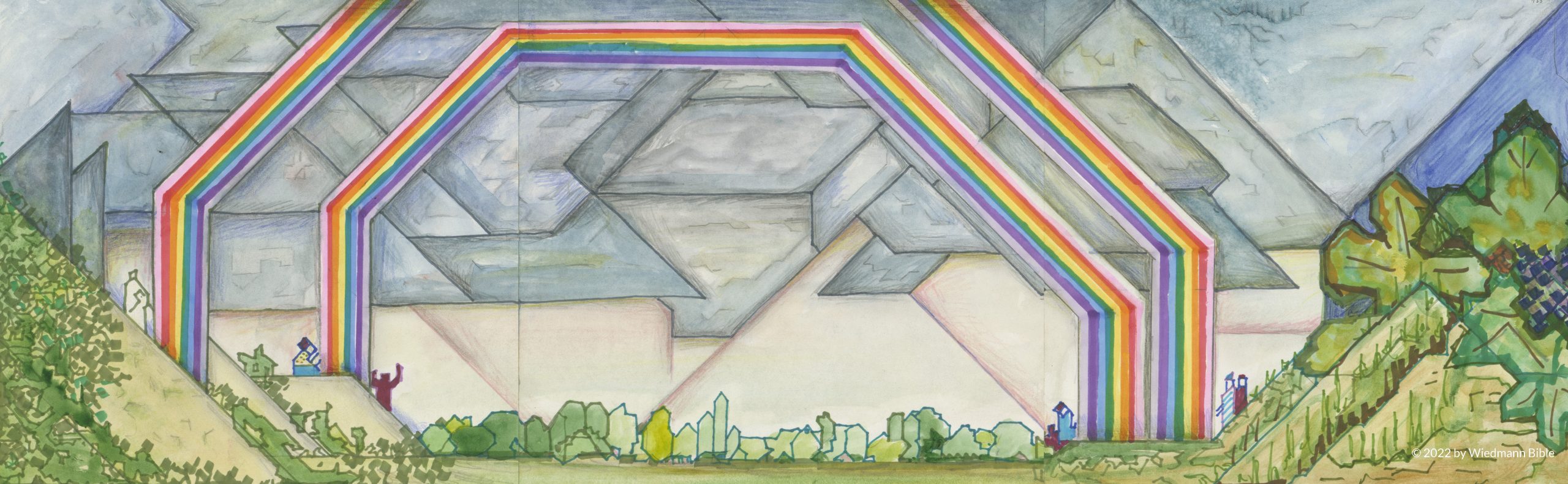
The Hebrew in Genesis 9:13 that is translated as “my rainbow” in English had to be translated without the possessive in Southern Samo. Lynell Zogbo explains: “Sometimes ‘my’ cannot be rendered. In Samo, it would come out ‘my snake up above,’ which might be OK in it itself, but it implies there are several rainbows that can be put in the sky and God decides to put his (in contrast to everyone else’s).”
Following are a number of back-translations as well as a sample translation for translators of Genesis 9:13:
Kankanaey: “there is what I will put above which is a rainbow or rainbow (two terms are used because neither one is understood throughout the language area), so-that that will be a sign of this that I have promised.” (Source: Kankanaey Back Translation)
Newari: “I will put my bow in the cloud. This will be the sign of the covenant that I have made with the world.” (Source: Newari Back Translation)
Hiligaynon: “And as a sign of my covenant with you (pl.) and with the animals, and with all your generations to come, I will-put my rainbow in the white-clouds.” (Source: Hiligaynon Back Translation)
English: “From time to time I will put a rainbow in the sky. It will remind me of my promise that I have made to you and everything on the earth.” (Source: Translation for Translators)
Click or tap here to see the rest of this insight.
Like a number of other East Asian languages, Japanese uses a complex system of honorifics, i.e. a system where a number of different levels of politeness are expressed in language via words, word forms or grammatical constructs. These can range from addressing someone or referring to someone with contempt (very informal) to expressing the highest level of reference (as used in addressing or referring to God) or any number of levels in-between.
One way Japanese shows different degree of politeness is through the choice of a first person singular and plural pronoun (“I” and “we” and its various forms) as shown here in the widely-used Japanese Shinkaiyaku (新改訳) Bible of 2017. The most commonly used watashi/watakushi (私) is typically used when the speaker is humble and asking for help. In these verses, where God / Jesus is referring to himself, watashi is also used but instead of the kanji writing system (私) the syllabary hiragana (わたし) is used to distinguish God from others.
I set my bow in the cloud: set translates the verb to put or place that is used in 1.17 of God setting the lights in the heavens. Bow translates the word meaning the bow used by an archer for shooting arrows. Many interpreters see this as the LORD hanging up his warrior’s bow because he will never use it again. For images of the LORD’s bow and arrows, see Psa 7.12-13; 18.14; Hab 3.9, 11. In this imagery God sets aside his weapon of destruction, and it becomes a sign of the stability of the new era. Others reject the imagery of God as a warrior carrying a bow. However, translators will note that Good News Translation and Revised Standard Version use “bow” and not “rainbow” here (although Good News Translation has “rainbow” in verses 14 and 16). Many other versions follow this usage. However, others avoid the use of “bow” and translate as “rainbow,” the reason being that “bow” associated with cloud can only mean “rainbow.” Where the language has a choice, translators may prefer to retain the images and background suggested by “bow.”
In the cloud: cloud is singular grammatically in Hebrew but collective in meaning, and many languages will require a plural form or may prefer “in the sky.”
It shall be a sign of the covenant: it, that is, the rainbow visible in the sky will be a sign. For sign of the covenant see comments on verse 12.
Between me and the earth: earth here represents those receiving God’s covenant in verse 12, “You [plural] and every living creature that is with you for all future generations.” It is not the physical earth but rather its inhabitants, both human and animal. Accordingly Good News Translation translates “my covenant with the world.”
Quoted with permission from Reyburn, William D. and Fry, Euan McG. A Handbook on Genesis. (UBS Helps for Translators). New York: UBS, 1997. For this and other handbooks for translators see here .

Leave a Reply
You must be logged in to post a comment.