
The Hebrew in Genesis 8:13 that is translated as “look” in English is translated in Elhomwe as atthurumella or “looked through a small opening,” the natural way of saying this. (Source: project-specific translation notes in Paratext)
Noah
The Hebrew, Latin and Greek that is transliterated as “Noah” in English is translated in Spanish Sign Language with a sign that combines the letter N + “boat.” (Source: Steve Parkhurst)
“Noah” in Spanish Sign Language, source: Sociedad Bíblica de España
For more information on translations of proper names with sign language see Sign Language Bible Translations Have Something to Say to Hearing Christians .
The following is a stained glass window depicting Noah by Endre Odon Hevezi and Gyula Bajo from 1965 for the Debre Libanos Monastery, Oromia, Ethiopia:
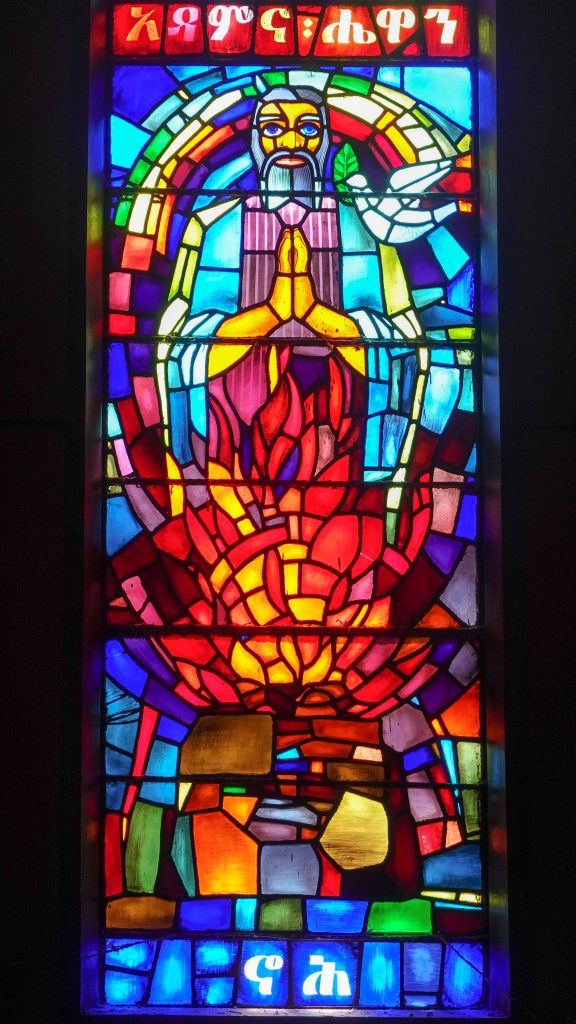
Photo by Timothy A. Gonsalves, hosted by Wikimedia Commons under a Creative Commons Attribution-Share Alike 4.0 International license

Stained glass is not just highly decorative, it’s a medium which has been used to express important religious messages for centuries. Literacy was not widespread in the medieval and Renaissance periods and the Church used stained glass and other artworks to teach the central beliefs of Christianity. In Gothic churches, the windows were filled with extensive narrative scenes in stained glass — like huge and colorful picture storybooks — in which worshipers could ‘read’ the stories of Christ and the saints and learn what was required for their religious salvation. (Source: Victoria and Albert Museum )
Learn more on Bible Odyssey: Noah .
complete verse (Genesis 8:13)
Following are a number of back-translations as well as a sample translation for translators of Genesis 8:13:
- Kankanaey: “When then Noe had six hundred and one years on the first day of the first month, the water was already dried-up/drained-off from the surface of the earth. Noe removed some of the roof of the ark so that he had a way to gaze properly, and he saw that the soil was drying.” (Source: Kankanaey Back Translation)
- Newari: “[By] the first day of the first month of Noah’s 601st year, the waters on the earth had subsided. When Noah removed the roof of the ship and looked, he saw that the earth was drying up.” (Source: Newari Back Translation)
- Hiligaynon: “Noe was already 601 years of age. And on the first day of the first month, the water subsided. Noe took-off/(removed) the cover of the ship and he saw that the land was already dry.” (Source: Hiligaynon Back Translation)
- English: “Noah was now 601 years old. By the first day of the first month of the Jewish year, the water had completely drained away from the ground. Noah removed the covering on top of the ark, and he was surprised to see that the surface of the ground was drying.” (Source: Translation for Translators)
Translation commentary on Genesis 8:13
The third episode (verses 13-19) also begins with a reference to time. In the six hundred and first year (as in 7.6, 11) refers to Noah’s age, and so Good News Translation has “When Noah was 601 years old….” In the first month, the first day of the month: see comments on 7.11.
The waters were dried from off the earth: dried translates a verb that means to dry up, but in the context and in relation to the verb used in verse 14, it is used as part of the drying process, and not as a state. So here the sense expressed is that the flood water has run off, disappeared, ended, or as Good News Translation says, “was gone.” The sense is that the land probably still remained wet but was drying out. One translation in an island language has “The earth was completely low-tide” (literally “… reefs all out of water”).
And Noah removed the covering of the ark: the word translated removed is used here in the sense of “undo, unfasten, take away”; however, it is not normally used for opening a door or window. The word translated covering has not been used before in connection with the boat and its construction. It may apply to part of the roof no longer needed. In any event removing it permitted Noah to look out, possibly in all directions. In translation covering may be referred to as “roof,” or “upper part.” Bible en français courant says “Noah opened the roof,” and New English Bible has “Noah removed the hatch.” At least one recent translation has “removed part of the roof.”
Looked is the same verb used for “to see.” The sense here is to direct the eyes for a particular purpose, to observe or carefully examine with the eyes. The object of Noah’s attention is the land, to know whether it appeared wet or dry. A number of translations say “looked around,” to convey the idea of a full and careful inspection. And behold: see “and lo” in verse 11.
Face of the ground: see comments on 2.6. Dry is the same word used earlier in the verse. If this word is taken in the sense of the drying process, Good News Translation “was getting dry” is suitable for English. New Jerusalem Bible has “was drying.” It is also possible that the narrator intends this to describe the completion of the drying, in which case “was dry” is satisfactory. Translators may follow either model.
Quoted with permission from Reyburn, William D. and Fry, Euan McG. A Handbook on Genesis. (UBS Helps for Translators). New York: UBS, 1997. For this and other handbooks for translators see here .
Leave a Reply
You must be logged in to post a comment.