In Aekyom, years are counted as “turtles” (ambum).
Norm Mundhenk tells this story:
“Recently I was checking some New Testament material in the Aekyom language of western Papua New Guinea. It seemed relatively clear until suddenly we came to a passage that started, ‘When Jesus had 12 turtles, …’ Surely I had misunderstood what they said.
“‘Did you say that Jesus had 12 turtles?’
“‘Let us explain! Around here there is a certain time every year when river turtles come up on the banks and lay their eggs. Because this is so regular, it can be used as a way of counting years. Someone’s age is said to be how many turtles that person has. So when we say that Jesus had 12 turtles, we mean that Jesus was 12 years old.’
“It was of course the familiar story of Jesus’ trip with his parents to Jerusalem. And certainly, as we all know, Jesus did indeed have 12 turtles at that time!”
In Tok Pisin, krismas (derived from “christmas”) is taken as the fixed annual marker, so Jesus had 12 “christmases” (Jisas i gat 12-pela krismas pinis) or Abram (in Gen. 12:4) had 75 (Abram i gat 75 krismas) (source: Norm Mundhenk). In Noongar it is biroka kadak or “summers had” (source: Warda-Kwabba Luke-Ang).
The Hebrew and Greek that is translated as “flood” in English is translated in the German Luther Bible as Sintflut and the influential Dutch Bibles Statenvertaling and Nieuwe Vertaling as zondvloed. Both terms originally mean “great / permanent flood” but have folk-etymologically been reinterpreted as “sin flood” (“sin” in Dutch is zonde and in German Sünde).
Today these terms are used in either language figuratively as well (“a lot of water” or “a lot”). (Source: Jost Zetzsche)
The Hebrew, Latin and Greek that is transliterated as “Noah” in English is translated in Spanish Sign Language with a sign that combines the letter N + “boat.” (Source: Steve Parkhurst)
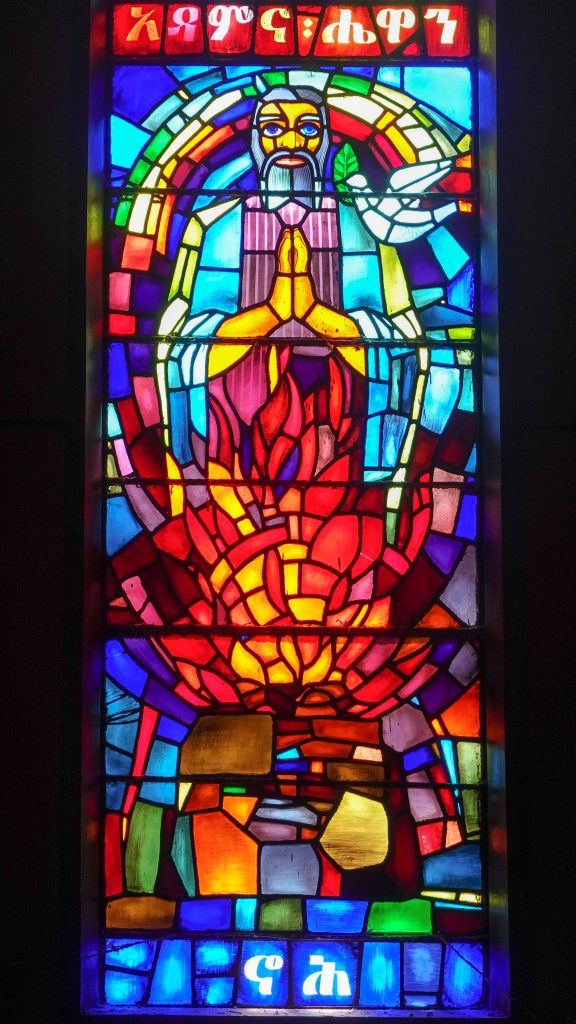
The following is a stained glass window depicting Noah by Endre Odon Hevezi and Gyula Bajo from 1965 for the Debre Libanos Monastery, Oromia, Ethiopia:
Photo by Timothy A. Gonsalves, hosted by Wikimedia Commons under a Creative Commons Attribution-Share Alike 4.0 International license
Stained glass is not just highly decorative, it’s a medium which has been used to express important religious messages for centuries. Literacy was not widespread in the medieval and Renaissance periods and the Church used stained glass and other artworks to teach the central beliefs of Christianity. In Gothic churches, the windows were filled with extensive narrative scenes in stained glass — like huge and colorful picture storybooks — in which worshipers could ‘read’ the stories of Christ and the saints and learn what was required for their religious salvation. (Source: Victoria and Albert Museum )
Noah was six hundred years old translates the Hebrew idiom “Noah was a son of six hundred years.” This is the first time in Genesis that a person’s age is given in relation to a particular event. Six hundred may be understood as “Noah was in his six hundredth year” (ordinal numeral) or “was six hundred years old” (cardinal numeral).
When the flood of waters came upon the earth is a time clause that may have to be placed at the beginning of the verse. Flood of waters refers to the “floodwaters” (New International Version) or “waters of the deluge” (Moffatt). See comments on flood at 6.17. Came upon the earth translates the Hebrew “was on the earth”; however, the verb indicates not a state but an action that happened at a particular time in Noah’s life and which in English is best translated as “came” or “flooded the earth.”
Quoted with permission from Reyburn, William D. and Fry, Euan McG. A Handbook on Genesis. (UBS Helps for Translators). New York: UBS, 1997. For this and other handbooks for translators see here .


Leave a Reply
You must be logged in to post a comment.