The following is a stained glass window from the Three choir windows in the Marienkirche, Frankfurt (Oder), Germany, of the 14th century, depicting Noah’s ark
Source: Der gläserne Schatz: Die Bilderbibel der St. Marienkirche in Frankfurt (Oder), Neuer Berlin Verlag, 2005, hosted by Wikimedia Commons under a public domain license
Stained glass is not just highly decorative, it’s a medium which has been used to express important religious messages for centuries. Literacy was not widespread in the medieval and Renaissance periods and the Church used stained glass and other artworks to teach the central beliefs of Christianity. In Gothic churches, the windows were filled with extensive narrative scenes in stained glass — like huge and colorful picture storybooks — in which worshipers could ‘read’ the stories of Christ and the saints and learn what was required for their religious salvation. (Source: Victoria and Albert Museum )
The Hebrew, Latin and Greek that is transliterated as “Noah” in English is translated in Spanish Sign Language with a sign that combines the letter N + “boat.” (Source: Steve Parkhurst)
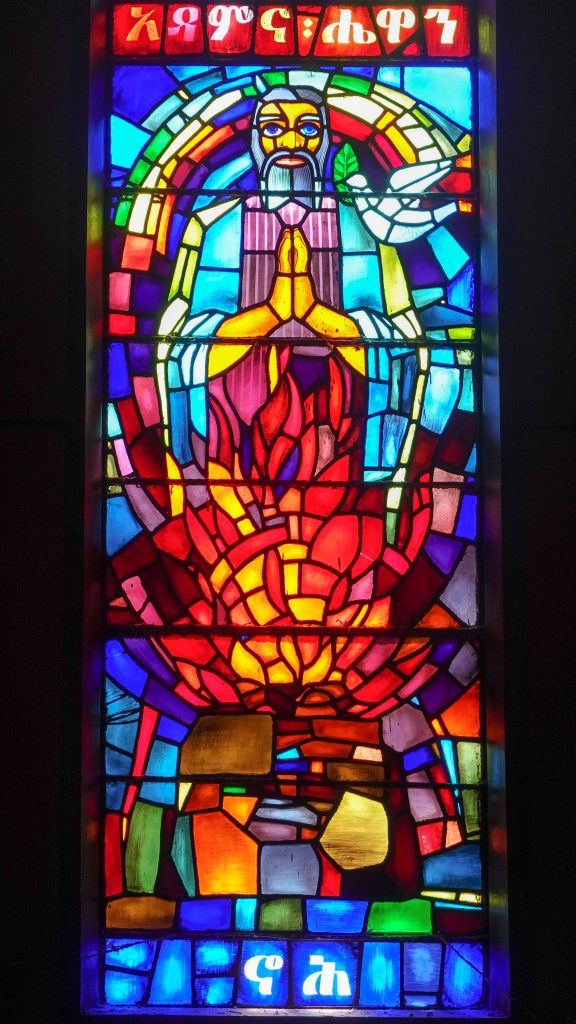
The following is a stained glass window depicting Noah by Endre Odon Hevezi and Gyula Bajo from 1965 for the Debre Libanos Monastery, Oromia, Ethiopia:
Photo by Timothy A. Gonsalves, hosted by Wikimedia Commons under a Creative Commons Attribution-Share Alike 4.0 International license
Stained glass is not just highly decorative, it’s a medium which has been used to express important religious messages for centuries. Literacy was not widespread in the medieval and Renaissance periods and the Church used stained glass and other artworks to teach the central beliefs of Christianity. In Gothic churches, the windows were filled with extensive narrative scenes in stained glass — like huge and colorful picture storybooks — in which worshipers could ‘read’ the stories of Christ and the saints and learn what was required for their religious salvation. (Source: Victoria and Albert Museum )
Following are a number of back-translations as well as a sample translation for translators of Genesis 7:15:
Kankanaey: “including all the kinds of animals and birds that God commanded, who were the time and the wild, the large and the small that were male and female.” (Source: Kankanaey Back Translation)
Newari: “All living beings that breathe, male and female, came to Noah in the ship.” (Source: Newari Back Translation)
Hiligaynon: “According to what God had-commanded Noe, he caused-to-go-inside the ship every pair of all the kinds of animals that had-come-near to him. After-that, the LORD closed the ship.” (Source: Hiligaynon Back Translation)
English: “Pairs of all animals came to Noah and entered the boat.” (Source: Translation for Translators)
They went into the ark: They refers to all the living species listed in verse 14. Went into the ark with Noah is repeated from Gen 7.9. Two and two can more naturally be translated “a pair” or “a male and a female.”
Of all flesh: flesh, as in 6.19, refers to living beings or creatures. In which there was the breath of life is the same as in 1.30. See there for discussion. Verse 15 may be rendered, for example, “One male and one female of every kind of living being went into the boat with Noah.” Bible en français courant translates “Pairs of every living species went into the boat along with Noah.”
Quoted with permission from Reyburn, William D. and Fry, Euan McG. A Handbook on Genesis. (UBS Helps for Translators). New York: UBS, 1997. For this and other handbooks for translators see here .



,_14th_century.jpg)

Leave a Reply
You must be logged in to post a comment.