
The Hebrew that is translated as “upright frames” in English is translated in Elhomwe with the term “upright plank,” “because in Elhomwe only the whole structure of vertical and horizontal planks would be called a ‘frame.'” (Source: project-specific translation notes in Paratext)
tabernacle (noun)
The Hebrew and Greek that is translated as “tabernacle” in English is translated in San Blas Kuna as “house of prayer that can be carried.” (Source: Ronald Ross)
In Bandi it is translated as “holy sitting place.” The “sitting place for the Bandi is where you live.” Therefore the tabernacle is the place where God lived. (Source: Becky Grossmann in this newsletter )
In Vidunda it is translated as “God’s tent” (source: Pioneer Bible Translators, project-specific translation notes in Paratext) and in Tibetan as gur mchog (གུར་མཆོག) or “perfect tent” (source: gSungrab website )
In American Sign Language it is translated with with a sign for “tent” combined with a sign referring to the outer court surrounding the tent (see Exodus 27:9 and following). (Source: Ruth Anna Spooner, Ron Lawer)
“Tabernacle” in American Sign Language, source: Deaf Harbor
See also tabernacle (verb) / dwell, festival of Tabernacles and ark of the covenant.
complete verse (Exodus 26:15)
Following are a number of back-translations as well as a sample translation for translators of Exodus 26:15:
- Kupsabiny: “Someone make/prepare acacia frames so the Tent may stand on (them).” (Source: Kupsabiny Back Translation)
- Newari: “Erect planks from the acacia tree to support the canopy of the tent of the meeting.” (Source: Newari Back Translation)
- Hiligaynon: “‘The framework for the Tent must-be acacia/[akasya] boards.” (Source: Hiligaynon Back Translation)
- Bariai: “‘And also, you (pl.) must make the shelter’s studs from akas wood, yet between each pair of studs, you must nail cross pieces, and so they make the pairs of studs to become like door frames. [When] it’s like that, then the pairs of studs together with their cross pieces will exist as the individual pieces of the wall’s bones.” (Source: Bariai Back Translation)
- Opo: “you shall chop white-acacia, build it for wood of tent which be 48.” (Source: Opo Back Translation)
- English: “‘Tell them to make 48 frames from acacia wood, frames that will be set up from which to hang the Sacred Tent covers.” (Source: Translation for Translators)
acacia
The plural form of shittah (shittim) is used sometimes as a place name (see Shittim), which is evidence of the wide distribution of this tree in Sinai and southern Palestine. The acacia referred to in the Bible was of two kinds, the Umbrella Thorn Acacia Acacia tortilis and the Common Acacia Acacia raddiana.
The Acacia tortilis is found in the hot Arabah Valley, whereas the Acacia raddiana tends to be found in cooler conditions throughout Sinai. A third variety (Acacia albida) is found in lowland Israel, the Sharon Plain, and lower Galilee. The common acacia was the only tree available to the Israelites for construction of the Tabernacle.
Both types of acacia are short, reaching 3-5 meters (10-17 feet) tall, but having a wide crown. As members of the Mimosa family, they have sharp spines, finely divided leaves, and tiny pale yellow flowers arranged in drooping bunches. The bean pod they produce is twisted and looped when dry.
Since the acacia is widespread in dry areas of Africa, Arabia, India and Australia, translators in those areas should be able to use a local word. In such languages a local species should be used, especially one that is used for building. Elsewhere, if none of these is available, the translator can transliterate from Hebrew (shittah) or from a major language, for example, sunt or talh (Arabic), akasiya (English/French/Spanish via Latin). West African translators need to beware of confusing “acacia” and “cassia,” a common tree with yellow flowers.
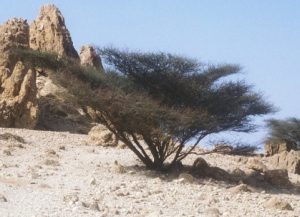
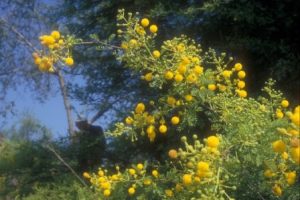
Source: Each According to its Kind: Plants and Trees in the Bible (UBS Helps for Translators)
Leave a Reply
You must be logged in to post a comment.