The Hebrew and Greek that is translated as “thirst” or “thirsty” in English is translated in Kituba as “hungry for water.” (Source: Donald Deer in The Bible Translator 1973, p. 207ff. )
See also thirst (figuratively).

וַיִּצְמָ֨א שָׁ֤ם הָעָם֙ לַמַּ֔יִם וַיָּ֥לֶן הָעָ֖ם עַל־מֹשֶׁ֑ה וַיֹּ֗אמֶר לָ֤מָּה זֶּה֙ הֶעֱלִיתָ֣נוּ מִמִּצְרַ֔יִם לְהָמִ֥ית אֹתִ֛י וְאֶת־בָּנַ֥י וְאֶת־מִקְנַ֖י בַּצָּמָֽא׃
3But the people thirsted there for water, and the people complained against Moses and said, “Why did you bring us out of Egypt, to kill us and our children and livestock with thirst?”
The Hebrew and Greek that is translated as “thirst” or “thirsty” in English is translated in Kituba as “hungry for water.” (Source: Donald Deer in The Bible Translator 1973, p. 207ff. )
See also thirst (figuratively).
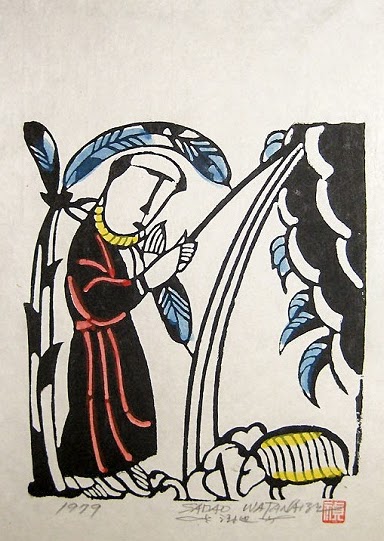
Hand colored stencil print on washi by Sadao Watanabe (1997).
Image taken with permission from the SadaoHanga Catalogue where you can find many more images and information about Sadao Watanabe.
For other images of Sadao Watanabe art works in TIPs, see here.
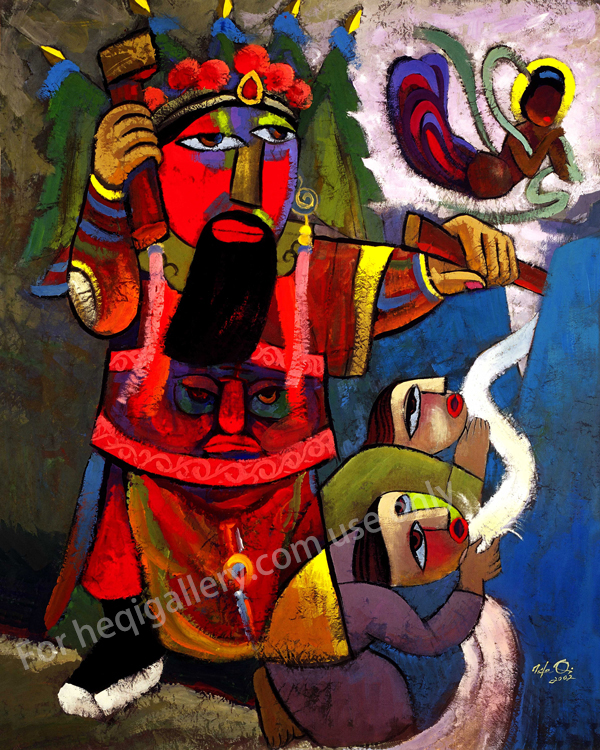
Image taken from He Qi Art . For purchasing prints of this and other artworks by He Qi go to heqiart.com .
For other images of He Qi art works in TIPs, see here.
In Telugu different verbs for humans drinking (tāgu / తాగు) and animals drinking (cēḍu / చేడు) are required.
The inclusive “we” specifically includes the addressee (“you and I and possibly others”), while the exclusive “we” specifically excludes the addressee (“he/she/they and I, but not you”). This grammatical distinction is called “clusivity.” While Semitic languages such as Hebrew or most Indo-European languages such as Greek or English do not make that distinction, translators of languages with that distinction have to make a choice every time they encounter “we” or a form thereof (in English: “we,” “our,” or “us”).
For this verse, the Jarai and the Adamawa Fulfulde translation both use the exclusive pronoun, excluding Moses.
Following are a number of back-translations as well as a sample translation for translators of Exodus 17:3:
The name that is transliterated as “Moses” in English is signed in Spanish Sign Language and Polish Sign Language in accordance with the depiction of Moses in the famous statue by Michelangelo (see here ). (Source: John Elwode in The Bible Translator 2008, p. 78ff. )
“Moses” in Spanish Sign Language, source: Sociedad Bíblica de España
American Sign Language also uses the sign depicting the horns but also has a number of alternative signs (see here ).
In French Sign Language, a similar sign is used, but it is interpreted as “radiance” (see below) and it culminates in a sign for “10,” signifying the 10 commandments:
“Moses” in French Sign Language (source )
The horns that are visible in Michelangelo’s statue are based on a passage in the Latin Vulgate translation (and many Catholic Bible translations that were translated through the 1950ies with that version as the source text). Jerome, the translator, had worked from a Hebrew text without the niqquds, the diacritical marks that signify the vowels in Hebrew and had interpreted the term קרו (k-r-n) in Exodus 34:29 as קֶ֫רֶן — keren “horned,” rather than קָרַו — karan “radiance” (describing the radiance of Moses’ head as he descends from Mount Sinai).
In Swiss-German Sign Language it is translated with a sign depicting holding a staff. This refers to a number of times where Moses’s staff is used in the context of miracles, including the parting of the sea (see Exodus 14:16), striking of the rock for water (see Exodus 17:5 and following), or the battle with Amalek (see Exodus 17:9 and following).
“Moses” in Swiss-German Sign Language, source: DSGS-Lexikon biblischer Begriffe , © CGG Schweiz
In Vietnamese (Hanoi) Sign Language it is translated with the sign that depicts the eye make up he would have worn as the adopted son of an Egyptian princess. (Source: The Vietnamese Sign Language translation team, VSLBT)
“Moses” in Vietnamese Sign Language, source: SooSL
In Estonian Sign Language Moses is depicted with a big beard. (Source: Liina Paales in Folklore 47, 2011, p. 43ff. )

“Moses” in Estonian Sign Language, source: Glossary of the EKNK Toompea kogudus
For more information on translations of proper names with sign language see Sign Language Bible Translations Have Something to Say to Hearing Christians .
Learn more on Bible Odyssey: Moses .
But the people thirsted there for water seems to repeat what has already been said, and some scholars believe this verse comes from a different tradition. But the present context suggests that it is repeated for emphasis, so Good News Translation has “very thirsty.” Revised English Bible has “The people became so thirsty there that…,” and New Jerusalem Bible has “But tormented by thirst, the people complained.” And the people murmured against Moses now uses the same Hebrew word for “murmuring” as in 15.24. New International Version has “and they grumbled,” without repeating the people. Good News Translation combines the two clauses: “But the people were very thirsty and continued to complain to Moses.”
And said introduces a rhetorical question similar to the questions in 14.11-12 and the complaint in 16.3. Why, literally “For what this,” is an emphatic Why, meaning “why indeed,” but Durham translates it as “What is this?” Did you bring us up out of Egypt is literally “you caused us to go up from Egypt.” The verb means to ascend from a lower level to a higher level, as explained at 3.8. Most translations do not reflect this.
To kill us is literally “to cause me to die.” The singular pronoun is also used with “my children” and “my cattle.” Jerusalem Bible has followed the Hebrew closely: “Was it so that I should die,” and so on. Hebrew Old Testament Text Project supports this reading with an {A} rating, even though many ancient versions have the plural us. Most translations, however, have used the plural for the sake of the context. Our children is literally “my sons,” and our cattle is literally “my livestock.” (For cattle see 9.3 and the comment.) Contemporary English Version has a helpful model for the final part of this verse: “Moses, did you bring us out of Egypt just to let us and our families and our animals die of thirst?”
Quoted with permission from Osborn, Noel D. and Hatton, Howard A. A Handbook on Exodus. (UBS Helps for Translators). New York: UBS, 1999. For this and other handbooks for translators see here .
No comments yet.
Leave a Reply
You must be logged in to post a comment.