14We must no longer be children, tossed to and fro and blown about by every wind of doctrine by people’s trickery, by their craftiness in deceitful scheming;
Many languages distinguish between inclusive and exclusive first-person plural pronouns (“we”). (Click or tap here to see more details)
The inclusive “we” specifically includes the addressee (“you and I and possibly others”), while the exclusive “we” specifically excludes the addressee (“he/she/they and I, but not you”). This grammatical distinction is called “clusivity.” While Semitic languages such as Hebrew or most Indo-European languages such as Greek or English do not make that distinction, translators of languages with that distinction have to make a choice every time they encounter “we” or a form thereof (in English: “we,” “our,” or “us”).
For this verse, translators typically select the inclusive form (including the addressee).
Source: Velma Pickett and Florence Cowan in Notes on Translation January 1962, p. 1ff.
Following are a number of back-translations of Ephesians 4:14:
Uma: “When we become like that, we will no longer like children who are easily deceived or like dry leaves that are blown back and forth by the wind. We no longer follow just any old teaching [lit., follow-following randomly teaching-teachings], we no longer immediately swallow the words of people who want to deceive us with their plans that make-fall.” (Source: Uma Back Translation)
Yakan: “When our (dual) trust is already firm/strong, our (dual) thinking is no longer like the thinking of a child who is easily deceived/taken-in. We (dual) are no longer carried-along by whatever is taught. We (dual) are no longer like other people, whatever they are taught by the deceiving religious-teachers they believe-obey, they figuratively just go along wherever the waves or the wind carry them.” (Source: Yakan Back Translation)
Western Bukidnon Manobo: “Then it will be possible that we will be no longer like children, because the person who is like that, His faith varies because He can easily believe any kind of doctrine that’s taught to Him by lying people who know how to deceive.” (Source: Western Bukidnon Manobo Back Translation)
Kankanaey: “And if that’s what we are like, we will not be like a child who easily keeps-changing his mind, because we will not of course be deceived by the not true teaching of clever and lying people.” (Source: Kankanaey Back Translation)
Tagbanwa: “For the Lord wants that we are not like children who can be influenced by various (lit.taken by here and there) teaching, in which they are like a boat that’s just floating and being-lifted-up-and-down by the waves and driven along by the wind. Good if we are not fooled by the teaching of people who don’t have good motives for they are just like lying-in-wait for whoever they might deceive.” (Source: Tagbanwa Back Translation)
Tenango Otomi: “Then we won’t be doing like children. Because the children are easily deceived. Like when the wind blows something here and there, thus are the children in that they follow after whatever teaching comes along. Because the teachers who are deceivers are knowledgeable in searching how to deceive the people. They want us to follow their lies which they teach.” (Source: Tenango Otomi Back Translation)
Copainalá Zoque: “Thus that we not be like children, and that we not totter back and forth, and that whatever teaching that blows [lit. runs] like wind may not blow [run] us along here and there, because thus men take thought how they may deceive us and (how) we may lose our way.” (Source: William Wonderly in The Bible Translator 1953, p. 14ff. )
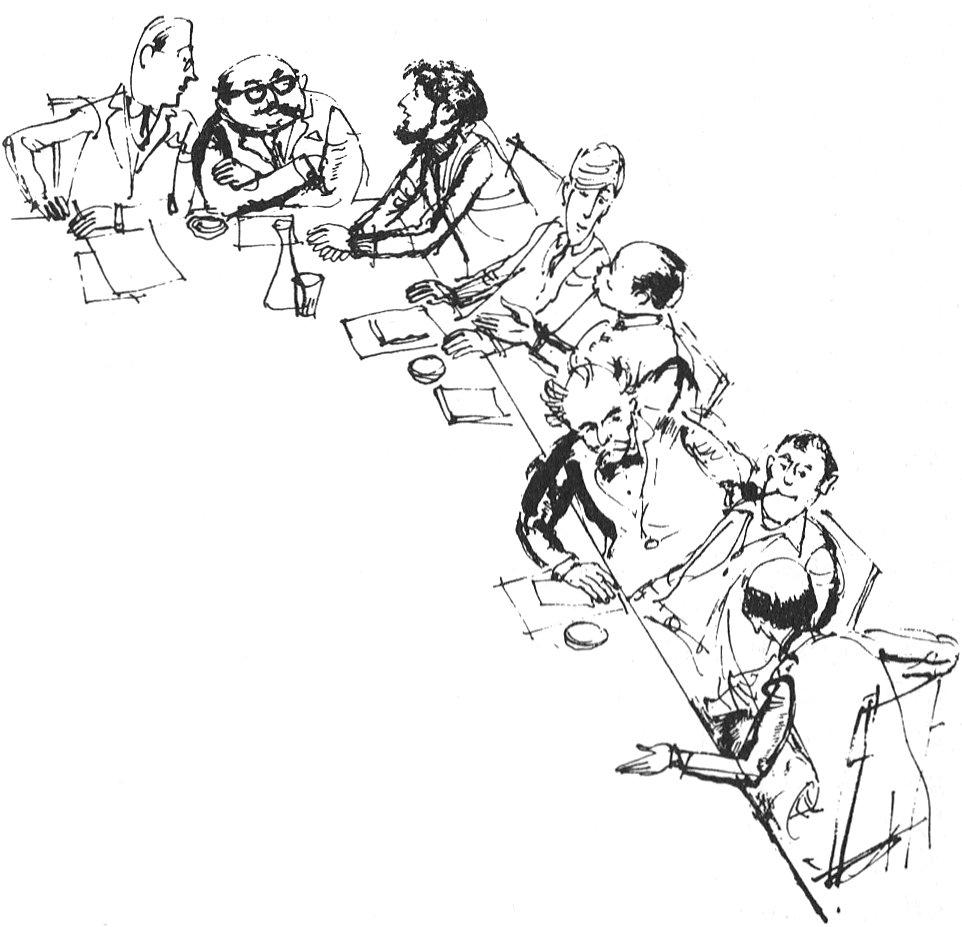
Illustration by Horst Lemke (1922-1985) for the GermanGute Nachricht für Sie – NT68, one of the first editions of the Good News Bible in German of 1968. Lemke was a well-known illustrator who illustrated books by Erich Kästner , Astrid Lindgren and many others.
Here the purpose or result of the church’s maturity is spelled out in contrast with the figure of immature, indecisive children who are led astray by cunning and artful schemers. In 1 Corinthians 13.11 Paul makes a contrast between “child” and “man” (and see also 1 Cor 3.1-2). In order to emphasize the figurative sense of the term children, it may be best to translate the first part of verse 14 as “then we shall no longer be like children.”
The first participle means “tossed about by waves” (the verb occurs only here in the New Testament; for the noun “wave” see James 1.6). The second participle is “carried around”; the picture is that of a small boat in a storm, unable to hold a steady course. This figure of rough waves and strong winds is applied to wrong teachings which carry immature Christians away from the truth of the gospel.
In order to make somewhat clearer the figurative expression carried by the waves and blown about by every shifting wind, it may be necessary to fill out the figurative expression by introducing the idea of a boat in a storm, for example, “we will no longer be like a small boat tossed one way and then another by the waves or blown in one direction and another by the wind which keeps changing.”
The teaching of deceitful men translates the Greek “the teaching in/by the deceit of man”; “deceit” translates a word used nowhere else in the New Testament, and which literally means “playing with dice.” Here it means “trickery, sleight of hand.” In order to relate teaching of deceitful men to the preceding figures of speech, it may be best to translate “the way deceitful men teach others is like that” or “that is just what happens when deceitful men teach people.”
“In the cunning in accordance with the scheming of error” (Hdb|fig:Table_EPH4-11.jpg): the Greek word for “cunning” or “craftiness” is used in 2 Corinthians 11.3 of the snake in the Garden of Eden as it tricked Eve; the meaning of the word is well illustrated by its use in Luke 20.23.
“Scheming” translates a Greek word which appears in the New Testament only here and in 6.11 “craftiness, trickery.” It is qualified by the genitive phrase “of error.” Here again, in order to emphasize his point, the writer employs redundant and flamboyant language which is none too precise. Translator’s New Testament translates “at the mercy of cunning men wickedly plotting to lead us astray”; New English Bible “dupes of crafty rogues and their deceitful schemes”; Barth “the trickery of men who are experts in deceitful scheming”; New International Version “the cunning and craftiness of men in their deceitful scheming.” Good News Translationthe tricks they invent is not good, since it might suggest the actual performance of tricks; better would be something like “their clever schemes/lies.”
The last clause of this verse, namely, who lead others into error by the tricks they invent, may be rendered as “they cause others to go astray because of the clever lies that they tell.” It may also be possible to translate who lead others into error as “who cause others to go down the wrong road” or “who cause others to believe what isn’t true.”
It should be noted that the writer does not specify what are the wrong teachings which he condemns. Beare conjectures: “It is an eccentric individualism, rather than sectarianism, which is attacked.”
Quoted with permission from Bratcher, Robert C. and Nida, Eugene A. A Handbook on Paul’s Letter to the Ephesians. (UBS Handbook Series). New York: UBS, 1982. For this and other handbooks for translators see here .
Living Water is produced for the Bible translation movement in association with Lutheran Bible Translators. Lyrics derived from the ESV® Bible (The Holy Bible, English Standard Version®).

Leave a Reply
You must be logged in to post a comment.