The Hebrew, Latin and Greek that is translated into English as “chariot” is translated into Anuak as “canoe pulled by horse.” “Canoe” is the general term for “vehicle” (source: Loren Bliese). Similarly it is translated in Lokạạ as ukwaa wạ nyanyang ntuuli or “canoe that is driven by horses.” (Source: J.A. Naudé, C.L. Miller Naudé, J.O. Obono in Acta Theologica 43/2, 2023, p. 129ff. )
Other translations include:
Chichicapan Zapotec: “ox cart” (in Acts 8) (ox carts are common vehicles for travel) (source: Loren Bliese)
Chichimeca-Jonaz, it is translated as “little house with two feet pulled by two horses” (source: Viola Waterhouse in Notes on Translation August 1966, p. 86ff.)
HausaCommon Language Bible as keken-doki or “cart of donkey” (source: Andy Warren-Rothlin)
The name that is transliterated as “Isaiah” in English is translated in Finnish Sign Language with the signs signifying “save + prophet” (referring to Genesis 2:21). (Source: Tarja Sandholm)
Following is a Russian Orthodox icon of Isaiah from the 18th century (found in the Transfiguration Church, Kizhi Monastery, Karelia, Russia). The text in the scrollis from Isaiah 2:2: “In the last days […] shall be established.”
Orthodox Icons are not drawings or creations of imagination. They are in fact writings of things not of this world. Icons can represent our Lord Jesus Christ, the Virgin Mary, and the Saints. They can also represent the Holy Trinity, Angels, the Heavenly hosts, and even events. Orthodox icons, unlike Western pictures, change the perspective and form of the image so that it is not naturalistic. This is done so that we can look beyond appearances of the world, and instead look to the spiritual truth of the holy person or event. (Source )
Following are a number of back-translations of Acts 8:28:
Uma: “Filipus did go. At that time, there was also an Ethiopia person traveling on that road returning going to his town. That Etiopia person was a man of big rank, who controlled all the contents of the house of the queen of the land of Etiopia who was named Kandake. Having finished worshipping God in Yerusalem, he was returning to his town riding a cart pulled by horses. While he sat in his cart, he read the letter of the prophet Yesaya.” (Source: Uma Back Translation)
Yakan: “Now he was on his way home from Awrusalam and he was there sitting on his kalesa (light horse-drawn vehicle) reading the holy-book written by Nabi Isaya.” (Source: Yakan Back Translation)
Western Bukidnon Manobo: “And then Philip left. And there was a person there, an Ethiopian, who had gone to Jerusalem because he will worship God. He was an official trusted by the Candace, which is to say, queen, there in Ethiopia. The queen entrusted to him all of her wealth. And when the official was going home riding on a cart, he was reading the book which Isaiah wrote a long time ago, Isaiah the inspired one of God.” (Source: Western Bukidnon Manobo Back Translation)
Kankanaey: “He was riding in his calesa to go-home while also reading the book written by Isaias who was a prophet back before.” (Source: Kankanaey Back Translation)
Tagbanwa: “He was riding in his vehicle which was pulled by horses, for he was now going home. What he was doing as he rode was, he was reading the writing of a prophet of the past who was Isaias.” (Source: Tagbanwa Back Translation)
Eugene Nida wrote the following about the translation of the Hebrew, Aramaic and Greek terms that are typically translated with “prophet” in English:
“The tendency in many translations is to use ‘to foretell the future’ for ‘prophesy,’ and ‘one who foretells the future’ for ‘prophet.’ This is not always a recommended usage, particularly if such expressions denote certain special native practices of spirit contact and control. It is true, of course, that prophets of the Bible did foretell the future, but this was not always their principal function. One essential significance of the Greek word prophētēs is ‘one who speaks forth,’ principally, of course, as a forth-teller of the Divine will. A translation such as ‘spokesman for God’ may often be employed profitably.” (1947, p. 234f.)
Following is a list of (back-) translations from other languages (click or tap for details):
Ayutla Mixtec: “one who talks as God’s representative”
Isthmus Mixe: “speaker for God” (source for this and two above: Viola Waterhouse in Notes on Translation August 1966, p. 86ff.)
Mezquital Otomi / Paasaal: “God’s messenger” (source: Waterhouse / Parrott in Notes on Translation October 1967, p. 1ff. and Fabian N. Dapila in The Bible Translator 2024, p. 415ff.)
Noongar: Warda Marridjiny or “News Traveling” (source: Warda-Kwabba Luke-Ang)
Kutu: mtula ndagu or “one who gives the prediction of the past and the future” (Source: Pioneer Bible Translators, project-specific translation notes in Paratext)
Ebira: ọnịsẹ, a neologism that combines the prefix ọn for “a person” with ịsẹ for “prediction” (source: Scholz /Scholz 2015, p. 49)
French 1985 translation by Chouraqui: inspiré or “inspired one” (“someone in whom God has breathed [Latin: in + spiro]) (source: Watson 2023, p. 45)
In Ixcatlán Mazatec a term is used that specifically includes women. (Source: Robert Bascom)
“In some instances these spiritual terms result from adaptations reflecting the native life and culture. Among the Northern Grebo people of Liberia, a missionary wanted some adequate term for ‘prophet,’ and she was fully aware that the native word for ‘soothsayer’ or ‘diviner’ was no equivalent for the Biblical prophet who spoke forth for God. Of course, much of what the prophets said referred to the future, and though this was an essential part of much of their ministry, it was by no means all. The right word for the Gbeapo people would have to include something which would not only mean the foretelling of important events but the proclamation of truth as God’s representative among the people. At last the right word came; it was ‘God’s town-crier.’ Every morning and evening the official representative of the chief goes through the village crying out the news, delivering the orders of the chief, and announcing important coming events. ‘God’s town-crier’ would be the official representative of God, announcing to the people God’s doings, His commands, and His pronouncements for their salvation and well-being. For the Northern Grebo people the prophet is no weird person from forgotten times; he is as real as the human, moving message of the plowman Amos, who became God’s town-crier to a calloused people.” (source: Nida 1952, p. 20)
In British Sign Language it is is translated with a sign that depicts a message coming from God to a person (the upright finger) and then being passed on to others. (Source: Anna Smith)
“Prophet” in British Sign Language (source: Christian BSL, used with permission)
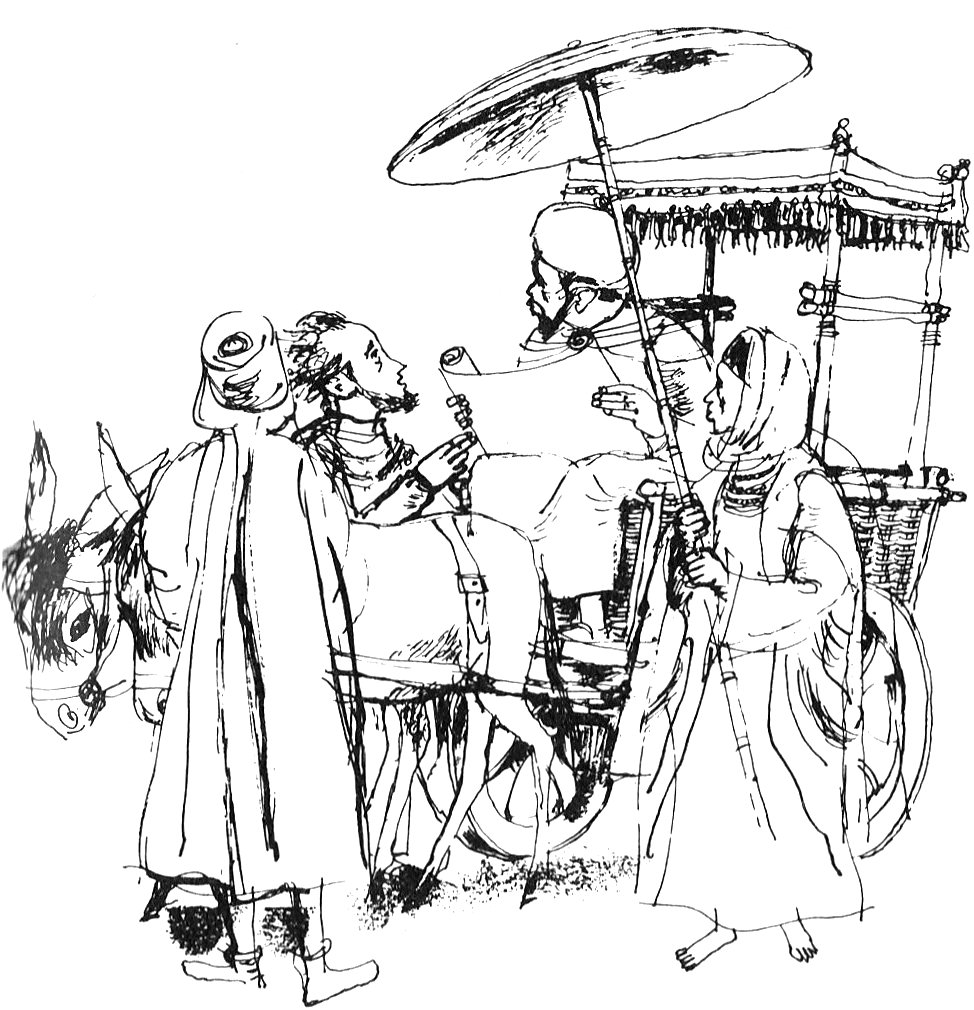
Illustration by Horst Lemke (1922-1985) for the GermanGute Nachricht für Sie – NT68, one of the first editions of the Good News Bible in German of 1968. Lemke was a well-known illustrator who illustrated books by Erich Kästner , Astrid Lindgren and many others.
Some equivalent of the transitional particle so is especially useful to point up the response of Philip to the immediately preceding command from the Lord.
The following sentence about the Ethiopian eunuch introduces another participant in the story. It is very important, therefore, to have some kind of transitional device to highlight the fact that another person is being introduced. In the Good News Translation this is done by the use of the conjunction now.
Although the word eunuch basically means “a man who has been emasculated,” the word is often used in the Old Testament as a synonym for a high political or military official; and the word translated important official (see New English Bible “high official”) indicates the importance of the position that he held in the court of Ethiopia. In some languages a literal equivalent of eunuch has such unfortunate connotations that in certain translations this type of reference has been omitted completely and simply an equivalent of “official” has been employed. This is perfectly acceptable within such a context, since there is no special reference to the physical condition of the official, only his position and prominence.
Jewish law forbade a eunuch to become a full convert to Judaism (see Deuteronomy 23.1); but hope was given to those eunuchs who obeyed the Law of the Sabbath day (Isaiah 56.3-8), and they were permitted to worship the God of the Jewish people. This eunuch had been to Jerusalem to worship God (perhaps it is too much to describe him as having been there “on a pilgrimage,” so New English Bible, though the identical expression in 24.11 may support this translation).
Candace (transliterated as Kandake in the New English Bible) is not the name of the queen but rather the title of the queens of Ethiopia, as Pharaoh was the title of the kings of Egypt. An equivalent of treasury may be “valuable possessions,” “the money of the kingdom,” or “the gold and silver which belonged to the queen.” An equivalent of Queen is in many languages simply “a woman ruler” or a “woman who ruled over the whole land.”
Carriage or “wagon” suits the context better than “chariot,” which suggests a two-wheeled cart used in war. As the eunuch rode along he was reading aloud, as was the custom in antiquity.
The expression the book of the prophet Isaiah must clearly indicate that this was “the book containing the words of the prophet Isaiah” or “the book written by the prophet Isaiah.” It is not “the book which belonged to Isaiah.”
Quoted with permission from Newman, Barclay M. and Nida, Eugene A. A Handbook on The Acts of the Apostles. (UBS Handbook Series). New York: UBS, 1972. For this and other handbooks for translators see here .
Living Water is produced for the Bible translation movement in association with Lutheran Bible Translators. Lyrics derived from the ESV® Bible (The Holy Bible, English Standard Version®).




Leave a Reply
You must be logged in to post a comment.