11Next to him was Shammah son of Agee the Hararite. The Philistines gathered together at Lehi, where there was a plot of ground full of lentils, and the army fled from the Philistines.
The term that is transliterated as “Philistines” in English is translated in American Sign Language with a sign that signifies the helmet the Philistine warriors wore was decorated with feather-like objects. (Source: Ruth Anna Spooner, Ron Lawer)
“Philistines” in American Sign Language, source: Deaf Harbor
Click or tap here to see a short video clip about Philistines (source: Bible Lands 2012)
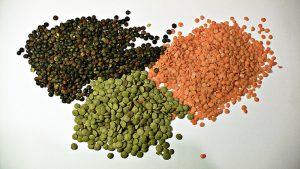
Scholars are agreed that the Hebrew word ‘adashah refers to the lentil Lens culinaris (formerly known as Lens esculenta). The Arabic word ‘adas, as well as several references in post-biblical Hebrew, confirm this identification, as does the Greek Septuagint. Seeds found in excavations dating to the sixth or seventh millennium B.C. show that the lentil is one of the first species to be cultivated by humans. In those excavations lentils are often found together with seeds of wheat and barley.
The lentil is a low-branched plant with a weak stem. It has tendrils, like pumpkins and squashes, and pinkish flowers that develop into a pod like a bean. The pod is very short with only one seed inside, about the size of a small pea. In one type of lentil the pea is reddish brown, hence the reference to “red” stew in Genesis 25:30. The pods are often in pairs or sets of three. In the Holy Land lentils grow in the cold season (November-March).
In Ezekiel 4:9 the strange bread, made from six kinds of grains and legumes including lentils, was probably intended to show that food would become scarce and that the people would have to eat whatever they could find. The lentil is typically used in soups and stews, as it was when Jacob used it to trick his brother Esau into giving up his rights as the firstborn son. Lentils were among the foodstuffs brought to David by local people when he was pursued by Absalom.
Lentils are now widespread in Asia, India, and North Africa. In places where they are not known, we suggest using the word for a local type of bean rather than a transliteration. However, in Ezekiel 4:9 “beans” are also mentioned, so a possible rendering for “beans and lentils” is “different kinds of beans.” In Genesis 25:34 a generic expression for “pottage of lentils” would be appropriate, such as “bean soup,” “bean stew,” or “vegetable soup.” If a transliteration from a major language is desired, consider Arabic adas; French cristallin, lentille; Spanish lenteja; Portuguese lentilha; and Swahili adesi.
The Hebrew, Aramaic, Greek and Latin that is translated as “army” in English is translated in Chichewa as “group of warriors.” (Source: Mawu a Mulungu mu Chichewa Chalero Back Translation)
Following are a number of back-translations as well as a sample translation for translators of 2 Samuel 23:11:
Kupsabiny: “And the third among the three courageous men was Shammah son of Agee of the house of Harar. The Philistines gathered in (a) garden of peas in Lehi. Then, the soldiers of Israel fled from those Philistines.” (Source: Kupsabiny Back Translation)
Newari: “Then the third brave one was Shammah son of Agee, the Hararite. The Philistines were lined up, gathering in a field of very good lentils. Then the Israelites ran away from Philistines.” (Source: Newari Back Translation)
Hiligaynon: “The next still was Shammah the child of Agee who is of/from-Harar. One time, the Filistinhon gathered at Lehi, and they attacked the Israelinhon in the field that is/was full of beans. The Israelinhon fled,” (Source: Hiligaynon Back Translation)
English: “The third one of the greatest warriors was Shammah, the son of Agee from the clan/town of Harar. One time the Philistia soldiers gathered at Lehi town, where there was a field full of lentils/peas that they wanted to steal. The other Israeli soldiers ran away from the Philistia troops,” (Source: Translation for Translators)
Next to him: continuing with ranking in order of importance, this expression now refers to the third most famous of the three top fighters. This should be translated in keeping with the way the same expression was handled in verse 9 above.
Son of Agee: the name here is disputed by textual experts. While there is some evidence for “son of Elah” (New Jerusalem Bible), Critique Textuelle de l’Ancien Testament recommends, with a {C} rating, the name “Agee,” as in Revised Standard Version, Good News Translation, and most other versions.
Hararite: this may refer either to an otherwise unknown tribe or to a place that is equally unknown. Parola Del Signore: La Bibbia in Lingua Corrente, for example, says “from the city of Harar.” The word may be related to the Hebrew word for mountain (har) and mean something like “mountaineer,” but translators should probably take it as a reference to a place or a clan and translate “from a place called Harar” or “from the clan of Harar.”
Lehi: this place name is found in the story of Samson (Judges 15.9), but here it is uncertain that this reflects the original reading of the Hebrew text. The difficulty is that in Hebrew the words “towards Lehi” and “into a band” are spelled with the same consonants. The vowels in the Masoretic Text make this word read “in a band”; some experts therefore think that the single Hebrew word rendered at Lehi should be translated “in a troop” (Traduction œcuménique de la Bible) or “in force” (New Jewish Publication Society’s Tanakh). But Critique Textuelle de l’Ancien Testament recommends “at Lehi,” giving a {B} rating to the correction, and this seems to be followed by the majority of modern versions. Probably the reading “in a band” in the Masoretic Text came about through making this word agree with the word for “a band” in verse 13.
Plot of ground: literally “a portion of a field.” The expression used here seems to refer to an area smaller than a complete field but large enough to grow a garden. Compare Gen 33.19, and see also Ruth 2.3; 4.3.
Lentils: this refers to the flat seeds of a small, pea-like plant that grows in the Near East. These seeds are high in protein and carbohydrates and are used to make a stew or soup (Gen 25.34), and as a basis for a kind of bread during difficult times (Ezek 4.9). The same word appears also in 17.28. The parallel passage in 1 Chr 11.13 has “barley” in place of lentils, but the two accounts should be translated without attempting to make them agree in translation.
The men: literally “the people.” This refers to the fighting men of Israel other than the hero of the story. So it may be preferable in some languages to say “the rest of the Israelite soldiers” or “the other warriors of Israel.”
Quoted with permission from Omanson, Roger L. and Ellington, John E. A Handbook on the First and Second Books of Samuel, Volume 2. (UBS Helps for Translators). New York: UBS, 2001. For this and other handbooks for translators see here .


Leave a Reply
You must be logged in to post a comment.