5and if he did not spare the ancient world, even though he saved Noah, a herald of righteousness, with seven others, when he brought a flood on the world of the ungodly;
The Hebrew and Greek that is translated as “world” in English is translated in Mandarin Chinese with shìjiè (世界). While shìjiè is now the commonly used term for “world” in Chinese, it was popularized as such by Chinese Bible translations. (Source: Mak 2017, p. 241ff.)
The Hebrew and Greek that is translated as “flood” in English is translated in the German Luther Bible as Sintflut and the influential Dutch Bibles Statenvertaling and Nieuwe Vertaling as zondvloed. Both terms originally mean “great / permanent flood” but have folk-etymologically been reinterpreted as “sin flood” (“sin” in Dutch is zonde and in German Sünde).
Today these terms are used in either language figuratively as well (“a lot of water” or “a lot”). (Source: Jost Zetzsche)
The Greek, Hebrew, Aramaic, and Latin that is translated as a form of “save” in English is translated in Shipibo-Conibo with a phrase that means literally “make to live,” which combines the meaning of “to rescue” and “to deliver from danger,” but also the concept of “to heal” or “restore to health.”
Following are a number of back-translations of 2 Peter 2:5:
Uma: “So also the evil men of long ago, God did not let them go without punishment. The world long ago he destroyed with water, with the result that all the disobedient/rejecting people died. Only the prophet Nuh and seven other people he helped so that they did not die, for Nuh spread/preached the Word of God to all people and advised them to follow his commands.” (Source: Uma Back Translation)
Yakan: “The people in the world of old times also, they were not pitied/shown mercy by God but/instead because of their sins God flooded this world. He only saved Nu and his seven companions. When the flood had not yet come Nu always preached to the people telling them to cause their doings to be straight/righteous.” (Source: Yakan Back Translation)
Western Bukidnon Manobo: “Neither did God also overlook all mankind long ago, for He caused the ocean to overflow and all who had no respect for Him drowned. Only Noah was saved who had taught righteous behaviour, and there were also seven other people whom He saved.” (Source: Western Bukidnon Manobo Back Translation)
Kankanaey: “God also punished the collective-people who had no thoughts for him who lived in the time of Noe long ago, because he flooded the earth and they drowned. But as for Noe who preached that they should follow a righteous way-of-life, God saved/rescued him and seven other people.” (Source: Kankanaey Back Translation)
Tagbanwa: “And something else, consider that because people were always opposing the will of God back in the early days of the world, that’s why God destroyed/dissolved this world. There really were none at all he saved, except Noe and seven people who were with him. The people had like that happen to them even though Noe was causing them to comprehend what the life was like which pleased God.” (Source: Tagbanwa Back Translation)
Tenango Otomi: “Neither did God forgive the ancient people who lived long ago. Rather the land was covered by water then there was a deluge of rain which finished off the evil people. Only eight people in all were left, including Noah, the one who told the sinners to live good lives.” (Source: Tenango Otomi Back Translation)
The Hebrew, Latin and Greek that is transliterated as “Noah” in English is translated in Spanish Sign Language with a sign that combines the letter N + “boat.” (Source: Steve Parkhurst)
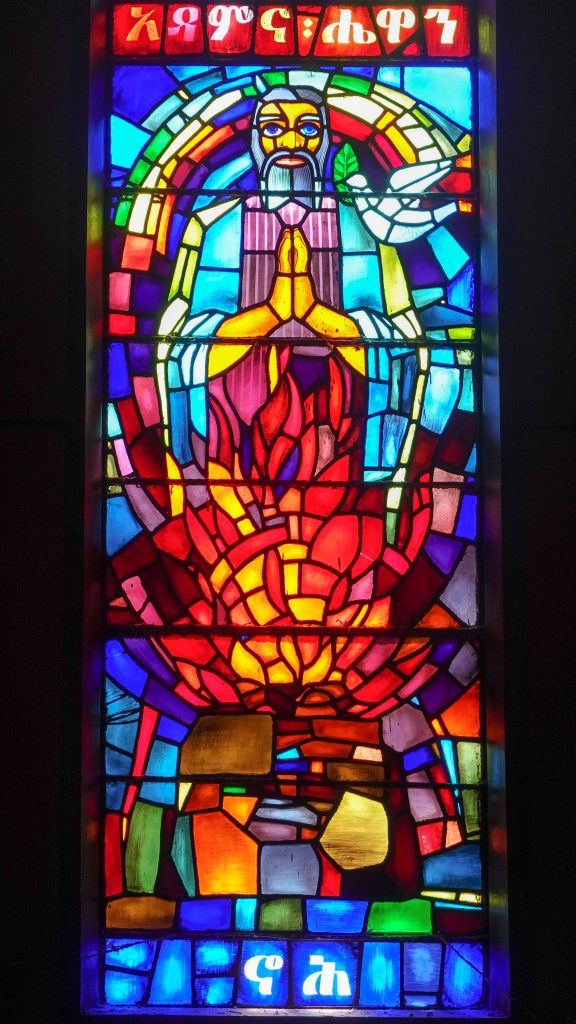
The following is a stained glass window depicting Noah by Endre Odon Hevezi and Gyula Bajo from 1965 for the Debre Libanos Monastery, Oromia, Ethiopia:
Photo by Timothy A. Gonsalves, hosted by Wikimedia Commons under a Creative Commons Attribution-Share Alike 4.0 International license
Stained glass is not just highly decorative, it’s a medium which has been used to express important religious messages for centuries. Literacy was not widespread in the medieval and Renaissance periods and the Church used stained glass and other artworks to teach the central beliefs of Christianity. In Gothic churches, the windows were filled with extensive narrative scenes in stained glass — like huge and colorful picture storybooks — in which worshipers could ‘read’ the stories of Christ and the saints and learn what was required for their religious salvation. (Source: Victoria and Albert Museum )
The Greek, Hebrew, and Latin terms that are translated in English mostly as “righteous” as an adjective or personified noun or “righteousness” (also as “upright(ness)” and “just(ice)”) are most commonly expressed with concept of “straightness,” though this may be expressed in a number of ways. (Click or tap here to see the details)
Following is a list of (back-) translations of various languages:
Paasaal: “white heart” (source: Fabian N. Dapila in The Bible Translator 2024, p. 415ff.)
(San Mateo del Mar Huave: “completely good” (the translation does not imply sinless perfection)
Nuer: “way of right” (“there is a complex concept of “right” vs. ‘left’ in Nuer where ‘right’ indicates that which is masculine, strong, good, and moral, and ‘left’ denotes what is feminine, weak, and sinful (a strictly masculine viewpoint!) The ‘way of right’ is therefore righteousness, but of course women may also attain this way, for the opposition is more classificatory than descriptive.”) (This and all above from Bratcher / Nida except for Bilua: Carl Gross; Tiv: Rob Koops; Muna: René van den Berg)
Yatzachi Zapotec: “walk straight” (source for this and four previous: John Beekman in Notes on Translation November 1964, p. 1-22)
Makonde: “doing what God wants” (in a context of us doing) and “be good in God’s eyes” (in the context of being made righteous by God) (note that justify / justification is translated as “to be made good in the eyes of God.” (source: Pioneer Bible Translators, project-specific notes in Paratext)
Aari: The Pauline word for “righteous” is generally rendered by “makes one without sin” in the Aari, sometimes “before God” is added for clarity. (Source: Loren Bliese)
Ekari: maakodo bokouto or “enormous truth” (the same word that is also used for “truth“; bokouto — “enormous” — is being used as an attribute for abstract nouns to denote that they are of God [see also here]; source: Marion Doble in The Bible Translator 1963, p. 37ff. ).
Guhu-Samane: pobi or “right” (also: “right (side),” “(legal) right,” “straightness,” “correction,” “south,” “possession,” “pertinence,” “kingdom,” “fame,” “information,” or “speech” — “According to [Guhu-Samane] thinking there is a common core of meaning among all these glosses. Even from an English point of view the first five can be seen to be closely related, simply because of their similarity in English. However, from that point the nuances of meaning are not so apparent. They relate in some such a fashion as this: As one faces the morning sun, south lies to the right hand (as north lies to the left); then at one’s right hand are his possessions and whatever pertains to him; thus, a rich man’s many possessions and scope of power and influence is his kingdom; so, the rich and other important people encounter fame; and all of this spreads as information and forms most of the framework of the people’s speech.”) (Source: Ernest Richert in Notes on Translation 1964, p. 11ff.)
German New Testament translation by Berger / Nord (publ. 1999): Gerechtheit, a neologism to differentiate it from the commonly-used Gerechtigkeit which can mean “righteousness” but is more often used in modern German as “fairness” (Berger / Nord especially use Gerechtheit in Letter to the Romans) or Gerechtestun, also a neologism, meaning “righteous deeds” (especially in Letter to the Ephesians)
Click or tap here to see the rest of this insight.
Like a number of other East Asian languages, Japanese uses a complex system of honorifics, i.e. a system where a number of different levels of politeness are expressed in language via words, word forms or grammatical constructs. These can range from addressing someone or referring to someone with contempt (very informal) to expressing the highest level of reference (as used in addressing or referring to God) or any number of levels in-between.
One way Japanese shows different degree of politeness is through the usage of an honorific construction where the morpheme are (され) is affixed on the verb as shown here in the widely-used Japanese Shinkaiyaku (新改訳) Bible of 2017. This is particularly done with verbs that have God as the agent to show a deep sense of reverence. Here, hogos-are-ru (保護される) or “protect” is used.
Living Water is produced for the Bible translation movement in association with Lutheran Bible Translators. Lyrics derived from the ESV® Bible (The Holy Bible, English Standard Version®).


Leave a Reply
You must be logged in to post a comment.